How the Five Compare on the Numbers
A small batch of dough is not a problem of capacity. Two pizzas need about three grams of yeast and six of salt, and the figure that decides whether a scale can do that is not the number in the title. It is the bottom of the stated range: the smallest amount the maker says the scale will actually register. Four of these five publish one.
BOMATA states a range starting at 0.5 grams. KKZ states its large platform runs from 1 gram. BakFee states stable readings from 3 grams. Bonvoisin states a minimum weighing capacity of 5 grams against a 66 pound ceiling. Ooni promises a tenth of a gram and publishes no minimum, no capacity and no unit list, which is the one gap on this page that no arithmetic can close.
Two of those rows carry a contradiction the listings never resolve. KKZ prints 0.001 ounces in its title and 0.03 ounces for the large platform in its first bullet, which only makes sense if the finer figure belongs to the small platform, and the listing does not say so. BakFee publishes a size field of 5.6 by 8.7 by 0.65 inches, dimension fields of 5.5 by 8 by 0.6, and a bullet reading 8 by 5.5 by 0.6, which are three near versions of the same scale. What no listing here publishes is a linearity or a repeatability figure, so a stated minimum is a claim about where the display starts moving and not about how close it lands.
The Bottom of the Range
Why the minimum matters more than the ceiling
Every scale in this pool will weigh 350 grams of flour. The question for a two pizza batch is whether it will weigh 2 grams of instant yeast without sitting at zero, and that is governed by the minimum load the maker states rather than by the readability. A scale can read in 1 gram steps and still refuse to notice the first 5 grams you put on it, which is exactly what Bonvoisin publishes.
So the ladder runs the other way from the marketing. Bonvoisin has the largest ceiling here at 66 pounds and the highest stated floor at 5 grams. BOMATA has the smallest ceiling of the four that publish one, at 5 kilograms, and states a floor of 0.5 grams with 0.1 gram readability. For small batch dough that trade is the right way round, and it is the reason BOMATA leads this page.
What each maker actually states
BOMATA states 0.1 gram accuracy and a 0.5 gram to 5 kilogram measurement range in one sentence, which is the clearest single specification in this group. KKZ states a large platform with 1 gram to 15 kilogram capacity and a separate small gram scale with its own sensor, so the fine work has dedicated hardware rather than a shared one.
BakFee states stable readings from 3 grams to 33 pounds with 1 gram precision. Bonvoisin states a readability of 1 gram and a minimum weighing capacity of 5 grams. Ooni states only that you can measure to a tenth of a gram, and names salt and yeast while doing it, but publishes no range, no capacity and no minimum, so the claim cannot be placed against the other four.
Two Platforms or One
Splitting the fine work off
KKZ and Ooni both use two platforms, and they describe the reason differently. KKZ says the two platforms have independent sensors, a large one for bulk items and a small gram scale for fine amounts. Ooni says the dual LCD lets you see both platform measurements at once, and supplies a custom fit measuring dish for yeast or herbs to sit on.
A second platform is the most direct answer to a small batch, because the fine sensor never has to cope with a 2 kilogram bowl. The cost is counter space: Ooni publishes 7.09 by 12.2 by 1.18 inches, which it also gives as 31 by 18 by 3 centimeters, and no other pick here publishes a body figure past 9.8 inches.
The single platform picks
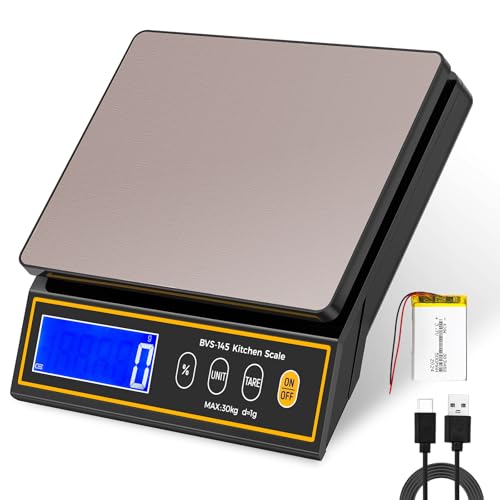
BOMATA, BakFee and Bonvoisin each use one platform and solve the problem with sensor quality instead. BOMATA publishes a 7.2 by 7.2 inch stainless weighing pan plus a HOLD function, which keeps a reading on screen when the item covers the display. Bonvoisin publishes a 9.45 by 7.09 inch stainless platter on an ABS plastic shell, and states plainly that the platter is not removable.
BakFee publishes no platform figure at all, only the body, described as a splash resistant stainless steel surface with non slip feet. For a small batch that is enough, because a 3 gram floor and 1 gram steps are the limits that matter and the platform is never the constraint when you are weighing yeast.
Working the Scale With Floury Hands
Tare, percentage and holding a reading
BOMATA and Bonvoisin both publish a percentage function, which lets you work to a baker’s ratio without converting it to grams first. On a small batch where a one gram error is a measurable share of the yeast, that is a more useful feature than another decimal place. BOMATA also lists tare, hold, unit, counting and auto off as named functions.
BakFee publishes a one touch tare and five auto off settings of 0, 1, 3, 15 or 30 minutes, which is the only adjustable timeout in this group and matters when dough is resting. KKZ publishes smart tare, accumulation and overload indication. Ooni publishes no function list at all beyond reading both platforms simultaneously.
Units and power
Bonvoisin offers nine units and names them: grams, kilograms, ounces, fluid ounces, pounds, pounds with ounces, carats, milliliters and one more. KKZ offers seven, BakFee six, and BOMATA lists a unit button without counting the options. Ooni never addresses units, which for a scale sold specifically for pizza prep is an odd omission.
On power, BOMATA charges over USB-C with one built in lithium cell and also takes two external AAA cells, which is the only pick offering both routes. Bonvoisin is rechargeable and states up to 60 hours of continuous use, with a replaceable battery and a note that a 3 to 5 volt adapter is required and not included. KKZ names an AAA battery version in its size field. BakFee and Ooni publish nothing about power.
Which One Fits Your Kitchen
Two pizzas and three grams of yeast. BOMATA states a 0.5 gram to 5 kilogram range with 0.1 gram readability, a 7.2 by 7.2 inch pan, a percentage function and 0.22 pounds. It is the pick when the small end of the scale is the whole point.
A dedicated sensor for the small stuff. KKZ gives two platforms with independent sensors, the large one stated from 1 gram to 15 kilograms, in a body 9.45 by 6.3 inches with a 1.1 inch profile. Read its two accuracy figures together before buying.
A slim scale that lives on the counter. BakFee states 3 grams to 33 pounds, 1 gram precision, a splash resistant steel top and five auto off settings, at 0.49 pounds. It is the pick if a resting dough must not time the display out.
Ratios rather than arithmetic. Bonvoisin publishes a percentage function, nine units, a 9.45 by 7.09 inch platter and 60 hours per charge. Its 5 gram minimum is the highest here, so it suits a batch that scales up more than one that scales down.
Flour and yeast read at the same time. Ooni gives two brushed steel platforms on a dual LCD with a measuring dish for yeast or herbs, at 7.09 by 12.2 by 1.18 inches and 1.76 pounds. It publishes a tenth of a gram and nothing else numeric.
What We Could Not Verify
These are the figures a small batch depends on and the listings do not give.
- Any minimum weight, capacity or unit list for the Ooni scale.
- Which platform the 0.001 ounce figure in the KKZ title belongs to.
- A linearity or repeatability figure for any of the five, so the stated minimums cannot be compared for accuracy.
- A platform size for BakFee, and a body size for Bonvoisin beyond its platter.
- Any power or battery statement for BakFee and Ooni.
- Whether the platform lifts off for cleaning on four of the five, since only Bonvoisin says, and it says no.