How the Five Compare on the Numbers
Not every kitchen has an oven that reaches 550 F, and a pizza steel is bought precisely to make up for one that does not. So the question this page asks is what each maker will actually say about heat: the oven it is designed for, the preheat it asks for, and what else it can sit on when the oven is not enough.
ROCKSHEAT is the only listing here that names the problem, stating that its plate is designed to improve results in low-temperature ovens. THERMICHEF publishes the other kind of answer, a preheat of 45 to 60 minutes at 500 F and a bake in under 8 minutes. AWTBDP publishes a recommended ceiling of 572 F, and two publish grills instead.
Only one of these five publishes a preheat figure, and only one publishes anything to lift the plate by. Those two facts describe the state of this category: the physics is well explained in every listing and the practical instructions are almost absent.
The Oven You Actually Have
One plate sold for a cool oven
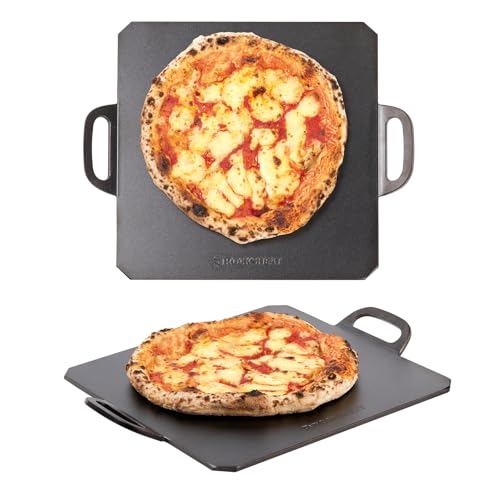
ROCKSHEAT publishes something no other listing here does: its 11.8 inch plate is described as a game-changer for low-temperature ovens, improving results where the oven cannot get hot enough on its own. That is exactly the case a pizza steel answers, because a conductive plate delivers its stored heat to the dough far faster than air does.
It is also the smallest and the lightest plate on this page at 11.8 by 11.8 inches and 10.57 pounds, and the only one with two published handles, described as making it easy to lift and maneuver even for beginners or those with smaller hands. On an accessibility page that sentence is the whole argument.
The plate that wants an hour
THERMICHEF publishes the opposite commitment and is admirably specific about it: preheat the oven to 500 F with the steel inside for 45 to 60 minutes, then cook a pizza in under 8 minutes. That is a real time cost and a real energy cost, and it is the only preheat figure published anywhere in this pool.
It also publishes the widest range of alternatives if the oven is not the answer: a grill, a stovetop where the 16 inch plate covers two burners on most gas and electric ranges, and a campfire. For a kitchen with a weak oven but a good hob, that stovetop line is more useful than any conductivity claim.
Where the Weight Lands
Ten pounds against seventeen
ROCKSHEAT publishes 10.57 pounds and Duvecfoi 10.78 for plates of 11.8 and 13 inches square. Primica publishes 14.44 pounds for 16 by 13.4 inches and THERMICHEF 17.6 for a 16 inch square. All four are a quarter inch or a shade under, so the weight difference is surface area rather than thickness.
THERMICHEF’s own listing makes the comparison for you, noting that 17.6 pounds is about the weight of a large Dutch oven, and recommending a 14 by 14 inch plate for compact or apartment ovens instead. That is an unusually honest piece of sizing advice from a maker whose bigger plate costs more.
The outlier that is not a slab
AWTBDP is in this group deliberately, and it is not a steel plate. It publishes two round stainless pizza pans of 13.5 inches across and 0.8 inches tall, at 0.88 pounds each, with sloped edges, a brushed stain-resistant finish and dishwasher permission. Two of them together weigh a fifth of what the THERMICHEF plate weighs.
What you give up is the physics. A thin stainless pan stores almost no heat, so it bakes like a tray rather than like a stone, and the listing never claims otherwise: it sells even conduction, a clean release and a recommended ceiling of 572 F. For a cook who cannot lift ten pounds out of a hot oven, that trade may be the right one.
What Each Maker Will Say About Care
The only dishwasher in the category
AWTBDP publishes dishwasher permission and one genuinely useful instruction: let the pan cool to room temperature before cleaning, to avoid deformation caused by sudden cooling. Stainless steel is the only material in this pool that can take a machine, and this is the only listing that says so.
THERMICHEF publishes a wash as the first step of seasoning, then oil and an hour at 375 F, after which the plate builds a patina. Duvecfoi publishes no washing routine but does publish the sentence most new owners need: discoloration, blueing and gray spots are normal on carbon steel and do not affect performance.
The two that say nothing
ROCKSHEAT publishes its factory seasoning, vegetable oil baked at 400 F for 30 minutes, and then nothing at all about washing. Primica publishes no care instruction of any kind, describing conductivity, heat capacity and grease drainage without once saying what to do with the plate afterwards.
For a kitchen where cleaning is the hard part, those silences matter as much as the figures. Carbon steel cannot be soaked or scrubbed with detergent without losing its seasoning, and a listing that never mentions it leaves a first-time buyer to find that out by ruining the surface.
Which One Fits Your Kitchen
The oven that never gets hot enough. ROCKSHEAT publishes an 11.8 inch plate at 10.57 pounds with two handles, pre-seasoned with vegetable oil at 400 F for 30 minutes, and states directly that it is designed to improve baking in low-temperature ovens.
The cook who will preheat properly. THERMICHEF publishes a 16 inch square quarter inch plate at 17.6 pounds, a preheat of 45 to 60 minutes at 500 F, a bake in under 8 minutes, and use on a grill, over two burners or on a campfire.
The lightest thing that still browns a base. AWTBDP publishes two 13.5 inch stainless pans 0.8 inches tall at 0.88 pounds each, dishwasher safe once cooled, with a recommended ceiling of 572 F and sloped edges that hold toppings.
The small square plate. Duvecfoi publishes 13 by 13 inches at 0.25 inch and 10.78 pounds for oven, grill and stovetop use, and publishes the most reassuring sentence in the group about the marks carbon steel develops.
The wide plate for a full size oven. Primica publishes 16 by 13.4 inches at 0.25 inch and 14.44 pounds, for the oven in winter and the grill in summer, with grease draining away from the crust. It publishes no care instruction.
What We Could Not Verify
All the figures above come from these makers’ own listings. Here is what they leave out.
- No preheat time from four of the five.
- No handles or lifting feature on four of the five.
- No washing instruction from three of the five.
- No maximum temperature from three of the five.
- No steel gauge from the stainless pans, only a pan height.
- No recovery time between pizzas from any of them.