How the Five Compare on the Numbers
A spatula used every day is decided by how much the blade gives under a hand. All five of these listings publish a gauge, which is unusual on this fact sheet, and no two of them chose the same way to write it. Adoco publishes 0.075 inches. Vovoly publishes 1.8 mm. HaSteeL publishes up to 1.5 mm. Anmarko publishes 1/32 inch.
Morikuru is the fifth and it never uses the word thickness at all. It publishes a size of 11.2 by 4.72 by 0.19 inches with 285 by 120 by 5 mm beside it, and the third figure in that triple is the only thing on the listing that can be the blade. It is also the only pick here that writes the same measurement twice, in two units, so a reader can check one against the other.
What the table cannot tell you is whether these five figures are measuring the same part. A gauge quoted for a blade and a gauge quoted for a whole tool are different claims, and only Morikuru places its figure inside a full size so a reader can see which edge it belongs to. The other four give a bare number and a material, and leave the rest to trust.
What Each Maker Means by Heavy Gauge
Three Units, Five Listings, One Specification
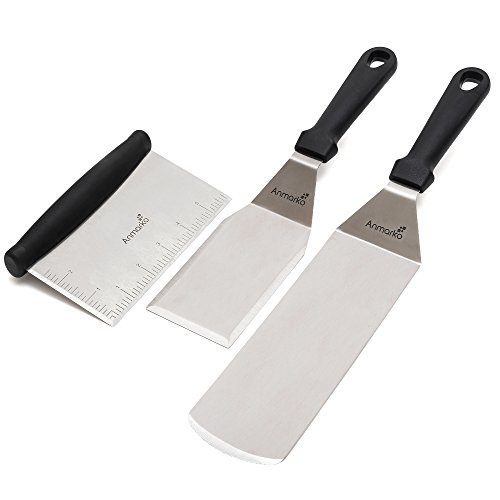
Adoco writes the figure as a decimal inch: premium stainless steel blade with 0.075 stiff heavy gauge steel, in a bullet otherwise about extra long wooden handles. Anmarko writes it as a fraction, stating that the stainless steel griddle spatula metal thickness is 1/32 inch. Those two listings are both working in inches and a reader still has to convert one of them before the pair can be compared.
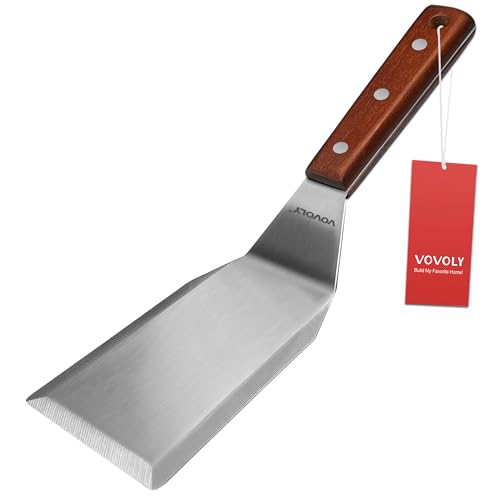
Vovoly and HaSteeL both choose millimeters. Vovoly puts 1.8 mm in its title and repeats it in a bullet about eliminating flex for smashing burgers and tough scraping. HaSteeL says up to 1.5 mm, which is a ceiling rather than a figure, and buries it in a sentence that also carries a weight. Neither offers an inch equivalent anywhere on the listing.
What Each Maker Sells the Gauge On
The argument attached to the number tells you what the maker thinks it is for. Vovoly ties 1.8 mm directly to smashing: stiff heavy gauge steel which can eliminate flex for smashing burgers and tough scraping tasks. HaSteeL ties 1.5 mm to lifting heavier food without bending and withstanding force as you press. Both are claims about stiffness under load, which is what a gauge figure is actually for.
Adoco and Anmarko are vaguer. Adoco pairs its figure with heat resistant wooden handles and long cooking hours, and Anmarko pairs its fraction with a claim that the set is designed to last a lifetime. Morikuru goes the other way entirely and sells its figure as lightness, stating that the kote is light in hand yet sturdy enough to lift, press, scrape and divide food on the plate.
Where the Gauge Sits in the Rest of the Tool
Handles, Rivets and Full Tang Construction
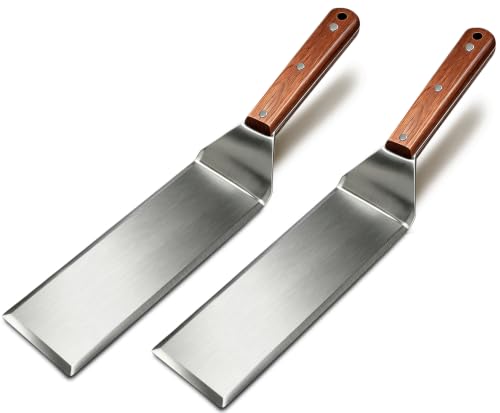
Four of these five publish a wooden handle and the fifth publishes plastic. Adoco states a durable wooden handle with triple stainless steel rivets. HaSteeL states eco friendly beech wood with a full tang design and triple rivets. Vovoly states a full tang wooden handle that will not break or melt. Anmarko states ergonomic plastic handles securely attached to the metal.
Morikuru has no handle as a separate part. It is one piece of bamboo, handcrafted in Japan, and the listing argues the whole case on the material rather than on joinery. That changes what the gauge figure means: on the four steel tools the blade is the part that flexes and the handle is the part that holds, while on the kote the same piece of wood does both jobs.
The Bamboo Blade That Publishes a Gauge Anyway
Morikuru is the only pick here that is not steel, and the only one whose figures agree with each other throughout. It publishes 11.2 by 4.72 by 0.19 inches and 285 by 120 by 5 mm for the same tool, and 2.18 oz with 62 g beside it. Every pair is the same measurement written twice, which is the opposite of what the other four listings do.
It also states what the bamboo is for: a smooth tapered edge meant for non stick hot plates, electric griddles, teppan grills and coated pans without scratching them. That is a use case the four steel picks cannot claim, and it is the reason a bamboo tool sits on a page about gauge at all. The sheet also carries a TURBRO portable electric griddle, which was left out of these five because it is the cooking surface rather than the tool.
Figures on These Listings That Cannot All Be Right
One Spatula With Three Published Blade Sizes
Vovoly publishes its size three times and gets three answers. The title ends with 4.7 x 2.7 Inch. The size variant reads 3 by 5 inches with a wooden handle. The dimension fields give 2.83 across and 11.2 long, and a height field that arrived near zero and was discarded. One of those is probably the blade, one probably the whole tool, and the listing never says which is which.
HaSteeL has a smaller version of the same problem. Its height field reads 0.1 inches while its own bullet states up to 1.5 mm, and those are not the same number. This site takes the maker’s sentence over the field, so 1.5 mm is the figure used here and the 0.1 is reported rather than quietly dropped. Its 12 by 2 inch body figure and its 4.5 inch handle are consistent with each other.
A Weight Too Light to Be the Product, and a Size Field Reading zzzz-s
The Anmarko listing carries the oddest pair on this page. Its weight field says 0.11 lb for a three piece commercial stainless steel set, and the fact sheet flags that figure as too light for an object of the published size, which means the field is probably not this product at all. Its gauge figure of 1/32 inch comes from a bullet and is unaffected.
The same listing gives its size as zzzz-s, which is placeholder text rather than a size, and its real dimension fields were set aside as the carton and republished as 4.33 by 14.96 by 2.76 inches for the box. The Adoco carton has its own oddity: 3 by 15 by 0.1 inches, where a 0.1 inch depth cannot hold two spatulas whose blades alone are stated at 0.075 inches.
Which One Fits Your Kitchen
You smash burgers and want the stiffest claim in writing. Vovoly publishes 1.8 mm and ties it directly to eliminating flex for smashing and scraping. It is one spatula at 0.44 lb, hand wash, and its listing gives three different sizes you will have to pick between.
You want two long handled tools and a figure in inches. Adoco publishes 0.075 inches of stiff heavy gauge steel across a set of two with wooden handles and triple rivets. It states hand wash only and is explicit that the wooden handle makes it not dishwasher safe.
You want somewhere to hang them. HaSteeL ships two spatulas at 12 by 2 inches with 4.5 inches of beech handle and two S shaped hooks, and publishes up to 1.5 mm. Its height field and its stated gauge disagree, so use the sentence.
You want three tools and a dishwasher. Anmarko is the only pick here cleared for a dishwasher, and the only one with plastic handles. Its gauge is 1/32 inch. Treat its 0.11 lb weight field with suspicion, because it is flagged as too light for the size.
You cook on coated pans and electric plates. Morikuru is bamboo at 0.14 lb, stated not to scratch non stick hot plates or coated pans, and publishes 11.2 by 4.72 by 0.19 inches with the metric equivalent beside it. Hand wash gently and air dry.
What We Could Not Verify
Six things a reader would want and no listing among these five supplies.
- Whether any gauge figure describes the blade alone or includes the handle, since only Morikuru places its figure inside a full size.
- What HaSteeL means by up to 1.5 mm, which is a ceiling and not a measurement of any particular part.
- Which of the three Vovoly sizes is the blade and which is the whole spatula.
- Any gauge figure at all expressed in the same unit by all five, so every comparison here needs a conversion first.
- What the Anmarko weight field is actually weighing, given it is flagged as too light for the published carton.
- Whether the HaSteeL 0.34 lb figure covers one spatula or the pair, since it sits inside a sentence about gauge rather than about weight.