How the Five Compare on the Numbers
A freezer tray is bought for the shape it leaves behind, and these five publish that shape very unevenly. Three state all three dimensions of a single cube, one states two, and one gives a volume and no dimension at all. The published figures run from a drink cube of 1 by 1 1/2 in up to a soup portion of 2.16 by 4.13 by 4.13 in.
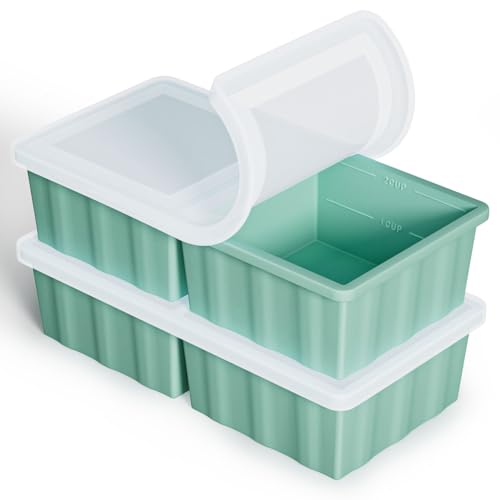
Volume is published by two of the five, in different units. GGOW marks each compartment at 1 cup, or 250 ml, and 2 cups, or 500 ml. Aopigavi marks its compartments from 1 Tbsp, or 15 ml, to 2 Tbsp, or 30 ml, which it also states as 1 oz. The other three leave the portion to a cube count instead.
What the table cannot tell you is whether a published cube still matches the figure once it is frozen. Water expands as it freezes and not one of these five mentions that. Two publish fill lines for volume and neither says whether those lines allow for the expansion. None of the five says whether a stated cube size is the mold or the result that comes out of it.
How Each Maker Measures One Portion
Three publish a cube in three dimensions
GGOW publishes the largest portion here and calls it a super cube: 2.16 by 4.13 by 4.13 in, in two compartments per tray, with the two trays stated to hold up to 8 cups between them. The figure sits in the first bullet beside the fill lines, which is where a buyer planning a batch would look for it rather than in a specification table.
NFK publishes 1.7 by 1.1 by 0.8 in for each of its 48 cubes, twelve to a tray across four trays. Tvmania publishes 1.5 by 1.2 by 0.7 in for cubes it makes fifteen at a time, thirty across the set. Those two are the only picks whose cube figures are close enough to read side by side, and both describe a drink cube rather than a food portion.
One publishes two figures and one publishes none
Vortihive publishes 1 by 1 1/2 in for its cube, which is two figures for a three dimensional object. Read literally it gives a face and a depth, or a face and a height, and the listing never says which. It is 304 stainless steel, so the cavity is rigid and the figure should be exact, which makes the missing third number more noticeable rather than less.
Aopigavi publishes no cube dimension at all. What it publishes instead is the volume, marked inside each compartment from 1 Tbsp, or 15 ml, to 2 Tbsp, or 30 ml, which it also states as 1 oz. For herbs in oil or a spoonful of broth that is arguably the better figure. For anything that has to drop through the neck of a bottle it is no help whatever.
Volume, and Where the Fill Lines Are
Two trays carry markings inside the compartment
GGOW marks each compartment with fill lines at 1 cup, or 250 ml, and 2 cups, or 500 ml, and states that the two trays together hold up to 8 cups. That is the only figure on this page for a whole set rather than for one cavity, and it is the number a batch cook plans against when deciding how many trays a pot of soup needs.
Aopigavi marks from 1 Tbsp, or 15 ml, to 2 Tbsp, or 30 ml, or 1 oz, across ten compartments per tray and twenty in the set. The two scales never overlap: the smallest line GGOW prints is 1 cup and the largest Aopigavi prints is 2 Tbsp. These are trays for two different jobs that happen to be sold into the same category.
Three leave the portion to a cube count
NFK, Tvmania and Vortihive publish no volume figure for a compartment. What they publish is a count: 48 cubes across four trays for NFK, thirty across two for Tvmania, and for Vortihive no count at all, only that the set is two trays. A count beside a cube dimension gets a reader most of the way there. A count on its own does not.
That is the practical split across this page. If you freeze liquid by the cup, the two trays with fill lines are the only ones that answer you at all. If you freeze by the cube and care what it looks like in a glass, the three with stated dimensions are the ones to read, and all three state a count beside the figure.
What the Published Figures Actually Describe
One tray figure and four packages
Only Tvmania publishes a size for the tray itself, 7.3 by 5.1 by 1.2 in, stated in a bullet and repeated in its size attribute. The other four publish a package figure instead: 4 by 6 by 2 in for GGOW, 4.52 by 7.9 by 3.38 in for NFK, 5 by 7.3 by 1.3 in for Vortihive and 4.53 by 10.43 by 1.57 in for Aopigavi. None of those four is a tray.
Two of those packages are close enough to a tray to be mistaken for one. The Vortihive package reads 5 by 7.3 by 1.3 in and the Tvmania tray reads 7.3 by 5.1 by 1.2 in, which is a coincidence rather than a measurement of the same thing. This page reports the four as packages and ranks nothing by them, which is the only safe reading available.
What the weights cover, and the release each maker names
All five publish a weight and every figure covers a whole set rather than one tray: 0.6 lb for two Tvmania trays, 0.88 lb for four NFK trays and a storage bin, 0.94 lb for two Aopigavi trays, 0.97 lb for two GGOW trays and 1.04 lb for two Vortihive trays. Not one of the five states what a single tray weighs on its own.
The release methods differ more than the weights do. GGOW asks for a gentle push from the bottom of the compartment. NFK offers a press or a twist. Tvmania says twist, then push up from the bottom. Aopigavi says press the bottom, one cube at a time. Vortihive, the steel one, asks you to run the base under the tap for about 30 seconds and then wiggle it.
Which One Fits Your Kitchen
The batch cook freezing soup by the cup. GGOW states a portion of 2.16 by 4.13 by 4.13 in with fill lines at 1 cup, or 250 ml, and 2 cups, or 500 ml, and two trays holding up to 8 cups. It publishes no tray size and no temperature figure.
The household that runs out of ice. NFK states 1.7 by 1.1 by 0.8 in for each of 48 cubes across four trays, and is the only pick here that supplies a storage bin for the cubes you have already released. Published at 0.88 lb for the whole set.
The buyer who wants to know what fits the freezer. Tvmania is the only pick publishing its own tray size, 7.3 by 5.1 by 1.2 in, with cubes at 1.5 by 1.2 by 0.7 in and a range of minus 40 F to 428 F. Fifteen cubes a tray, thirty in the set.
The drinker who wants steel rather than silicone. Vortihive is 304 stainless at 1.04 lb for two trays, with a cube stated as 1 by 1 1/2 in. Release means running the base under the tap for about 30 seconds, and no cube count or temperature figure is published.
The cook freezing herbs and spoonfuls. Aopigavi marks its compartments from 1 Tbsp, or 15 ml, to 2 Tbsp, or 30 ml, or 1 oz, across twenty compartments, and states minus 40 F to 446 F. It publishes no dimension for the cube those markings fill.
What We Could Not Verify
Everything above comes from the makers’ own listings. These are the things those listings do not answer.
- Whether any stated cube size allows for water expanding as it freezes. None of these five raises the question in any form.
- The third dimension of the Vortihive cube. Its listing gives 1 by 1 1/2 in and no indication of which two faces those are.
- Any cube dimension from Aopigavi, which measures its portions by volume and never by size.
- A tray size from GGOW, NFK, Vortihive or Aopigavi. All four publish a package figure in place of one.
- What one tray weighs. Every weight here covers a set of two or four trays, and in one case a storage bin as well.
- A temperature range from GGOW, NFK or Vortihive. GGOW clears its trays for an oven without publishing a figure for it.