How the Five Compare on the Numbers
Fifteen ice tray listings sit on this fact sheet and eight of them are stainless steel with a lever handle, which is a different product with a different failure mode. The seven silicone sets are what this page compares, and among those the useful question for a first kitchen is not how much ice you get. It is what the listing tells you to do before the first batch.
The five below were picked because each publishes something the others do not: a first use instruction, a waiting time before the lid comes off, a certification, a storage bin and scoop, or lids with holes so they hang up to dry. Four publish a believable weight and one publishes a figure that cannot describe four silicone trays.
What none of the five publishes is how long a batch takes to freeze, which is the figure a first time user actually wants. Nor does anyone publish a silicone thickness, so how much a tray flexes when it is full and carried across a kitchen is unstated. Two listings publish no cube count at all, which on an ice tray is close to publishing no capacity.
What the Listing Tells a First Time User
One Set Says Boil It Before You Use It
PET Hous publishes the most useful sentence on this fact sheet and it is aimed squarely at somebody who has never owned silicone. Before the first freeze it recommends boiling the molds for 15 to 20 minutes or running them through the dishwasher, on the stated grounds that this refreshes the silicone so the first cubes come out without an odor.
That is a real property of new silicone and no other listing in this pool mentions it. The same listing publishes 15 cubes per tray across four trays for a stated total of 60, a cube size of 1.2 inches on each side, and 1.34 lb for the set, which is the heaviest believable figure among these five.
Thirty Seconds Before You Open the Lid
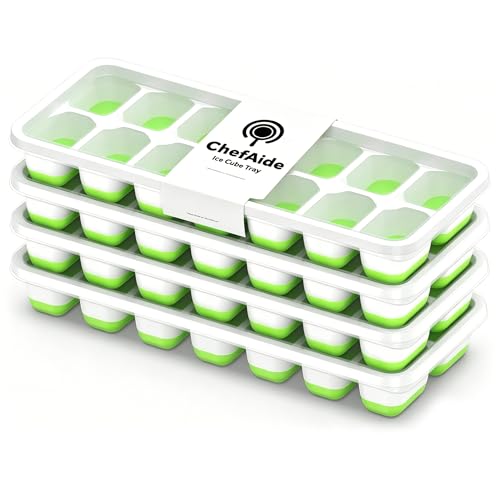
ChefAide publishes the other instruction worth having. It says to fill each tray to the marked max line, close the lid, freeze, and then wait around 30 seconds before opening the lid so it comes away smoothly. Anyone who has pulled a frozen lid off a full tray and lost half the water will understand why that sentence exists.
It also explains its own construction rather than just naming materials: a rigid plastic upper half to hold the tray’s shape with a flexible silicone bottom to push cubes out, which it contrasts directly with fully silicone molds. At a published 0.75 lb for four trays it is the lightest set on this page.
Cubes, and How Many Actually Come Out
Fifteen a Tray, or Fourteen
Three of the five publish a cube count. PET Hous states 15 per tray and 60 in total. ChefAide states 14 per tray and 56 in total. Vethwal states 15 per tray across three trays. Those are the numbers that decide whether one batch fills a jug, and they are also the numbers two listings here leave out entirely.
Cube size is rarer still. PET Hous and Vethwal both state 1.2 by 1.2 by 1.2 inches, which is the figure that matters if you want ice that fits a particular glass. ChefAide and both DOQAUS listings publish no cube dimension at all, so on three of these five the size of the ice is a photograph.
Two Listings Publish No Count at All
Both DOQAUS sets describe four silicone trays and neither says how many cubes a tray makes. The set with the bin publishes a tray size of 8.2 by 4.5 by 3.6 inches and the plain four pack publishes 7.2 by 4.1 by 1.3 inches, so the trays themselves are measured and the ice is not.
What those listings publish instead is the honest limitation the others skip. The plain four pack states plainly that its lids are not airtight, describing them as spill resistant with lift tabs that allow airflow to prevent a vacuum seal. That is a caveat rather than a feature and it is the only one of its kind here.
Where One Figure Cannot Be Right
Twelve Pounds of Silicone Trays
The DOQAUS four pack publishes 12.3 lb. Four silicone trays each stated at 7.2 by 4.1 by 1.3 inches do not weigh that, and the comparison inside this page settles it: the other three four tray sets publish 0.75 lb, 0.86 lb and 1.34 lb. Twelve pounds is roughly ten times the highest of those for the same number of trays in the same material.
So that field carries nothing on this page. The listing’s own text is what it is judged on: four trays at a stated 7.2 by 4.1 by 1.3 inches, food grade silicone and PP, independently certified to LFGB standards, lids that are not airtight, and top rack dishwasher cleaning. The certification is the reason it is here.
The Same Brand, Two Very Different Sets
Both DOQAUS listings are four tray silicone sets and they publish almost nothing in common. One states 0.86 lb, a tray of 8.2 by 4.5 by 3.6 inches, and a set that includes a central storage bin and a scoop. The other states 12.3 lb, a tray of 7.2 by 4.1 by 1.3 inches, an LFGB certification, and no extras.
The difference that matters for a first kitchen is the bin. A set of loose trays means loose trays in the freezer, and the version with a container and a scoop turns four trays into a system where finished cubes go somewhere. It is the only pick on this page that includes anything beyond the trays and their lids.
Which One Fits Your Kitchen
A first set of silicone anything. PET Hous, a published 1.34 lb for four trays of 15 cubes each and a stated 60 in total, cubes of 1.2 inches on each side, a tight sealing lid, and a first use instruction to boil for 15 to 20 minutes or run it through the dishwasher.
A tray that keeps its shape. ChefAide, a published 0.75 lb for four trays of 14 cubes each and a stated 56 in total, with a rigid plastic upper half and a flexible silicone base, a marked max fill line, and a stated wait of about 30 seconds before the lid comes off.
Somewhere to put the finished ice. DOQAUS with bin, a published 0.86 lb for four silicone trays at a stated 8.2 by 4.5 by 3.6 inches plus a central storage container and a scoop, with lift tab lids and top rack dishwasher cleaning.
Lids that hang up to dry. Vethwal, a published 0.8 lb for three trays of 15 cubes each with cubes of 1.2 inches on each side, removable silicone lids with small holes for hanging, and stated use in a dishwasher, a microwave and a refrigerator.
A certification you can look up. DOQAUS 4 pack, four silicone and PP trays at a stated 7.2 by 4.1 by 1.3 inches, independently certified to LFGB standards, with lift tab lids the listing states are not airtight. Its published 12.3 lb cannot be the set.
What We Could Not Verify
Every figure above comes from the maker’s own listing text. These are the things we went looking for and could not source in any of them.
- No listing publishes how long a batch takes to freeze, which is the figure a first time user most wants.
- The DOQAUS four pack publishes 12.3 lb, where three comparable four tray sets here publish 0.75 lb, 0.86 lb and 1.34 lb.
- Both DOQAUS listings publish no cube count at all, so how much ice a tray makes is unstated on two of five.
- No listing publishes a silicone thickness, so how much a full tray flexes when carried is unknown.
- Only two of the five publish a cube size, so on three of them the ice is judged from a photograph.
- Only one listing says its lids are not airtight, so on the other four the seal is described and never qualified.