How the Five Compare on the Numbers
Smart does very little work in most of these listings. Only two publish a meat probe, and only one publishes an app. The rest use the word to mean a preset list, an algorithm name, or a fan with several speeds. Sorting them by what they actually publish gives four different definitions of the same adjective, and the gap between the first and the last is large.
Weight follows the format rather than the intelligence. Cosori, the only basket fryer here, is the lightest at 13.2 lb, and Breville’s countertop oven is the heaviest at 30.2 lb. Typhur sits near the top at 26 lb and is the only machine with both a wireless probe and an app, so in this group connectivity and bulk travel together.
What the table cannot show is which of these claims is a capability and which is a name. Element iQ and TurboBlaze are trademarks attached to real descriptions, five quartz elements and a 3600 rpm fan. Smart Cook System is a thermometer. AI Recipe Generation is a feature in an app. Only the figures in the rows below the names can be compared across makers.
Four Different Meanings of Smart
Cooking to a Temperature, Not a Timer
The strongest definition is the one Typhur and Ninja share: a probe that reads the inside of the food and stops the machine when it gets there. Ninja calls it the Foodi Smart Thermometer and states you choose doneness from rare to well done at the touch of a button. Typhur goes further, with a wireless probe and an automatic shutoff when the target is reached.
That changes what the appliance is. Every other machine here cooks for a length of time at a temperature, which means the cook is a guess that happens to be a good one. A probe makes the food itself the control input. It is also the only smart feature in this group that cannot be replicated by paying attention, which is worth more than any preset count.
Granular Control Instead of Connectivity
Nuwave takes a completely different route and publishes the most precise numbers on this page without any probe or app at all. It states 50 F to 450 F adjustable in 5 F increments, fan speeds from zero to three, and a top and bottom heater ratio adjustable anywhere from 0 to 100 percent, giving the worked example of 70 percent at the bottom and 30 at the top for a thick pizza.
It also makes the only claim here about evenness between racks, stating the convection system keeps the temperature difference between layers to 0 to 1 F. Whether that figure is achievable is not something a listing can settle, but it is a specific, checkable claim about the thing that actually goes wrong in a multi-rack oven, and no rival publishes anything comparable.
Format Decides More Than Software
Baskets, Dual Baskets, and Ovens
Cosori is a single basket fryer at 6 quarts and 13.2 lb. Ninja is two independent baskets totaling 10 quarts, with Smart Finish to have two foods finish together and Match Cook to copy settings across both. Nuwave, Breville and Typhur are all countertop ovens with racks. Those three formats behave differently regardless of what the control panel can do.
The dual basket idea is the one no oven replicates. Two separate zones with separate fans and heaters let a vegetable at one temperature finish at the same moment as a chicken at another, which is a genuinely different capability from an oven with two racks at one temperature. Ninja also states it cooks two 6 lb chickens up to 30 percent faster than a traditional oven.
The Only Machine That Publishes Its Interior
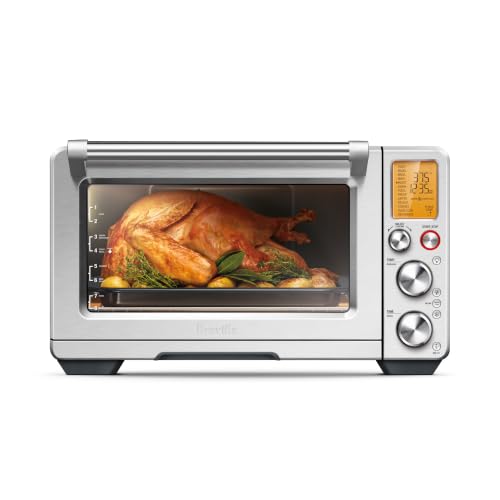
Breville is the only listing here that publishes an interior dimension: 16 by 13.5 by 7 inches, which it then converts into food, stating room for 9 slices of bread, a 14 pound turkey, a 5 quart Dutch oven, most 9 by 13 inch pans and a 12 cup muffin tray. That is more usable than a quart figure, because a 21 quart oven with 3 inches of rack clearance is not a 21 quart oven in practice.
Nuwave states 21 quarts and Cosori 6, and neither publishes an interior measurement, so how much of that volume is reachable is unknown. Typhur publishes no capacity figure of any kind, despite being an oven with a basket, a roasting pan, a wire rack and a crumb tray included. For the machine with the most software here, that is a strange omission.
What the Listings Publish, and What They Borrow
The Fan Figures Nobody Else Gives
Two makers publish a fan speed and it is worth noting which. Cosori states 3600 rpm on its top setting and five selectable speeds, and then publishes the only noise figure in this pool, under 53 dB even at the highest fan speed. Typhur states a 2400 rpm fan with dual heating elements. Nobody else publishes a fan speed, a noise level, or a preheat time.
That combination of a fan speed and a decibel figure is unusual and useful, because a fast fan in a small basket is loud and everyone who owns an air fryer knows it. Cosori is also the only listing that names a coating standard twice, stating PFAS-free ceramic on both the basket and the crisper tray, where Ninja states 100 percent PFAS free on its cooking surface.
Two Bullets That Are Press Quotes
The Typhur listing is worth reading carefully for a different reason. Two of its six feature bullets are not specifications at all: one attributes an award and a quotation to a review site, and the second is a sentence attributed to a newspaper. Those are claims about the product made by other people, and nothing on this page relies on them.
What remains in the Typhur listing is still the strongest smart specification here: a built-in wireless probe described as NIST verified, an app for custom cook targets, multi-stage cooking and alerts, a 2400 rpm fan with dual elements, and a recipe generator that takes a photo of ingredients. Also worth noting is the November update reference, which means some features arrived after launch.
Which One Fits Your Kitchen
The cook who wants doneness, not guesswork. Typhur Sync, the only machine here with both a built-in wireless probe and an app, with multi-stage cooking, alerts and a 2400 rpm fan on dual elements. At 26 lb it is a large countertop oven, and it publishes no capacity figure.
The household cooking two dishes for one meal. Ninja DZ550, with two independent baskets totaling 10 qt, a smart thermometer, Smart Finish and Match Cook, six programs and a stated PFAS free surface. It states two 6 lb chickens cook up to 30 percent faster than in an oven.
The cook who wants to set everything by hand. Nuwave Bravo Pro, with 50 F to 450 F in 5 F increments, four fan settings, a top and bottom heater ratio adjustable across the full range, 1800 W, and a stated 0 to 1 F difference between racks.
The cook replacing an oven rather than adding a gadget. Breville Pro, the only listing here that publishes its interior at 16 by 13.5 by 7 inches, with five quartz elements, PID temperature control, 13 functions and two convection speeds. The heaviest here at 30.2 lb.
The small kitchen that wants a quiet basket. Cosori TurboBlaze, the lightest here at 13.2 lb, with a 3600 rpm fan across five speeds, 90 F to 450 F, PFAS free ceramic on basket and tray, and the only noise figure on this page at under 53 dB.
What We Could Not Verify
These are the makers’ own published figures. These are the gaps that mattered.
- Typhur publishes no capacity figure at all, despite shipping a basket, a roasting pan and a wire rack.
- Ninja and Breville publish no temperature range, so neither ceiling nor floor can be compared for them.
- Only Breville publishes an interior dimension, so quart figures elsewhere cannot be converted into usable space.
- Only two makers publish a fan speed and only one publishes a noise level.
- Two of the six Typhur bullets are press quotations rather than specifications, and nothing here relies on them.
- No maker publishes a preheat time, which is the figure every one of them implies is short.