Brod & Taylor Small Sourdough Starter Jar (12oz) Les...
A 12 oz jar for up to 100 g of risen starter, with one loose plastic lid.
- 12 Ounce
- 0.39 lb
The deciding specification is the pair of covers each maker ships, because a small starter is fed under something breathable and parked in the fridge under something closed.
By the Lush Editorial Team·Researched & Compared
I compared the stated covers, capacities, washing instructions and spare parts of sixteen sourdough starter jars on the manufacturer fact sheet.
A 12 oz jar for up to 100 g of risen starter, with one loose plastic lid.

Two 12 oz jars, each with a daily plastic lid and a clamped glass lid.
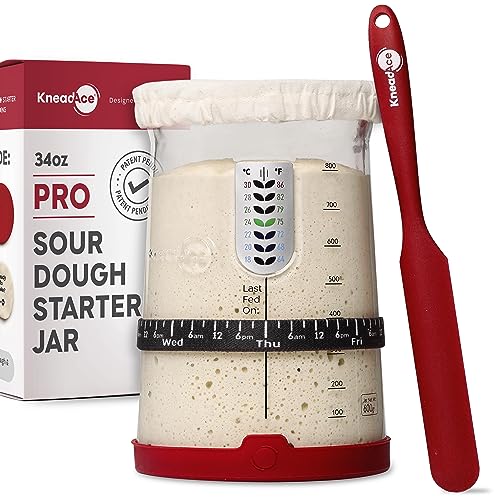
Volume, net weight and feed line marks plus a thermometer on a 34 oz jar.

Two 34 oz jars with 304 stainless steel lids and a breathable cloth cover.

Two 3/4 liter jars stated safe for the microwave and the dishwasher.
| Model | Brand | Size (Capacity) | Weight | Best For |
|---|---|---|---|---|
| Brod & Taylor Small Sourdough Starter Jar (12oz) Les... | Brod & Taylor | 12 Ounce | 0.39 lb | Best for cutting discard |
| Sourdough Starter Jars 12 oz 2 Pack | Freshmage | 12 oz | Not listed | Best for a clean spare jar |
| KNEADACE Pro Sourdough Bread Starter Kit - 34 oz Lar... | KNEADACE | 1 Pack | 1.98 lb | Best for reading the starter |
| ComSaf Sourdough Starter Jars | ComSaf | 34 fl oz x 2 - Sourdough Starter Jars | 2.55 lb | Best for fridge storage |
| WECK 743 Glass Canning Jars with Lids | WECK | 3/4 Liter | 2.47 lb | Best for canning as well |
A 12 oz jar for up to 100 g of risen starter, with one loose plastic lid.
Two 12 oz jars, each with a daily plastic lid and a clamped glass lid.
Volume, net weight and feed line marks plus a thermometer on a 34 oz jar.
Two 34 oz jars with 304 stainless steel lids and a breathable cloth cover.
Two 3/4 liter jars stated safe for the microwave and the dishwasher.
A small starter needs air on the counter and a seal in the fridge, and these five answer that differently. Brod & Taylor sends one loose plastic lid for both jobs on a 12 oz jar. Freshmage sends a clamped glass lid and a daily plastic lid, plus spare clamps. KNEADACE pairs cloth with a silicone base cover. ComSaf uses 304 stainless lids. WECK states microwave safe and names no fermenting cover.
“A starter needs air on the counter and a seal in the fridge.”
Lush Food & Drink
Because the two states a starter lives in want opposite things. While it is active it produces gas, so it needs a cover that lets pressure out, which is why Brod & Taylor describes a loose-fitting plastic lid and ComSaf and KNEADACE both ship a breathable cloth. In the fridge the culture is dormant and the problem becomes drying out, which is what a stainless lid or a clamped glass lid with a gasket solves.
Brod & Taylor states that its 12 oz jar holds up to 100 g of fully risen starter and says the size exists to reduce discard and make regular care easier. Freshmage states 350ML and names small-batch starters directly. If you bake one or two small loaves a week, the larger jars on this page mean feeding and discarding more flour each time for headroom you never use.
Only WECK states it. Its listing describes thick heat-resistant glass that is safe for microwave and dishwasher use. Freshmage states the opposite, ruling out the oven, the microwave and sudden temperature changes. Brod & Taylor, KNEADACE and ComSaf publish nothing either way, so there is no basis for assuming it. If warming a cold starter is part of your routine, that is a deciding line.
Freshmage is the only listing here that answers it: each jar includes 4 metal clamps, two for use and two spares. WECK describes lid, gasket and jar as separate pieces but says nothing about replacements. Nobody publishes a spare cloth cover, silicone base or gasket, and on a jar fed every day the cloth is usually the first part to need changing.
Because all three arrive as a two-jar set and the published figures describe the carton. Freshmage publishes 4.3 x 4.3 x 2.8 in, ComSaf 3.74 x 3.74 x 7.48 in and WECK 5 x 5 x 7 in, and in each case that is the box. This page shows those as package figures rather than treating them as the jar, because a 2.8 in box cannot hold a jar that stands taller than it.
KNEADACE. It publishes volume marks, net weight marks and feed line marks on the glass, a thermometer, a cloth cover, a silicone cover that doubles as a base, a spatula and an elastic band marked with the days of the week. It also publishes 4.13 x 4.13 x 6.7 inches for the jar. What it does not publish is any washing instruction, which is unusual on this page.
Specifications come from the manufacturers' own published listings. Lush Food & Drink may earn a commission if you buy through a link on this page, at no extra cost to you. How we research.
A small starter is handled twice a day and covered twice a day, and the cover is not one object. While the culture is working it needs air. When it goes into the fridge it needs to be shut. Five listings here hand you a different answer to that pair of jobs, and two of them ship two separate lids per jar to do it.
Capacity sets the context rather than the ranking. Two of these are 12 oz jars sized for the discard a small loaf produces, two are 34 oz, and the WECK pair is sold as 3/4 liter. What changes between them is the closure, the spare parts, and whether the maker will let the jar near a microwave at all.
| Specification | Brod & Taylor 12oz | Freshmage | KNEADACE | ComSaf | WECK 743 |
|---|---|---|---|---|---|
| Stated capacity | 12 oz | 12 oz, 350ML | 34 oz | 34 oz each | 3/4 liter |
| Jars in the box | One | Two | One | Two | Two |
| Cover named for fermenting | Loose plastic lid | Plastic lid for daily use | Breathable cloth cover | Breathable cloth cover | not published |
| Cover named for the fridge | The same loose plastic lid | Glass lid with gasket and clamps | Silicone cover that doubles as a base | Stainless steel lid | Lid with rubber gasket and clamp |
| Spare parts named | not published | Two spare metal clamps per jar | not published | not published | not published |
| Glass named | not published | not published | not published | Soda lime | not published |
| Microwave statement | not published | Ruled out | not published | not published | Stated safe |
| Dishwasher statement | Jar and lid both | Jars dishwasher safe | not published | Wipe metal lids dry after washing | Stated safe |
| Published weight | 0.39 lb | not published | 1.98 lb | 2.55 lb for the pair | 2.47 lb for the pair |
| Published size figures | 3 in wide, 3.6 in tall | Package 4.3 x 4.3 x 2.8 in | 4.13 x 4.13 x 6.7 in | Package 3.74 x 3.74 x 7.48 in | Package 5 x 5 x 7 in |
| Feeding tracker included | Silicone height ring, marks in inches and centimeters | not published | Thermometer, feed lines, day band | Thermometer sticker, feeding band | not published |
What the table cannot tell you is how loose a loose lid is. Brod & Taylor and Freshmage both describe a plastic lid for daily use, and neither publishes a gap, a vent count or an air exchange figure, so the only difference you can read is the word each maker chose. The carton figures on three of these rows are the box the pair arrives in, not the jar, and no maker in that group publishes the jar on its own.
Freshmage is the clearest case on this page. Each 12 oz jar arrives with a glass sealing lid, a gasket and clamps for long storage, and a separate plastic lid for daily use, and the maker says both fit its 27oz jars as well. That is two closures for the two jobs a starter actually has, bought once.
ComSaf takes a different route to the same end. Its two 34 oz jars come with 304 stainless steel lids for the fridge and a breathable cloth cover for the counter, and the listing explains the choice: metal avoids the rusty-lid problem in cold storage, provided you wipe the lids dry after washing. KNEADACE pairs a cloth cover with a silicone cover that doubles as a non-slip base.
Brod & Taylor ships a single loose-fitting plastic lid and argues that one is enough. The maker says the plastic lets the starter breathe and helps regulate pressure during fermentation, so the same lid stays on in the fridge. There is nothing to lose and nothing to swap, which on a 12 oz jar fed every day is a real advantage.
WECK is the outlier. Its listing names silicone lids for the 743 in one bullet and a lid with a rubber gasket held by a glass clamp clip in another, and nowhere resolves which you receive. It never names a cover for active fermentation at all, which on a canning jar sold for sourdough is the figure most worth having and the one missing.
Brod & Taylor states the case for a small jar in its own words: the 12 oz size exists to reduce discard and make regular care easier, and it holds up to 100 g of fully risen starter. For a baker making one or two small loaves a week, that is the whole argument. Feeding a 50 oz jar means throwing more away every time.
Freshmage reaches the same size from the other direction, calling its 350ML straight-wall jars right for small-batch sourdough starters, single-serve yogurt and overnight oats. Two of them means one can stay clean while the other works. Neither maker publishes how much flour a feed takes, so the discard saving is stated as a design intention rather than a figure.
KNEADACE and ComSaf both publish 34 oz, and in both cases the jar is doing more than holding a small starter. KNEADACE adds a funnel-shaped opening, volume and net weight marks and a thermometer, and publishes 4.13 x 4.13 x 6.7 inches for the jar itself, which is the only full set of jar dimensions on this page.
WECK publishes 3/4 liter and two jars, and nothing else about the size of either. Its published 2.47 lb for the pair, and a 5 x 5 x 7 in carton, are the only other figures the listing gives. On a small-loaf routine the extra headroom is harmless, but you are feeding a bigger jar than the job needs and the maker does not pretend otherwise.
Freshmage is explicit that its jars are not suitable for the oven, the microwave or sudden temperature changes, which matters if the habit is warming a cold starter. WECK states the opposite in plain terms: its jars are heat resistant and safe for microwave and dishwasher use. No other listing on this page mentions a microwave in either direction.
Washing splits more evenly. Brod & Taylor states that the glass jar and the plastic lid are both fully dishwasher safe and describes smooth walls and a curved bottom with nowhere for starter to stick. Freshmage and WECK both state dishwasher safe. ComSaf asks for the metal lids to be wiped dry, and KNEADACE publishes no washing instruction at all.
A clamped canning lid fails at the clamp, and Freshmage is the one maker here that accounts for it: each jar includes 4 metal clamps, two for use and two spares. Nothing else on this page names a replaceable or spare part. WECK describes lid, gasket and jar as separate pieces, which makes washing easier, and says nothing about getting another gasket.
The silicone and cloth parts are the other wear point. ComSaf ships a breathable cloth cover, a silicone spatula and a feeding band, and KNEADACE ships a cloth cover, a silicone cover that doubles as a base and a spatula. Neither says whether any of it can be bought again, and a cloth cover on a daily starter is the part that goes first.
One small loaf a week. Brod & Taylor states 12 oz and up to 100 g of risen starter, with a single loose plastic lid for both the counter and the fridge. The maker’s own reason for the size is less discard, which is exactly the small-loaf complaint.
Baker who wants a clean jar waiting. Freshmage gives two 12 oz jars, each with a plastic lid for daily use and a clamped glass lid for storage, plus two spare clamps. It is the only listing here that plans for a part breaking.
Starter that lives in the fridge most weeks. ComSaf pairs two 34 oz jars with 304 stainless steel lids and explains why metal suits cold storage. Wipe them dry after washing, which the maker asks for directly, and rotate the two jars.
Baker who wants the numbers on the jar. KNEADACE publishes 4.13 x 4.13 x 6.7 inches, volume and net weight marks, a thermometer and a day-marked band. It is the one pick here whose own dimensions are fully published rather than a carton figure.
Cook who reheats and cans as well. WECK states microwave and dishwasher safe across two 3/4 liter jars with gasketed clamp lids. There is no cover named for active fermentation, so plan on supplying a cloth yourself.
These are the figures we went looking for on the manufacturer listings and did not find.