How the Five Compare on the Numbers
Sixteen spiralizers sit on the fact sheet for this topic and half of them are handheld. A dual blade cone published at 2.76 by 2.76 by 6.32 inches, a knob operated gadget at 0.48 lb, a julienne peeler, a mason jar lid with three blades, and several small spiral cutters and flower curlers around 3 by 2 inches. All of them work and none of them is a machine you would use to feed four people.
The five here are countertop machines or a mixer attachment, and what separates them for a family is not blade count. It is where a batch of noodles ends up, where up to ten very sharp blades live between uses, and whether the machine folds or packs down when the counter is needed for something else.
What the table cannot tell you is how long any of these blades stays sharp. Every listing here describes its steel and two name a grade, and not one says how many vegetables a blade will cut before it starts tearing rather than slicing, or whether a replacement can be bought when it does. On a machine with ten blades that is ten unanswered questions, and a dull spiralizer blade is the most common reason one ends up in a cupboard.
The Machine That Catches What It Cuts
Noodles Into a Container, Not Onto a Counter
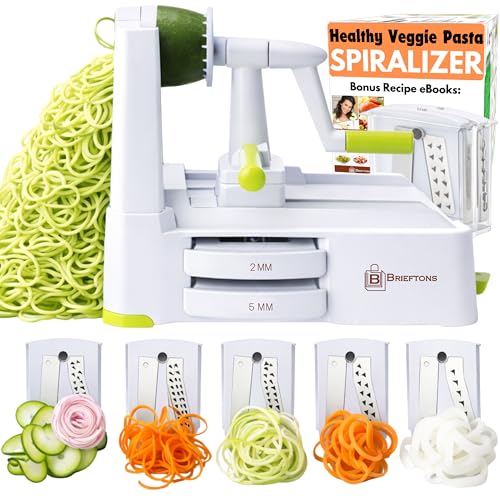
The ten blade Brieftons opens its second bullet with the problem rather than the feature: most spiralizers leave vegetable noodles scattered across the countertop. It then solves it by cutting directly into an included catch container, which takes a lid so the batch goes straight into the fridge without being transferred. For a family meal that is one job rather than two.
It backs that with a side handle for pushing dense vegetables like sweet potato and butternut squash actively through the blade, an oversized suction pad that locks to granite, marble, tile and glass, and a stated capacity for produce up to 10 inches long. At 3.5 lb and 6.0 by 11.8 by 8.3 inches it is the heaviest and largest thing here.
Ten Blades, All Accounted For
Its third bullet is the one a household with children should read. All ten blades have a home: one pre-installed in the blade rack, two in a built-in self-storage compartment and seven in an included blade caddy, with the listing stating plainly that none are loose and none are scattered. That is the honest way to sell a machine with ten mandoline-grade blades in the box.
What it never publishes is a width. Angel hair, spaghetti, tagliatelle, linguine, pappardelle, ribbons, curly fries, fine ridged pasta, crinkle chips and lasagne-width flats are named, and not one of the ten is measured. Its own five blade sibling does publish them, which makes the omission on the larger machine harder to explain.
Two Ways to Publish a Cut
Millimeters, on Labeled Blades
The five blade Brieftons is the better documented of the pair. Every blade is labeled so the right cut is picked without holding two up to the light, and every width is published: 2mm angel hair, 3mm spaghetti, 5mm fettuccine, 5.5mm pappardelle and a flat ribbon slicer. The steel is named as Japanese 420-grade.
Its safety detail is the best on this page. Blades snap into a safety-locking rack stated to prevent accidental ejection, and a platform slide-stop halts before the blade rack so fingers and the holder are protected as the vegetable runs out. It publishes what it needs to work: firm produce at least 1.5 inches wide, which rules out thin carrots and is worth knowing in advance.
Fractions of an Inch, and a Temperature
SUSTEAS publishes the same five cuts in the other system, as five sixty fourths, one eighth, three sixteenths and seven thirty seconds of an inch plus a ribbon slicer. Read against the millimeter figures the two sets describe a similar ladder, and neither listing converts for the other, so a buyer comparing the two is doing the arithmetic themselves.
Its cleaning bullet is the most specific in the pool and also the most restrictive: the blades, handle bar and blade holder are safe on the top rack, the main body is hand wash only, and the maximum is 158 F. It stores as one compact whole, which is the right answer for a cabinet, and its largest published figure, 11.02 inches, is the one to check against a shelf.
Folding Away, and Not Cranking at All
A Handle That Folds Up
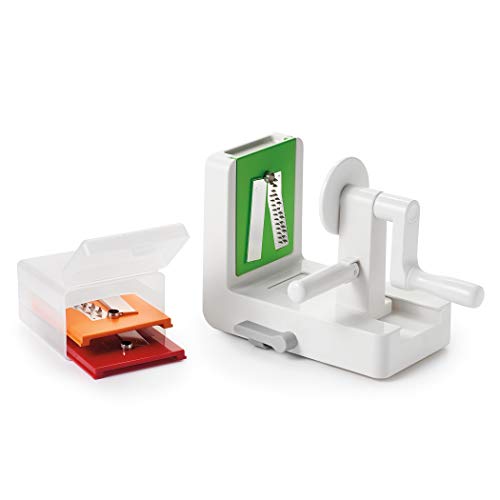
OXO is the smallest and simplest machine here at 1.5 lb, the lightest published weight of these five, with three blades: a one eighth inch spaghetti cut, a one quarter inch fettuccine cut and a ribbon. Its side handle, which advances the vegetable through the blade, folds up for compact storage, and the removable blade box stores on board so nothing travels separately.
The food holder has sharp teeth to grip produce as the handle turns, and a StrongHold suction cup keeps it still. What is missing is any cleaning instruction at all, on a machine with three exposed blades, and any statement of the minimum produce size it needs. Three blades is also the fewest here, which for a family that wants variety is a real limit.
Letting the Mixer Do It
KitchenAid answers the family question differently: if there is already a stand mixer on the counter, the motor does the work and nobody cranks. Five quick-change blades cover two spiralizing cuts, two slicing cuts and an optional peeling blade, in premium metal construction that gains its stability from the mixer it bolts to.
The attachment and its accessories fit inside their own storage case, and all the blades are top-rack dishwasher safe with the body wiped clean by a warm damp cloth. The obvious condition is the mixer itself, sold separately and the larger purchase by far. It publishes no cut widths, naming its blades only as medium, fine, large core and small core.
Which One Fits Your Kitchen
Prepping several vegetables in a row. The ten blade Brieftons, cutting straight into a catch container that takes a lid for the fridge, with a side handle for dense produce, ten blades all stored, and 10 inch produce capacity at 3.5 lb.
Wanting to know the noodle before you cut it. The five blade Brieftons, publishing 2mm, 3mm, 5mm and 5.5mm on labeled 420-grade blades, with a safety-locking rack, a finger-protecting slide stop and a stated 1.5 inch minimum produce width.
A cabinet rather than a counter. SUSTEAS, five cuts in inch fractions, packing away as one compact whole, with a suction base locked by a switch. Its body is hand wash only at up to 158 F.
A small kitchen and three cuts is enough. OXO, 1.5 lb with a one eighth inch spaghetti cut, a one quarter inch fettuccine cut and a ribbon, a blade box on board and a side handle that folds up.
A stand mixer already on the counter. KitchenAid, five quick-change blades driven by the mixer motor with no cranking, in metal, with its own storage case and top-rack dishwasher safe blades.
What We Could Not Verify
Every figure above comes from the maker’s own listing text. These are the things we went looking for and could not source in any of them.
- The ten blade machine names ten cuts and publishes a width for none of them.
- KitchenAid publishes no cut widths either, naming its blades only as medium, fine, large and small.
- Only two listings publish a produce size, and neither publishes a maximum diameter.
- No listing says how long a blade stays sharp or whether replacements can be bought.
- OXO publishes no cleaning instruction at all, on a machine with three exposed blades.
- No listing states how much a catch container holds, including the one that supplies it.