How the Five Compare on the Numbers
Five live pages already rank this pool: by stainless steel and published weight, by which parts are dishwasher safe, by how many jars one purchase holds under brine and the jar each weight fits, by published weight again for a small batch, and by how many separate objects land in the cabinet. All of those describe the weight sitting in the jar doing its job.
At lunchtime it has to come out, with one hand, from under brine, while the other hand holds the jar. Every listing here publishes something about that and no two describe it the same way. Four publish a handle in four different words and the only listing in this pool that uses stainless steel for the weight itself publishes no handle at all.
What the table cannot tell you is which grip actually works, because not one of these five publishes a figure for the handle: no height above the glass, no diameter for the knob, no projection for the finger grip. Every claim in the first row is a sentence rather than a measurement, which is why this page quotes the sentences instead of ranking numbers that do not exist.
Five Ways to Get a Weight Out of a Jar
Four Handles, Described Four Ways
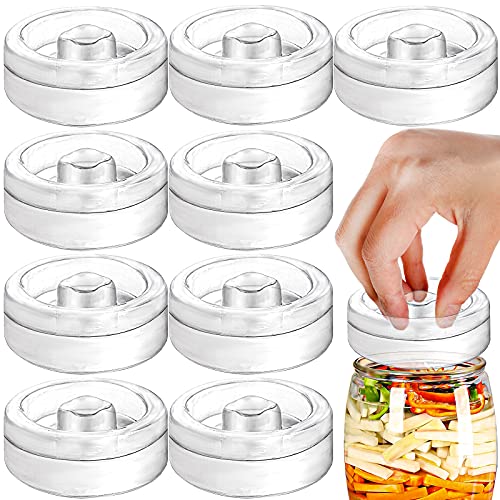
Yesland publishes the most useful version, because it names the conditions: an upgraded knob handle, described as a smart bulge, that makes the weight easy to take out no matter whether your hand is dry, wet, or halfway down a jar. That last clause is the one that matters at lunchtime and no other listing in this pool states it.
The other three describe the same object differently. eleganttime publishes a ribbed handle it calls an innovative non-slip grip design. Glolaurge publishes a built-in easy-lift handle, stated to help especially when wet or slippery. Masontops publishes a finger grip and tells you the action: pinch it. None of the four attaches a figure to the handle it describes.
One Coil and No Handle at All
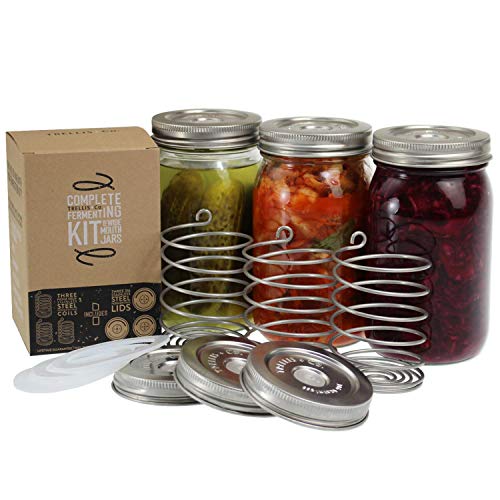
Trellis + Co. does something different. Its kit contains three Pickle Helix fermentation weight coils, which sit as a spring against the underside of the lid rather than as a disc on top of the vegetables, so the weight comes out when the lid does. The maker calls this no fuss, and in a one-handed lunch that is the strongest claim on this page.
It is also the listing that tells you least about the weight itself: no diameter, no height, no mass per coil, and a dimension field set of 15.0 by 10.0 by 10.0 inches that the sheet flags as implausible for a jar accessory. Its 0.85 lb weight field covers three lids, three airlocks and three coils together.
The Pool Is Named for a Material One Listing Uses
Glass Where Steel Is Advertised
This pool is called stainless steel pickle weights and exactly one of these five uses stainless steel for the weight: the Trellis + Co. coils, in 316 stainless. Yesland, Masontops, eleganttime and Glolaurge all publish glass. Masontops and eleganttime both name soda lime glass, the same glass a mason jar is made from, and all four describe it as non-porous.
That is worth saying plainly rather than quietly picking five things and calling them steel. Glass is the normal material for a pickle weight and the search term does not reflect it. If stainless steel is the requirement, this pool offers one answer and it is a coil rather than a disc, with a different shape and a different action.
What Steel Buys and What It Costs
Trellis + Co. makes the material argument directly: professional fermenters use nothing but stainless steel, its lid kit has the smallest amount of plastic on the market, and 316 stainless is the safest and cleanest material for food. It also drops the water airlock entirely, calling a water pool stagnant and pathogen-filled, which removes topping up water from a long ferment.
What it costs is visibility and mass. A glass disc at 7 oz sits visibly on the vegetables and holds them by its own weight; a coil holds them by spring tension against a lid you cannot see through. Neither listing publishes a force figure for the coil, so there is nothing to compare with the 7 oz and 11 to 13 oz figures the glass weights publish.
Weight Fields That Cannot Be Right
Nine Weights at Seven Ounces
Yesland publishes nine weights, each stated at 7 oz given also as 200 g, and a weight field of 0.44 lb for the purchase. A single one of those weights is already about as heavy as the whole field allows, so the field describes one weight and not nine. Its carton figure of 2.36 by 2.36 by 0.79 inches points the same way: that is one weight’s box.
eleganttime is the control that proves the point. It publishes four weights at 7 oz each and a weight field of 1.89 lb, which sits where four weights of that mass plus a box should sit. Same stated mass per weight, different pack count, and only one of the two fields behaves. We have used the per-weight figures from both and the pack field from neither.
A Two Pack Published at 700 Pounds
Glolaurge publishes two weights, each stated at approximately 11 to 13 oz, and a weight field of 700.0 lb. That is not a near miss. Two weights of 11 to 13 oz come to a figure close to 700 in grams, so 700 is almost certainly the gram mass of the pair sitting in a field labeled pounds, which is the most common fault of its kind in this data.
Masontops has a different problem and it is in the dimensions rather than the mass. Its fields read 100 by 100 by 50 inches, three round numbers that no jar accessory could have, and its 3.31 lb field for eight weights is the only figure on the listing that behaves. No diameter and no per-weight mass is published anywhere in its five bullets.
Which One Fits Your Kitchen
You want the weight out when the lid comes off. Trellis + Co. Three Pickle Helix coils in 316 stainless steel with three waterless airlock lids, which is the only mechanism here that does not need a grip at all.
Your hands are wet and the jar is half empty. Yesland. Nine glass weights at 2.75 inches and 1 inch high, 7 oz each, with a bulge knob handle stated to work dry, wet or halfway down the jar.
You want eight weights and a mouth size choice. Masontops. Soda lime glass with a finger grip you pinch, in a wide mouth eight pack, with a regular mouth version offered. No diameter is published.
You want a figure you can trust on the box. eleganttime. Four weights at 7 oz and 2.7 inches, with a ribbed non-slip handle, and the only pack weight field here that matches its own per-weight mass.
You ferment in gallon jars or Weck jars. Glolaurge. Two weights at 3.43 inches and about 11 to 13 oz with an easy-lift handle. Ignore its 700.0 lb weight field entirely.
What We Could Not Verify
These are the specifications we went looking for in all five listings and did not find.
- Any figure for a handle: no height above the glass, no knob diameter, no finger grip projection.
- A diameter or a per-weight mass from Masontops, and a diameter from Trellis + Co.
- Any force or tension figure for the Trellis + Co. coil, to set against the glass weights in ounces.
- A usable pack weight from Yesland, whose field is close to one weight, or from Glolaurge, whose field reads 700.0 lb.
- A washing instruction from any of the five, none of which publishes one.
- A height from four of the five, with only Yesland publishing one at 1 inch.