How the Five Compare on the Numbers
A WDT tool is a handle with a cluster of needles between 0.23 and 0.4 mm thick standing proud of it. On a bench that is fine. In a bag it is a row of wires waiting to be bent, and a bent needle is the whole tool ruined. Only one of the five mentions carrying it, so the question is narrower: what does each maker do about the needles when the tool is not standing on its stand.
Three of the five answer it in writing, in three different ways, and two of those answers are explicitly about bending. The table gives that first, then the spare needles supplied, because a spare set is the other way to survive a journey, then the counts, diameters and sizes each maker publishes.
What the table cannot tell you is how much force any needle will take. No maker publishes a needle length, a material temper or a bend resistance, only a diameter, and 0.23 mm against 0.4 mm is the only hint the pool offers: Normcore’s needles are the finest published here and Zolunu’s the most substantial, which is very likely also the order in which they bend. That is an inference, not a published claim.
What Happens to a Needle in a Bag
One Tool Puts the Needles Away
Subminimal is the only listing in this pool where the needles do not stick out when the tool is not in use. It states retractable needles for enhanced safety with one-click deployment and a magnetic release mechanism, and it is stated to sit either on its own aluminum base or magnetically on a machine or wall. For anything that gets packed, that is the difference between a tool and a hazard.
It is also the listing that publishes the least about the needles themselves: no count and no diameter appear anywhere in its features, only that two sets of replacement needles and an Allen key are included. So you are buying the mechanism rather than the specification, which is an unusual trade in this category and the right one if the tool travels.
Two Makers Address Bending Directly
MEION is the only listing to use the words. It states seven food-grade stainless steel needles at 0.35 mm plus seven replacements, a thoughtful needle storage tube, and then says goodbye to the bent needles. The tube holds the spares rather than the fitted needles, so it is a recovery plan rather than protection, but it is the only listing that names the failure mode at all.
NESSUS protects the fitted needles instead. It states a non-hollow base with a noise-free silicone bottom and says plainly that this protects the needles, alongside ten needles at 0.35 mm, an extra set of ten, and a built-in cleaning brush in the base that cleans the needles as you push them in and pull them out. At a published 0.12 lb it is also the lowest weight here, on figures of 4.12 by 1.22 inches.
Spares Are the Other Answer
Sixteen, Ten, Seven, and Two Sets
Every maker that publishes a needle count also publishes spares, and the counts are generous. Normcore supplies sixteen extra needles against nine fitted at 0.23 mm. NESSUS supplies ten extra against ten fitted. MEION supplies seven against seven, describing the package as fourteen needles in total. Subminimal supplies two sets without saying how many are in a set.
That changes what a bent needle costs. With sixteen spares and an Allen key or a removable head, a bent needle on the road is an inconvenience; with none it is the end of the tool for that trip. Normcore is also the only pick combining generous spares with the finest published diameter, which is the combination that most needs them.
The Pick With No Spares at All
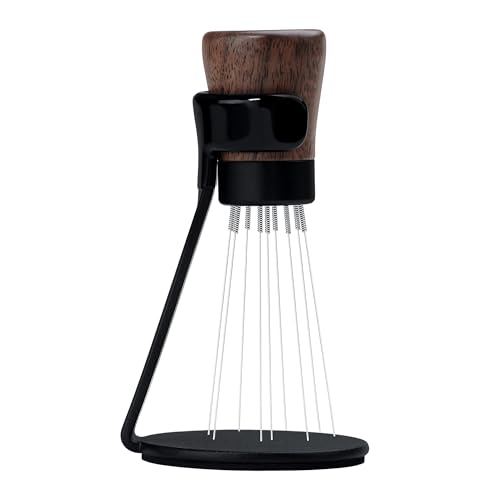
Zolunu publishes no spare needles, no replacement mechanism and no needle removal. It states five fine needles at 0.4 mm in high quality stainless steel, a natural walnut handle and stand, and an integrated design of stirrer and base that it says makes the tool easy to carry around. It is the only one of these five that says anything about carrying at all.
So Zolunu and Subminimal answer the same question from opposite ends. Zolunu makes the whole object one piece you can pick up and go, with the coarsest needle gauge published here and nothing to replace them with. Subminimal hides the needles instead and hands you two sets of spares and the key to fit them.
What Else Has to Travel With It
Stands, Bases and Magnets
Four of the five arrive with a stand, which is a second object to pack. MEION states an aluminum handle and stand, NESSUS a stand with the cleaning brush built into it, and Normcore a magnetic stand. Zolunu builds the base into the tool, so there is only one thing to carry, and that is the basis of its portability claim.
Subminimal offers two placements, its own aluminum base or a magnetic attachment to the machine or a wall, so the base is optional rather than required. A magnet is no use in a bag, but it does mean the tool has somewhere to go in a rented kitchen without asking for counter space, which is the other half of travelling with espresso equipment.
Wood, Water and One Contradictory Bullet
Two picks use walnut. Zolunu states a natural walnut handle and stand and that the tool is cleaned by rinsing with water and leaving it to dry. Normcore states an American walnut handle in its title and an anodized aluminum CNC handle in its features, with 304 stainless spring wires described as nonstick and rust resistant, which is two different handles in one listing.
MEION carries a stranger contradiction. Its own features state an aluminum alloy handle and an aluminum stand, and then warn that the wooden handle and base cannot be cleaned with water and easily accumulate dust. There is no wood in the tool it just described. That reads as boilerplate carried over from another product, and it is a reminder that a water warning in this pool may not belong to the tool you are reading about.
Which One Fits Your Kitchen
A tool that goes in a bag. Subminimal is the only pick whose needles retract, with one-click deployment, a magnetic release and two sets of replacement needles plus an Allen key. Published at 0.71 by 0.71 by 4.33 inches and 0.18 lb, it stands on its own aluminum base or clings to a machine.
A plan for the needle you bend. MEION is the only listing to name the problem, supplying seven needles at 0.35 mm, seven replacements and a storage tube, with a head that takes three to seven needles as you like. It publishes no size or weight, and its water warning describes a wooden handle it does not have.
The lowest published weight. NESSUS states 0.12 lb and 4.12 by 1.22 inches, ten needles at 0.35 mm plus ten spares, a head configurable from five to nine needles, and a silicone base bottom it states protects the needles. The cleaning brush is built into that base.
The finest needles, and spares to match. Normcore states nine prongs at 0.23 mm with sixteen extra needles and a magnetic stand, published at 1.1 by 1.1 by 3.4 inches. Its 304 stainless wires are stated nonstick and rust resistant. Its title and its features disagree about whether the handle is walnut or aluminum.
One piece to pick up and go. Zolunu states five needles at 0.4 mm, the coarsest gauge published here, in a natural walnut handle with the stand integrated into the tool, which is the basis of its claim to be easy to carry. Cleaning is a rinse and a dry, and there are no spare needles.
What We Could Not Verify
All of this comes from the makers’ own listing text. These are the questions it leaves open.
- Only one of the five mentions carrying the tool anywhere, and none describes a case, sleeve or cap.
- No maker publishes a needle length, a temper or any measure of how much force a needle will take.
- Subminimal publishes neither a needle count nor a needle diameter.
- Two of the five publish no dimensions at all, and three publish no weight.
- One listing warns about a wooden handle in a tool whose own features describe an aluminum one.
- Two listings on the fact sheet were set aside: a flat palm leveler with no needles, and a needle tool that publishes no size and no weight.