How the Five Compare on the Numbers
Sixteen listings sit on the fact sheet and five are on this page. The eleven left off repeat footprints already represented here rather than adding new depth figures, and one of them, KITESSENSU, is the same narrow two loaf shape Yupjlia already covers. The five below were chosen because between them they publish every kind of depth figure this pool has: a field, a sentence, both, neither, and a package number that contradicts the pan.
A drawer asks two questions of a baking pan and neither is about baking. The first is the footprint, and these five run from 15 by 6.3 in up to 15 by 13. The second is how much vertical space the pan claims, and that is where the listings get interesting: the published figures sit between 0.85 in and 1 in, one maker’s own sentence says 1.5, and one two pack is boxed thinner than a single one of its own channels.
What the table cannot give you is the figure a drawer actually needs, which is how tall the stack is once the pans are in it. Only Tiawudi and Kbiykuy ship two pans, and only Kbiykuy publishes a package figure that could answer it, and that figure contradicts the pan. Nobody publishes whether two of their pans nest into each other or sit one on top of the other, and on a perforated pan with raised channels those are very different heights.
The Depth Figures, and Where They Stop Agreeing
A Box of Two Published at 0.86 Inches
Kbiykuy publishes its package as 0.86 by 15 by 12.8 in. The same listing says each tray has four rounded channels and gives a channel depth of 0.94 in. Two trays of that description cannot go into a box 0.86 in through, and one of them cannot either. The figure is real, in the sense that the maker published it, and it is not a measurement of two baguette pans.
The useful part is what it implies rather than what it states. A carton that flat is a carton for flat things, which fits a pan whose channels are pressed into a sheet rather than built up from it, and it is the only hint in this pool that two pans of the same model go together rather than on top of each other. This page does not treat 0.86 in as the height of anything, and no comparison here is anchored on it.
Chicago Metallic Publishes 1 Inch and 1.5 Inches
The dimension fields on the Chicago Metallic listing read 9 by 16 by 1 in. Its own fourth bullet says the pan measures 16 by 9 by 1.5 inches. Half an inch is a large disagreement on a figure this small, and it is the difference between a pan that slides under a drawer divider and one that does not. The maker’s sentence is used in the table above and the field is recorded beside it.
That choice follows from what each figure comes with. The sentence names the pan, its three loaves and its footprint together. The field names nothing. On a page about whether a pan fits in a drawer, taking the larger of two published depths is also the safer error, since a drawer that swallows 1.5 in will swallow 1, and the reverse is a pan that does not close.
Footprint Is Still the First Question
Fifteen by Six Against Fifteen by Thirteen
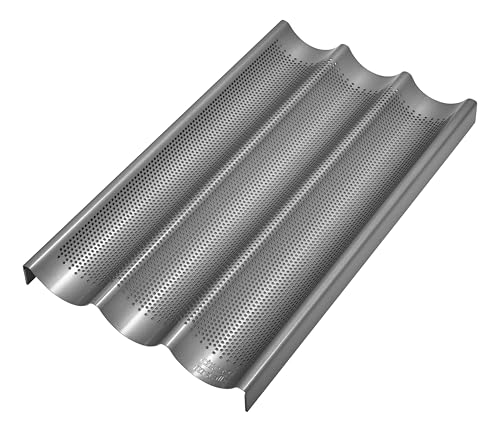
Yupjlia is a two loaf pan at 15 by 6.3 in. EAMQXERTOI, Kbiykuy and Tiawudi are four loaf pans at 15 by 13. Chicago Metallic sits between them at 16 by 9 for three loaves. In a standard base cabinet drawer the difference is not marginal: the two loaf pan lies down in a space where none of the four loaf pans will go in flat at all.
Every one of these pans is longer than it is wide, so the drawer’s short side is what rules. A 15 in pan needs a drawer with 15 in of clear interior in some direction, and the four loaf pans need 13 in in the other direction as well. That is the whole of the storage question, and no listing in the pool addresses it, because no listing was written with a drawer in mind.
EAMQXERTOI’s Fields and Sentence Are Four Tenths Apart
EAMQXERTOI publishes 15 by 13 by 0.87 in in a bullet and lists 15.08 by 12.99 by 0.87 in as its size. Its dimension fields read 12.59 by 14.96 by 0.85. The lengths agree closely, the depth agrees to two hundredths, and the remaining side differs by roughly four tenths of an inch depending on which figure is read. For a drawer that is within the margin you would leave anyway.
It is worth recording because it shows what the other listings are hiding. Only Kbiykuy publishes no depth field at all, and two publish no depth in words. EAMQXERTOI is the one pan that gives a depth in words, in its size line and in its fields, and it is also the lightest here at 0.57 lb. Consistency and detail travel together on these listings, and the pans that publish least are the ones you are most likely to measure wrong.
What Else the Drawer Has to Take
One Purchase or Two Pans
Kbiykuy and Tiawudi both ship two four loaf trays and both are described the same way, at 15 by 13 in with four channels. Their published weights are not the same: Kbiykuy states 1 lb for the pair and Tiawudi states 2.2 lb. Two identical descriptions, two figures that differ by more than double, and nothing on either listing to explain it.
For a drawer the count matters more than the weight. Two pans is twice the stack, and neither maker says whether they nest. Tiawudi adds a lifetime guarantee, the only one among these five, and publishes a channel width of 2.8 in against Kbiykuy’s 2.72. Those two channel figures are the closest thing in this pool to a shared specification, which suggests the same pressing with two brands on it.
Edges, Coatings and Getting It Back Out
A pan pulled from a full drawer is gripped by its rim. EAMQXERTOI is the only pick that describes that edge, calling it smooth and burr free, and it is also the only one that suggests keeping the pan in use for dough resting, storage and freezing rather than only for baking. Chicago Metallic describes a two layer nonstick and is the only pick here in aluminum rather than carbon steel.
Coatings decide the other half of storage, which is what happens when pans are slid over each other. Kbiykuy names PFOA free nonstick, Tiawudi and Yupjlia name a food grade nonstick without a further claim, and Chicago Metallic recommends hand washing to preserve its coating even though the pan is dishwasher safe. None of the five says anything about scratching one pan against another, which is what a drawer does to them.
Which One Fits Your Kitchen
A drawer that will not take a wide pan. Yupjlia, two loaves at 15 by 6.3 in, 0.94 in through the fields and 0.59 lb. It is thickened carbon steel rated to 446 F, and it is the only pick here that will lie flat in a drawer built for utensils.
One pan, measured the same way three times. EAMQXERTOI, four loaves at 15 by 13 by 0.87 in with a 0.85 in field, 0.57 lb, smooth burr free edges, and a maker that names dough resting and freezing as uses rather than baking alone.
Two trays and a guarantee behind them. Tiawudi, two four loaf pans at 15 by 13 by 1 in with 2.8 in channels and a lifetime guarantee, published at 2.2 lb for the pair. Expect to find drawer space for two pans, not one.
Two trays at the lower published weight. Kbiykuy, two four loaf pans with 2.72 in channels 0.94 in deep, carbon steel to 446 F, published at 1 lb for both. Its 0.86 in package figure is not the height of anything you will be storing.
Aluminum and a dishwasher. Chicago Metallic, three loaves at 16 by 9 in, published as 1.5 in deep in the maker’s sentence and 1 in the fields, in heavy weight aluminum with a two layer nonstick and 0.86 lb.
What We Could Not Verify
Every figure above is from the maker’s own listing. These are the things we went looking for and could not source in any of the five.
- No listing says whether two of its pans nest into each other or stack one on the other, which is the figure a drawer needs from the two packs.
- Kbiykuy’s published package, 0.86 in through, is thinner than the 0.94 in channel depth on the tray inside it, and the listing does not explain which figure is the pan.
- Chicago Metallic publishes 1 in in its fields and 1.5 in in its own sentence, and nothing there says which describes the pan.
- Kbiykuy and Tiawudi describe the same two pack at the same footprint and publish 1 lb against 2.2 lb, with no stated difference between them.
- Only three of these five publish a temperature rating, 446 F twice and 450 F once, so two pans cannot be compared on heat at all.
- Not one listing publishes a rim height or an overall thickness including the channels, so the depth figures cannot be checked against the shape of the pan.