How the Five Compare on the Numbers
Ten microwave covers sit on the fact sheet for this topic and five are here. Two of the ten are the same maker’s medium and large covers, and reading them side by side is instructive rather than useful: the large one is stated at 13 by 13 by 4 inches and the medium at 10.5 by 10.5 by 3 inches, and the large one carries the lighter published weight of the two. One listing publishes no dimensions at all.
This page asks what each maker is willing to tell a beginner. Only one publishes a temperature ceiling. Only one publishes a maximum heating time. One rules out two microwave modes, one draws a line between the cover and the mat it comes with, and two publish nothing beyond the phrase heat resistant. That spread is the whole story here.
What the table cannot tell you is how fast steam actually clears. Every listing here mentions vents and not one publishes a hole count or a vent area, so the difference between enlarged perforated vents on one cover and a dual vent system on another is a phrase rather than a figure. For food that spits, that is the property you are buying, and none of the five gives you a way to compare it.
The One Listing That Publishes a Ceiling
266 F, and Ten Minutes
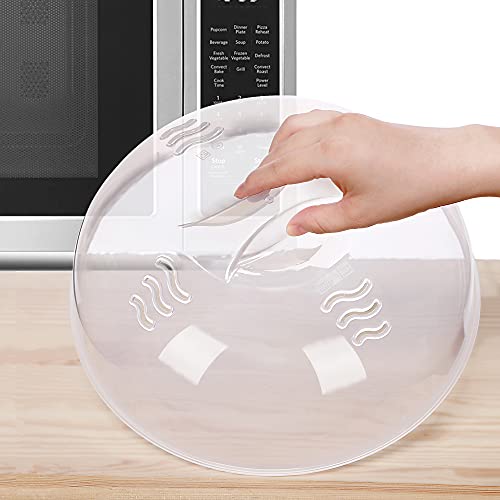
GLICPIX is the only cover in this pool that puts numbers on its own safety. It states that the cover is safe to heat up to 266 F, gives the same figure as 130 C, and then adds a limit nobody else attempts: the longest heating time cannot exceed ten minutes. For a first kitchen that second figure is worth more than the first, because nothing else on any of these listings suggests there is an upper bound at all.
The rest of the listing is ordinary in a good way. It states 10.5 by 10.5 by 3.5 inches, easy-grip handles, perforated steam vents, and a second use as a colander for fruit or vegetables. Its published weight is 0.3 lb. Its height field reads 0.1 inches, which is the cover flattened for shipping rather than the height it works at.
And the One Thing It Gets Wrong
Two consecutive bullets name two materials. The first says the PP and TPR is a heat resistant material that will not melt in the microwave or dishwasher. The second says the cover is made with sturdy silicone and will withstand years of dishwasher use. Those are different plastics with different behavior, and a cover that publishes a precise 266 F ceiling should know which one it is describing.
It matters more here than it would elsewhere, because the temperature limit belongs to a material. A silicone cover and a PP cover with a TPR grip do not share a ceiling, so the figure and the material have to be read together. This page quotes the limit as published and flags that the material behind it is unresolved on the listing itself.
What Fits Under the Lid
The Only Interior Measurement in the Pool
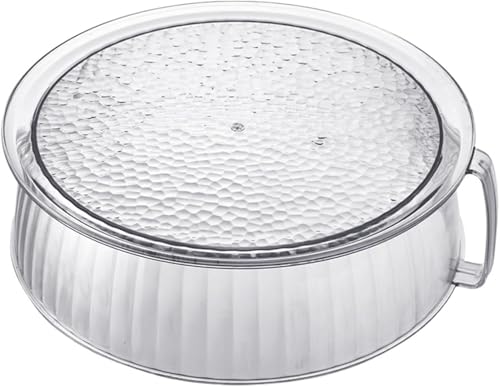
Nordic Ware publishes what everyone else leaves out. Its second bullet gives an interior diameter of 10.4 inches at the lip, 9.7 by 2.2 inches inside the lip and with the dip on top, and an exterior of 10.5 inch diameter and 3.1 inches in height. That is the difference between knowing what the cover occupies and knowing what fits under it, and it is the only listing in this pool that distinguishes the two.
It is also the only pack of two, which for a starter kitchen is the practical answer: one by the microwave and one in the dishwasher. It states BPA free and melamine free plastic, top rack dishwasher safe, and made in the USA. It is rigid, so two of them take real cupboard space, and its dimension fields describe the carton at 10.5 by 10.5 by 2.12 inches.
A Taller Cover, and a Mode It Rules Out
Tusjiain states 11.5 by 11.5 by 4.5 inches, the largest stated footprint among these five, with enlarged perforated steam vents that it says prevent condensation building up. At 0.31 lb it is as light as the small collapsible covers. Its dimension fields read 11.02 by 11.02 by 4.72 inches, which disagrees with its own consistent 11.5 by 11.5 by 4.5, and this page quotes the maker’s sentence.
Its useful contribution is a restriction nobody else publishes: do not use it in grill or convection mode. Plenty of microwaves are combination ovens now, and a grill element radiates heat a microwave does not. That single line is the kind of thing a first kitchen needs told to it, and four of these five listings never mention the possibility.
Two Answers to Storage and Material
A Cover That Comes With a Mat
AIDACOM is two things for one purchase. The cover is 10.5 inch diameter with vented holes and a handle in the middle, and its height can be changed from 0.8 to 3.2 inches, so it flattens into a drawer. The silicone mat that comes with it is named for a trivet, pot holder, spoon rest, place mat, hot pad, jar opener and dish drying mat, which for a kitchen being furnished from nothing is a fair amount of coverage.
It is also the only listing here that draws a line inside its own product. The cover is PP plastic and is stated not to be oven safe. The mat is food grade silicone and is stated to be both microwave and oven safe. Nobody else in this pool distinguishes between the parts they sell, and at 0.57 lb the pair is still the heaviest published weight of these five.
Glass, With a Thickness Published
Le’raze is the only cover here made of glass, and it is the only listing that publishes a wall thickness: 5.4mm of borosilicate, stated at 11.75 by 10 by 4.25 inches, with a ceramic screw rather than a plastic one and a claim to be completely plastic free. It vents on the side as well as the top, which it explains as keeping the steam away from the hand that lifts it.
Its weight is the catch and the listing is honest about it in the one place it mentions it: 3 lb, given at the end of a bullet, with the weight field left empty. Every plastic cover in this group publishes under 0.6 lb. Its dimension fields read 10.0 by 10.0 by 0.1 inches, which cannot describe a cover 4.25 inches tall, so the bullet is the only measurement worth using.
Which One Fits Your Kitchen
Furnishing a kitchen from nothing. Nordic Ware, two BPA and melamine free covers with an interior of 9.7 by 2.2 inches inside the lip and a 10.5 inch exterior diameter, top rack dishwasher safe. Two covers means one is always clean.
Wanting to be told where the line is. GLICPIX, a collapsible cover stated at 10.5 by 10.5 by 3.5 inches with a published ceiling of 266 F and a maximum heating time of ten minutes, plus a second use as a colander. Read its material bullets twice.
A combination microwave with a grill element. Tusjiain, stated at 11.5 by 11.5 by 4.5 inches at 0.31 lb with enlarged steam vents, and the only listing here that says not to use it in grill or convection mode.
One purchase doing several jobs. AIDACOM, a 10.5 inch cover adjusting from 0.8 to 3.2 inches with a silicone mat named for a trivet, pot holder and spoon rest, at 0.57 lb, with the cover stated not oven safe and the mat stated safe in both.
Keeping plastic away from hot food. Le’raze, borosilicate glass stated at 11.75 by 10 by 4.25 inches and 5.4mm thick, with side and top vents and a ceramic screw. Its own bullet states 3 lb, so this is a cover you lift deliberately.
What We Could Not Verify
Every figure above comes from the maker’s own listing text. These are the things we went looking for and could not source in any of them.
- Four of these five publish no temperature limit, so what can safely sit under the cover is unstated.
- Only one listing publishes a maximum heating time, and it does not say what happens past it.
- Only Nordic Ware publishes an interior measurement, so on four of five whether a plate fits is guesswork.
- No listing here publishes a vent hole count or vent area, so steam clearance cannot be compared.
- GLICPIX names two different materials in consecutive bullets and never resolves which one it is.
- No listing states whether the cover may touch the food it is placed over, which on a piled plate it will.