How the Five Compare on the Numbers
Sixteen listings sit on the fact sheet for this topic and five are here. The pool holds several near duplicates, including one maker’s four pack and six pack of the same stainless airlock lids, and one product that is not a fermentation lid at all: a set of stainless storage lids with silicone gaskets that states in capitals that it is not for canning and has no valve of any kind.
Reading the rest together, two questions separate them. What kind of airlock is it, because that decides whether you top up water or forget about it entirely. And does anything in the box hold the vegetables under the brine, because every listing here agrees that floating solids ruin a batch and only one of these five does anything about it.
What the table cannot tell you is the figure that would actually let you compare these: the pressure at which a one-way valve opens. Every waterless lid in this pool describes automatic venting and none publishes a number, so the difference between one silicone valve and another is a claim rather than a specification. For a first batch that matters less than it sounds, because either the jar vents or it does not, but it means a comparison can go no further than counting parts.
Two Airlocks, Two Different Routines
Nothing to Fill and Nothing to Remember
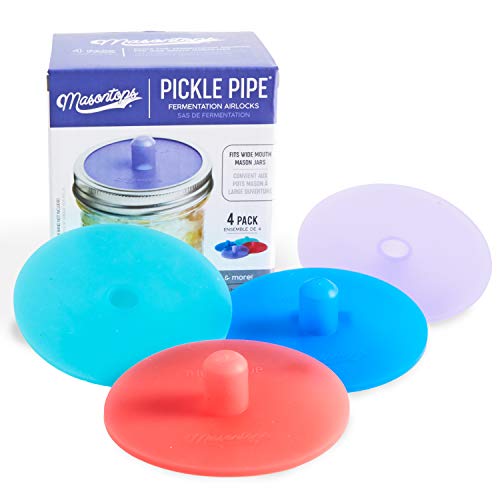
Masontops takes the simplest possible approach and its listing does not overclaim it. Each cap is one piece of food-safe silicone with a one-way waterless valve, stated to need no water, no burping and no maintenance, and the low profile is a deliberate point: jars with these fitted still go in a cupboard or a drawer, which is not true of anything with an airlock standing on top.
It is also the easiest of the five to clean, going into the dishwasher alongside the wide mouth jars, with no parts to separate. What it does not publish is a diameter or a jar size range, so the only fit information is the phrase wide mouth. Its dimension fields read 0.5 by 3.3 by 3.3 inches and no weight is published, so a four pack’s bulk is a guess.
Water in the Airlock, and a Warning Attached
JILLMO and Klemon both use the three-piece plastic airlock that most people picture when they think of fermenting, and both of them attach the same caution. JILLMO says to wash the plastic airlocks with warm water only and not to boil them. Klemon puts it in a warning: do not sterilize the plastic airlocks with boiling water, and suggests soaking in bleach water to disinfect instead.
That is a real consideration for a pantry project, because boiling is how most people sterilize anything that touches a ferment. Both kits are stainless lids with silicone rings and both ship spare grommets, which is the part that perishes first. Klemon publishes 0.9 lb and JILLMO 0.84 lb for six sets, which makes Klemon the heaviest published weight of these five.
What a First Batch Actually Needs
The Only Kit That Holds the Cabbage Down
Ultimate is the only pick here that treats the gas and the floating as two separate problems. It ships three stainless venting lids and three stainless fermenting springs, and its listing names the reason outright: floating vegetables are what makes a ferment mushy, moldy and wasted, and the springs press the contents down and readjust as the cabbage settles during the batch.
It also publishes the fit properly, at a 3.375 inch standard wide mouth across 4, 8, 16, 32 and 64 oz jars, and it supplies beginner recipes for kraut, kimchi and pickles along with guidance on telling a healthy ferment from one to throw out. It states a lifetime warranty. It publishes no weight, no dimensions and no cleaning instruction, which is a strange gap on an otherwise instructive listing.
The Kit That Publishes the Procedure
Klemon is worth a second look for what it writes rather than what it contains. Its fourth bullet gives the assembly in order: insert the airlock into the lid hole, screw the lid onto the jar, add half of water to the airlock, and after fermentation take the airlock off and close the silicone cap. Its fifth explains that the three-piece airlock disassembles and can be cleaned through with a small brush.
That is more practical help than any other listing in the pool provides, and it comes with 18/8 stainless lids, a stated range of 4 oz to 64 oz, and named compatibility with Ball, Kerr and branded wide mouth jars. Its one slip is arithmetic: the title says six silicone grommets and the first bullet says nine. Nine for six lids is three spares, so the bullet is the better news.
Scale, Spares and What Fits What
A Gallon Jar Is a Different Problem
Fermentaholics is the outlier and belongs here because a pantry project often outgrows a mason jar. Its two lids are stated at 110mm for a standard gallon jar, each with a silicone gasket, a rubber grommet and an S airlock, and the whole assembly is stated dishwasher safe. It is named for beer, wine, mead, cider and hard kombucha as well as sauerkraut and pickles.
It will not fit anything the other four fit, which is the point and also the limitation. At 0.26 lb for two lids it is the lightest published weight here, and an S airlock stands tall enough that a jar wearing one is not going into a cupboard. Two lids and a gallon jar each is a commitment to a larger batch than a first attempt usually wants.
Spare Grommets and Stated Promises
The part that fails on a reusable fermentation lid is not the steel. It is the silicone: the ring that seals the lid to the glass and the grommet that holds the airlock in the hole. Two of these five ship spares for exactly that reason, Klemon with nine grommets against six lids and JILLMO with extra grommets and a stated one year replacement for damaged small parts.
Nobody publishes how long any of it lasts. There is no stated life for a gasket, a ring or a valve anywhere in these sixteen listings, so a kit that ships spares and a kit that states a replacement policy are the only two ways this category addresses wear at all. On a project meant to run batch after batch, that is worth more than a parts count.
Which One Fits Your Kitchen
A first batch with as little to go wrong as possible. Masontops, four one-piece silicone caps with a waterless one-way valve, no water to add and no burping, low enough in profile that the jars still fit a cupboard, and dishwasher safe with the jars.
Sauerkraut, where the cabbage will try to float. Ultimate, three stainless venting lids with three fermenting springs, a stated 3.375 inch wide mouth fit across 4 to 64 oz jars, beginner recipes supplied and a stated lifetime warranty.
Wanting the steps written down. Klemon, six 18/8 stainless lids with six three-piece water airlocks and nine grommets, published assembly order including half filling the airlock, and a clear warning against boiling the plastic.
Several jars going at once, for years. JILLMO, six stainless lids with seals, airlocks and grommets for 3.38 inch or 86 mm wide mouth jars from 8 oz to 64 oz, with spare grommets and a stated one year replacement on small parts.
A batch bigger than any mason jar. Fermentaholics, two 110mm lids for a gallon jar with a gasket, a grommet and an S airlock each, 0.26 lb, dishwasher safe throughout, and suited to cider and mead as well as vegetables.
What We Could Not Verify
Every figure above comes from the maker’s own listing text. These are the things we went looking for and could not source in any of them.
- No listing publishes the pressure at which its one-way valve opens, so venting cannot be compared.
- Masontops and Klemon publish no jar diameter, only that the lids are for wide mouth jars.
- Ultimate never says what force its springs apply, only that the pressure is consistent.
- Two of these five publish no weight and no dimensions of their own at all.
- No listing states how long a silicone gasket, ring or valve lasts before it needs replacing.
- Neither water airlock kit says what to sterilize the plastic with, having ruled out boiling it.