How the Five Compare on the Numbers
Fifteen salad container sets are on this fact sheet and seven publish a weight. Not one of the fifteen publishes a dimension trio for the container itself, so every size figure here is either a package measurement or a sentence in a bullet. On a page about a light build that leaves the weight field carrying the whole argument, and the weight field is not always telling the truth.
These are sets, and a set weight covers everything in the box. One figure here describes nine stainless steel containers, another describes twenty pieces of plastic, and another describes two bowls. Reading the column on its own would rank them backwards, so the count sits in the second row and every figure below should be read against it.
The row that would settle a lunch bag decision is missing on four of the five. Nobody publishes the weight or the height of a single bowl, only of the box it arrives in, and only SOLIGT states a figure in words. So if what you want to know is what one container adds to a bag on a Tuesday, none of these listings answers it directly and two of them do not answer it at all.
Three of These Weights Cannot Be Right
Nine Stainless Containers at Half a Pound
YUANYE publishes 0.5 lb and its own first bullet lists what that is supposed to cover: two containers of 50 oz, two of 34 oz, two of 27 oz and three of 6 oz, nine stainless steel pieces in total with lids and silicone seals. Half a pound of steel does not make nine containers that size. The figure is in the field and the listing text contradicts it, and the text is far more specific.
Tanjiae has the same problem in a milder form: 0.6 lb across three 50 oz stainless bowls with lids and three 2.5 oz stainless dressing cups. Both listings publish a real package size, 5.31 by 7.48 by 3.15 inches and 7.09 by 7.09 by 3.15 inches, which are believable cartons for stacked bowls. The weight fields are the part not to build a comparison on.
What a Believable Figure Looks Like
Bentgo publishes 1.32 lb for a twenty piece set, ten plastic bowls and ten custom fit lids. Thin polypropylene at that ratio is entirely plausible, and it is the lightest figure here that survives arithmetic. Freshmage publishes 1.4 lb for two 52 oz bowls with three compartments each and a sauce container in the middle, which is also a figure that matches the object described.
So the useful ranking on this page is not the raw column. It is Bentgo and Freshmage as the plastic sets whose figures hold up, SOLIGT as the glass set that is genuinely heavy, and the two stainless sets as sets whose real weight is unknown. That is a less tidy answer than the field offers and it is the one the listings support.
Glass Costs You Four Pounds
One Jar, Three Spaces, and Real Mass
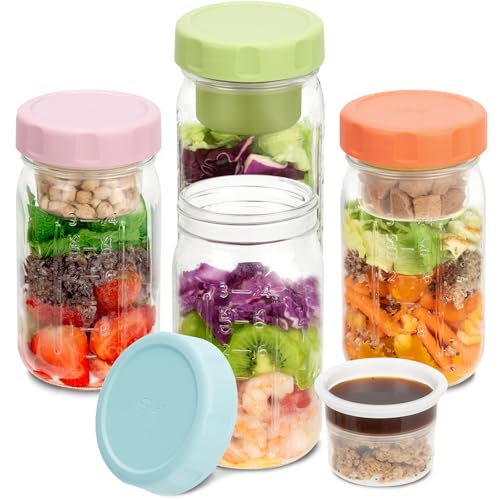
SOLIGT publishes 4.63 lb, the heaviest of these five, for four wide mouth glass mason jars. It is also the only pick that states a size in words: 3.93 inches long by 6.69 inches high per jar. Each jar is divided into three spaces by two layers of BPA free plastic inserts, with a 3 oz lower container for dressing and removable silicone rings on both the lid and the dressing container.
The listing is specific about the payoff too, saying assembled jars keep in the refrigerator for up to five days. That is the only shelf life figure among these five. Glass is the material that will not stain, will not hold an odor and will not warp, and on this fact sheet it is also the material that weighs more than three times what a plastic set of ten bowls weighs.
Stainless in the Middle, in Theory
Stainless steel ought to sit between plastic and glass and here it cannot be placed at all, because both stainless sets publish a weight that their own contents rule out. What they do publish is useful in other ways. Tanjiae names food grade 304 stainless steel for both the bowl and the dressing cup, and adds a built in date dial on the lid for tracking how long a prepped salad has been stored.
YUANYE names no grade but is the most detailed on heat, stating that the bowls are freezer and oven safe and that mirror polishing reduces food adhesion. It also does something unusual and honest: it warns that the lids on the three 6 oz containers are silicone, are not leakproof, and should not be inverted. That is a limitation most listings in this pool would leave out.
What a Light Set Gives Up
Heating, and Which Parts Can Take It
The plastic sets win on reheating and they are careful about how. Bentgo states that food can be heated straight from the freezer or refrigerator, that each bowl is microwave and top shelf dishwasher safe, and that the lids must not go in the microwave, only the trays. That last clause is the kind of detail that decides whether a lid survives a month of office lunches.
The stainless sets go the other direction. YUANYE states freezer and oven safe, which is a claim no plastic set here makes, and says nothing about a microwave, which steel cannot enter. Tanjiae states fridge and freezer friendly with top rack dishwasher safety for bowls and cups. SOLIGT and Freshmage publish no dishwasher or microwave statement at all.
Dressing Cups and What Seals Them
Four of these five separate the dressing and they do it with different parts. Tanjiae supplies three stainless cups of 2.5 oz with leakproof lids. YUANYE supplies three stainless cups of 6 oz whose lids it states are not leakproof. SOLIGT builds a 3 oz container into the jar with its own silicone ring. Freshmage puts a sauce container in the middle of the bowl.
Bentgo is the one that does not, offering ten one compartment bowls with volume embossed on the tray for portioning instead. For a household packing the same lunch five days a week that is arguably the right trade, because ten bowls and ten lids at a published 1.32 lb is the least mass any of these five needs to cover a week. It just means the dressing goes in something else.
Which One Fits Your Kitchen
A week of lunches at a believable weight. Bentgo, a published 1.32 lb for twenty pieces, ten one compartment bowls and ten fitted lids in plastic free of PFAS and BPA, with volume embossed for portioning, microwave and top shelf dishwasher safe trays, and lids that must stay out of the microwave.
Salad that will not go soggy. SOLIGT, a published 4.63 lb for four glass mason jars stated at 3.93 by 6.69 inches, each divided into three spaces with a 3 oz dressing container, silicone sealing rings, and a stated five days in the refrigerator.
Three compartments and one carry. Freshmage, a published 1.4 lb for two 52 oz bowls with three compartments and a central sauce container, with locking lids the listing says seal tighter than a rubber rim. It publishes no cleaning instruction.
Steel that can go in an oven. YUANYE, nine containers at 50, 34, 27 and 6 oz, stated freezer and oven safe and dishwasher safe, with a frank warning that the three 6 oz silicone lids are not leakproof. Its 0.5 lb figure cannot describe the set.
Knowing when you prepped it. Tanjiae, three 50 oz bowls in food grade 304 stainless steel with three 2.5 oz leakproof dressing cups and a built in date dial, top rack dishwasher safe. Its 0.6 lb figure also cannot describe the set.
What We Could Not Verify
Every figure above comes from the maker’s own listing text. These are the things we went looking for and could not source in any of them.
- Not one of the fifteen listings in this pool publishes a dimension trio for the container itself, only for the package it ships in.
- No listing publishes the weight of a single bowl, so what one container adds to a lunch bag is unstated everywhere.
- The YUANYE 0.5 lb and Tanjiae 0.6 lb figures cannot cover the stainless steel sets their own bullets describe, so neither anchors a comparison here.
- Bentgo publishes no capacity in its bullets, saying only that volume is embossed on the tray.
- Freshmage names no material beyond food grade and publishes no dishwasher or microwave statement.
- Only SOLIGT publishes a refrigerated shelf life, so how long a prepped salad keeps in the other four is not stated.