How the Five Compare on the Numbers
Sixteen adjustable rolling pins are on this fact sheet and the thing that separates them is not length or material. It is the set of rings in the box. Three of them, four of them or five of them, at thicknesses that do not line up between brands, which means two pins described in the same words will roll pastry to different depths.
The five below were chosen to make that comparison readable: a five step set with silicone rings, two four step steel sets, a three step set that goes thicker than anything else here, and a four step wooden pin that gives two different millimeter figures for its own second ring. Four publish a weight between 0.9 lb and 1.2 lb, and the wooden one publishes none.
What no listing here publishes is the barrel diameter, which is the figure that decides how much of the dough a single pass covers. Three of the five leave their third dimension field empty and the other two fill it with a tenth of an inch. Nor does anyone state how the rings grip: whether a ring slides, screws or clips is described in words and never in a tolerance.
The Ring Steps Are Not the Same Set
Three Rings, Four Rings, Five Rings
The Folksy pin supplies five removable silicone rings at 2, 3, 5, 8 and 10 mm. It is the only pick with a 5 mm and an 8 mm step, and for everyday work those two fill the awkward gap between a thin wrapper and a thick scone. It is also the only pick that names the ring material, which matters because a silicone ring behaves differently on a cold steel barrel than a rigid one.
AGIgear goes the other way with three rings at an eighth, a quarter and half an inch, and it is the only pick here to publish its steps as fractions alone. That half inch setting is beyond anything else among these five, where the usual maximum is 10 mm. It is a genuine option for thick cookie dough and focaccia, and it comes at the cost of having no setting finer than an eighth of an inch.
The Same Fraction, Two Different Millimeter Figures
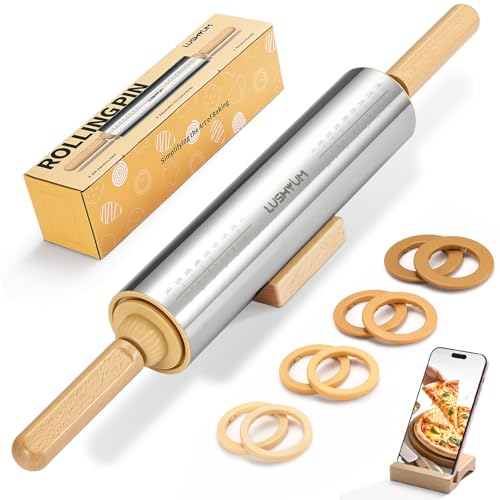
PEASUG and BIDFUL both supply four steps and both write them as inch fractions converted to 2, 3, 6 and 10 mm. LUSHYUM supplies the same four metric steps and gives its inch equivalents as decimals instead, 0.08, 0.12, 0.24 and 0.39 inch. Elsewhere in this pool four other listings publish the same four fractions and convert the second one to 4 mm rather than 3 mm.
BIDFUL does not even agree with itself. Its ring bullet gives the second step as 3 mm and a later bullet about small portions gives the same ring as 4 mm, so one listing carries both conversions. If you bake to a recipe written in millimeters, read the metric figure rather than the fraction, because neither rounding is wrong and a buyer comparing fractions alone would never see the gap.
Length, Barrel and What the Fields Say
One Listing Separates Total Length From Barrel
LUSHYUM is the only pick that publishes both numbers: approximately 20.2 inches in total length with a 10.4 inch stainless steel barrel. That distinction is the most useful thing on this page, because the rolling surface is the barrel and the rest is handles. A pin quoted at 17 inches with handles has less working surface than one quoted at 17 inches without them.
Nobody else makes the split. AGIgear states 19 inches, PEASUG and BIDFUL state 17 inches, and the Folksy pin states 17.5 inches, and in each case the listing leaves you to guess how much of that is rolling surface. PEASUG at least removes the ambiguity a different way, describing a seamless one piece design with no separate handles at all.
Two Dimension Trios That Cannot Be a Pin
PEASUG publishes 17.0 by 17.0 inches in its dimension fields. A rolling pin is not square, and its own bullet states a 17 inch pin, so the second 17 is the first one repeated rather than a measurement. AGIgear publishes 3.34 by 11.0 inches against a stated 19 inches, so its fields reach only 11.0 inches where its own title says 19, a gap of eight inches.
On both this page used the maker’s sentence and left the fields as published. The Folksy pin agrees with itself, publishing 1.5 by 17.52 inches against a stated 17.5 inches, and BIDFUL comes close at 2.75 by 17.32 inches against a stated 17. LUSHYUM publishes 2.5 by 15.7 inches, which sits between its stated 10.4 inch barrel and its stated 20.2 inch total and matches neither.
Steel, Wood and Everyday Cleaning
Chilling a Steel Barrel Before Pastry
Two listings treat temperature as a feature rather than a side effect. LUSHYUM states that the smooth metal barrel stays cool and advises chilling it before rolling buttery pastry or pie crust so the dough stays firm. Elsewhere in the pool another steel pin puts a time on the same advice, suggesting thirty minutes in the fridge before rolling butter based dough.
BIDFUL argues the opposite case for wood, stating that wood does not conduct heat and therefore controls temperature better than a metal pin. Both claims are plausible and neither is measured. What is checkable is that the wooden pin is also the only pick here that publishes no weight, so the trade between a cool barrel and a warm one cannot be weighed against anything.
Two Pins You Must Not Soak
Cleaning splits the same way. The Folksy pin states soapy water and adds that it is dishwasher safe. PEASUG states that it can be rinsed directly with water and is safe for hand washing or the dishwasher. LUSHYUM goes the other way, stating hand wash only, a damp cloth or warm water, no prolonged soaking and prompt drying. AGIgear says only that it is very easy to clean, and names no method at all.
BIDFUL says the same thing more plainly: wipe off flour with a warm damp cloth, avoid soaking the pin in water, then let it air dry. On a beech wood barrel that is the right instruction. For everyday prep, two pins that must not soak are a different daily routine from the two that are cleared for a dishwasher, and AGIgear leaves you to guess which group it belongs to.
Which One Fits Your Kitchen
The most useful spread of steps. Folksy, a published 0.9 lb at a stated 17.5 inches in food grade stainless steel, with five removable silicone rings at 2, 3, 5, 8 and 10 mm, dimensions marked on the surface, and stated dishwasher safe.
Thick dough more than thin. AGIgear, a published 1.01 lb at a stated 19 inches in food grade 304 stainless steel, with three detachable rings at an eighth, a quarter and half an inch, a step none of the other four here offers.
A pin that stores as one piece. LUSHYUM, a published 1.2 lb, a stated 20.2 inches overall with a 10.4 inch barrel, four pairs of rings at 2, 3, 6 and 10 mm, wooden handles that unscrew and store inside the barrel, and a stand that also holds a phone.
Nothing to unscrew or lose. PEASUG, a published 1.1 lb at a stated 17 inches, seamless and one piece with no handles, four rings at 2, 3, 6 and 10 mm, rinsed under water and stated safe by hand or in a dishwasher.
Dough that must not warm up. BIDFUL, a stated 17 inches of beech wood with four rings at 2, 3, 6 and 10 mm, usable as a plain pin with the rings off, wiped with a warm damp cloth and never soaked. It publishes no weight.
What We Could Not Verify
Every figure above comes from the maker’s own listing text. These are the things we went looking for and could not source in any of them.
- No listing publishes the barrel diameter, which is what decides how much dough one pass covers.
- Only LUSHYUM separates total length from barrel length, so on four of these five the rolling surface is unknown.
- Only the Folksy pin names its ring material, so what the other four rings are made of is unstated.
- The same fraction is converted to different metric figures across this pool, and no listing explains the rounding.
- BIDFUL publishes no weight at all, so the wooden pin cannot be compared with the four steel ones.
- No listing states how tightly a ring grips, so whether a ring slips under pressure is not addressed anywhere.