How the Five Compare on the Numbers
Every pressure cooker sold for weeknight cooking makes a speed claim, and almost none of them publishes the figure that speed comes from. Pressure is that figure. Of these five, MICHELANGELO publishes 9 PSI and 15 PSI as two selectable levels and Peterboo publishes 11.6 PSI. The other three publish a percentage instead, measured against a baseline each one chooses for itself.
The baselines are not the same. Instant Pot says up to 70 percent faster compared to slow cooking. Ninja says up to 2x faster and footnotes it against traditional slow cooking. T-Fal says up to twice as fast as conventional methods. Peterboo says 50 percent faster than traditional cooking. Read together those numbers look like a ranking and they are four different measurements.
The row that matters most for a Tuesday is the one almost nobody fills in. Pressure build time is dead time: the cooker is on and nothing is cooking. Ninja is the only listing of the five that admits its timings exclude it, in a footnote attached to rice in as little as 8 minutes and quinoa in as little as 5 minutes. The other four publish no build time, no excluded time and no explanation.
Pressure, Published and Unpublished
The two cookers that give a figure
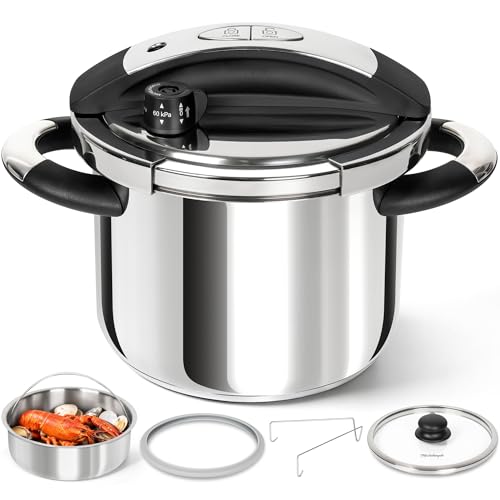
MICHELANGELO publishes two selectable levels, 9 PSI stated as 60 kPa for vegetables, seafood and steaming, and 15 PSI stated as 100 kPa for beans, rice, stock, stews and tougher meats. That is the only listing here that connects a pressure to a food, and it is the most useful sentence in this pool. It also means one dial choice changes the cooking time of the same recipe.
Peterboo publishes a single figure, 11.6 PSI, and describes it as balanced pressure cooking. That sits between the two MICHELANGELO settings, and for a 4.2 quart pot serving two or three people it is a sensible single choice. What neither listing publishes is a time table, so the PSI figures tell you what the pot does without telling you how long anything takes.
What the electric cookers publish instead
Instant Pot and Ninja both describe programs rather than pressures. Instant Pot publishes 7 cooking functions and 13 one touch options, an easy release steam switch, and a stainless steel pot with a tri-ply bottom. Ninja publishes nine functions including sous vide, a removable pot it says goes to the table, and a capacity it describes as fitting a 4 lb chicken or a 5 lb roast.
Neither states an operating pressure anywhere in its published text. For a weeknight that is a real gap, because the setting a program uses is the thing that decides whether beans take twenty minutes or fifty. What you get instead is a program name, which is a promise that somebody has chosen a pressure for you and will not say what it was.
Countertop or Stovetop for a Weeknight
What each format publishes about space
The two electric cookers are the heaviest here and one of them will not say how large it is. Instant Pot publishes 12.6 by 13 by 12.2 inches and 14.6 pounds. Ninja publishes 15.87 pounds and no dimensions at all, which for an appliance that lives permanently on a counter is the figure a buyer most needs. Its own listing calls the design space saving without measuring it.
The stovetop cookers publish less weight and more variation. Peterboo is the lightest of the five at 4.5 pounds, T-fal publishes 7.7 pounds, and MICHELANGELO publishes 11.44 pounds with no dimensions. A stovetop pot goes in a cupboard between meals, so weight is about lifting it down rather than about counter space.
Time to pressure, indirectly
No listing here publishes a time to pressure, so the only clues are construction. MICHELANGELO publishes a 7 mm tri-ply base and says it keeps the base flat on the burner. Instant Pot publishes a tri-ply bottom without a thickness. Peterboo describes a U shaped cooking area for faster heat transfer. T-fal and Ninja publish nothing about the base at all.
Those are the figures a fast weeknight actually depends on, and they are stated as constructions rather than as times. A thick base spreads heat and takes longer to warm; a thin one heats quickly and scorches. Neither behavior is published for any of these five, so the base description is as close as this category comes to an answer.
Safety, Lids and What Gets Washed
How each one describes its lid
The lid is where these five differ most in their own words. T-fal publishes a five point safety system, a lid that opens and closes with one hand, and an adjustable pressure valve it contrasts with small removable weights. MICHELANGELO publishes a pressure indicator, an upward steam vent, a max fill guide and an overpressure window, and a selector that turns with one hand.
Peterboo publishes a pressure indicator, a pressure regulator and an emergency release valve, and describes the indicator rising and falling to lock the lid. Instant Pot publishes an easy release steam switch. Ninja publishes hands free steam release as part of its function list. Every one of these is a safety description and none of them is a standard, so they cannot be compared.
Cleaning on a weeknight
Two of the five publish a dishwasher statement and both come with a condition. T-fal states the stainless steel pot is dishwasher safe and adds a 10 year warranty on that pot. Peterboo states dishwasher use is fine but the sealing ring must come out first and be washed by hand, which is the sort of detail that only appears once you own the thing.
Instant Pot, Ninja and MICHELANGELO publish no dishwasher guidance in their feature text. MICHELANGELO does state an uncoated stainless cooking surface, which is the relevant fact for scrubbing, and Ninja states that its pot is removable and goes to the table. For a pot that has just held a stew, whether it can go in a machine is worth more than a program count.
Which One Fits Your Kitchen
The cook who wants the pressure named. MICHELANGELO publishes 9 PSI for vegetables and seafood and 15 PSI for beans and stews, a 7 mm tri-ply base and an uncoated 18/8 stainless interior. It also takes a glass lid and a steamer basket, so it works as a stockpot between pressure meals.
The small household. Peterboo publishes 11.6 PSI in a 4.2 quart pot for two or three people, at 4.5 pounds, the lightest of the five. Its dishwasher note is specific: the sealing ring comes out and is washed by hand before the rest goes in.
The cook who wants programs, not decisions. Instant Pot publishes 7 functions, 13 one touch options and 12.6 by 13 by 12.2 inches of counter, at 14.6 pounds. Its 70 percent figure is measured against slow cooking, so read it as a comparison with a slow cooker.
The cook feeding a crowd on a Tuesday. Ninja publishes 6.5 quarts, nine functions, and rice in as little as 8 minutes with a footnote saying that excludes pressure build and release. It publishes 15.87 pounds and no dimensions, so measure your own counter.
The cook who wants one pot and one lid. T-fal publishes 6.3 quarts, 11.35 by 14.47 by 8.89 inches, 7.7 pounds and a five point safety system, with a one hand lid and a dishwasher safe pot carrying a 10 year warranty. There are no programs to learn.
What We Could Not Verify
All of the above is from the makers’ published text. These are the figures that are not in it.
- No operating pressure from three of the five, including both electric cookers.
- No time to pressure from any of the five, which is the dead time in a weeknight meal.
- No dimensions at all from two of the five, one of them a countertop appliance.
- No common baseline behind the speed claims, so 70 percent and twice as fast are not comparable.
- No cooking time table for any listed food from any of the five.
- No gasket life or replacement interval, although one listing requires the gasket be removed for washing.