How the Five Compare on the Numbers
Only one of these five is built the way a breakfast sandwich is built. Hamilton Beach layers bread, cheese and meat in a lower compartment, adds an egg above it, closes the lid, and then pivots the center cooking plate out so the stack drops together. It publishes a 24 square inch cooking surface and a built in timer with an audible tone. The other four press a sandwich flat.
Published power exists on three listings and in three different states. Imusa states 1200 W outright. Aigostar states 750 W and calls it a motor, which a heating element is not. Chefman’s wattage sentence is cut off at 1000 with no unit attached. Hamilton Beach and BLACK+DECKER publish no wattage at all. BLACK+DECKER is the heaviest of the five at 6.2 pounds.
What the table cannot tell you is cooking time on four of the five, because only one publishes a figure and that figure is a claim rather than a setting. Nor does it tell you the depth of the sandwich cavity on any of them, which is what decides whether a bagel fits. Chefman is the only listing that addresses thickness at all, through a floating hinge it says adjusts to thick or thin.
Stacking Versus Pressing
The One Machine Built Around an Egg Layer
The Hamilton Beach is a different machine from the other four and its listing describes the sequence in four steps. Bread, cheese or meat go in the bottom layer, an egg goes above that if you want one, a second slice of bread caps it, and the lid closes. The center cooking plate then pivots out and the stack settles into a finished sandwich in one movement.
That mechanism is what the search term describes, and it is also the only pick with a timer. There are up and down arrows, power and preheat lights, and an audible tone when the cooking time is up, which matters because a cooked egg is a timing problem rather than a pressure problem. Five minutes or less is the claim, and the machine weighs 3.75 pounds.
Four Presses and What They Do Instead
Chefman is the most flexible of the four presses. It opens to a full 180 degrees so both plates lie flat, turning 5.5 by 8.75 inches of closed sandwich space into 10 by 8.75 inches of grill, and a floating hinge takes up the difference between a thin sandwich and a thick one. There is a removable drip tray at the back and skid resistant feet that tilt the unit to drain grease.
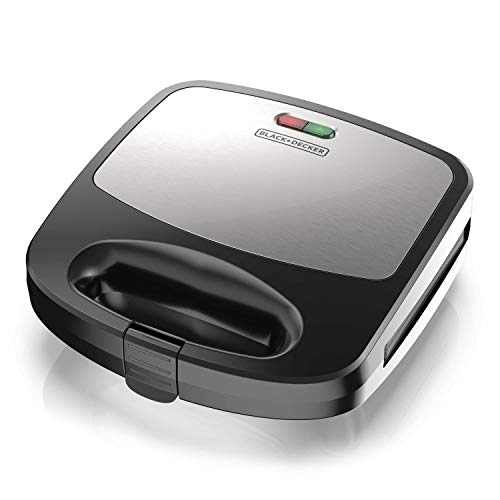
Imusa keeps the lid on top but makes the gap adjustable, with height settings and a locking clip that also holds it shut for storage. BLACK+DECKER swaps the plates instead, with waffle, grill and sandwich sets that snap in while the unit is cool. Aigostar does none of these and simply closes on the sandwich with a cool touch locking handle.
Cooking Surface, Power and Timers
Three Listings Publish an Area and Two Do Not
Hamilton Beach publishes 24 square inches of cooking surface, which is the only figure in this pool expressed as an area rather than as two sides. Chefman publishes both of its states, 5.5 by 8.75 inches closed and 10 by 8.75 inches flat, which is the most complete answer here because it covers the sandwich job and the grill job separately.
Imusa publishes its size three times and gets three answers. A feature says the press measures 11 by 6.5 inches, the size field says 12 by 10 inches, and the dimension fields say 6.22 by 14.17 by 11.73 inches. The 11 by 6.5 figure reads like the plate and the rest read like the appliance, but nothing on the listing says so, and BLACK+DECKER and Aigostar publish no plate size at all.
Wattage in Three Different Conditions
Imusa is the only listing to publish a clean wattage, 1200 W, and it is also the only one with a temperature knob to spend that power deliberately. Aigostar publishes 750 W and describes it as a motor with an automatic thermostat, which suggests the listing text was not written by anyone who knew what part was being described.
Chefman’s power figure is there and unusable. Its last feature ends with the number 1000 and then stops mid sentence, with no unit, so it cannot be read as watts with any confidence. Hamilton Beach and BLACK+DECKER publish no power figure at all, which on the Hamilton Beach matters less because it publishes a timer instead, and on the BLACK+DECKER means a waffle plate arrives with no heating specification.
Cleaning, Plates and Storage
Removable Plates Versus a Damp Cloth
Two picks let you take the cooking surfaces out. Hamilton Beach states that its nonstick, PFAS free cooking components remove for the dishwasher or wipe clean with a soapy cloth, and it is the only listing in this pool to make a PFAS claim. BLACK+DECKER’s plates are removable because they are interchangeable, and are stated dishwasher safe with a warning against metal utensils and aerosol sprays.
The other three are fixed. Chefman compensates with a removable drip tray and feet that tilt the grease toward a drain at the back, which is the best fixed plate arrangement here. Imusa states nonstick plates over cast aluminum and gives no cleaning method at all. Aigostar tells you to wipe with a damp cloth once cool, which on a fixed plate press is the whole routine.
Where These Go When You Are Done
Two listings publish a storage position. Imusa has a locking clip that holds the press closed, and Aigostar states that it stands upright and takes minimal cabinet space. Hamilton Beach calls its design compact and square and claims it saves counter space compared with traditional sandwich appliances, without giving a stored size.
The dimension fields are the only guide for the rest. BLACK+DECKER is 9 by 9 by 4 inches, the squarest of the five, and also the heaviest at 6.2 pounds because it carries three sets of plates. Chefman’s fields read 12 by 10 by 5 inches and Imusa’s 6.22 by 14.17 by 11.73, and Aigostar publishes no weight at all to go with its 9.17 by 9.33 by 3.5 inch fields.
Which One Fits Your Kitchen
You actually want a breakfast sandwich. Hamilton Beach is the only pick that stacks one, with a separate egg layer, a pivoting center plate, a built in timer with an audible tone, 24 square inches of surface and PFAS free removable parts for the dishwasher.
Sandwiches on weekdays, burgers at weekends. Chefman opens to 180 degrees, turning 5.5 by 8.75 inches of press into 10 by 8.75 inches of flat grill, with a floating hinge for thick fillings, a removable drip tray and UL approval with one year of support.
Paninis with control over the heat. Imusa publishes 1200 W and a temperature knob, cast aluminum plates under nonstick, adjustable height settings and a locking clip for storage. It is the only pick here that lets you choose a temperature.
One appliance, three jobs. BLACK+DECKER swaps between waffle, grill and sandwich plates that snap in cool and go in the dishwasher, behind a preheat light and a heat resistant handle. At 6.2 pounds it is the heaviest here, and it publishes no wattage.
A dorm room or a tight cupboard. Aigostar publishes 750 W, a cool touch locking handle, two indicator lights and upright storage, and asks only for a damp cloth to clean. It publishes no weight and no plate size, so buy it for the footprint.
What We Could Not Verify
Six things a buyer would want from these five listings and cannot get.
- Two of the five publish no wattage at all, and a third publishes a sentence that stops at the number 1000 without a unit, so power cannot be compared across the group.
- No listing publishes the depth of its sandwich cavity, so whether a bagel or a thick roll fits is unstated on all five.
- Two of the five publish no cooking surface figure, and a third publishes three different sizes on one listing without saying which describes the plate.
- Only one publishes a cooking time, and it is stated as five minutes or less rather than as a setting the machine holds.
- Aigostar publishes no weight and describes its 750 W heating element as a motor, so its own specification text cannot be read literally.
- A sixth listing in this category is not an appliance at all. It is a stainless steel toaster cage whose own feature text describes a baking net rack for cooling cakes, and it was excluded for that reason.