How the Five Compare on the Numbers
Cleaning a proofing basket is not one job. It depends entirely on what the basket is made of, and these five are made of three different things. Two are silicone and go in the dishwasher. Two are rattan and are brushed out. One is spruce wood pulp and must never be washed with water at all, which is the most specific cleaning instruction in this whole category.
So the deciding specification here is the washing method each maker publishes, and how much detail it comes with. Bulka publishes a drying temperature and a time. yeatruojeet publishes a routine for the basket and a separate one for its liner. HEBEICRMY and JOCXSPI publish dishwasher permission and a temperature range. GIONG publishes nothing about cleaning.
What the table cannot tell you is how any of these behave after a summer of humid weather, and not one of these five publishes a word about mold, storage humidity or how long a basket lasts. Two of the five also publish no cleaning instruction worth the name, which on a flour-filled object used weekly is the gap that matters.
Three Materials, Three Different Routines
The basket that must stay dry
Bulka publishes the strictest instruction in this category and the most useful: do not wash with water. To clean it, dry the basket with residual oven heat at 210 to 250 F for half an hour, then brush the flour off. That is a real procedure with a temperature and a duration, and it exists because the basket is spruce wood pulp bound by its own lignin.
The same construction is the reason for the instruction. Bulka publishes thick wood pulp walls that insulate the dough and draw moisture off its surface, sized for a 750 g loaf in an 11.4 inch oval at 0.82 pounds. Wet that material and you undo it, so the cleaning rule is not fussiness, it is how the basket works.
The two that go in the machine
HEBEICRMY publishes four silicone baskets measuring 10 by 6.8 by 3.54 inches, dishwasher safe, with a stated range of -40 F to 428 F so the same basket goes from a cold proof to the oven. It publishes a reinforced support ring to hold the shape under high hydration dough and two integrated handles for moving it.
JOCXSPI publishes a silicone pair, a 9 inch round and a 10 inch oval, with two clear lids, rated to 450 F and either rinsed in seconds or put in the dishwasher. Both fold flat. For a baker who wants proofing to be a wipe rather than a ritual, these two are the only answer on this page.
What Rattan Actually Asks For
The routine, published in full
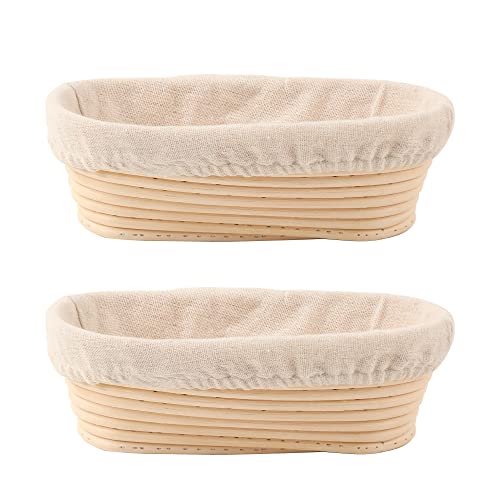
yeatruojeet publishes the fullest rattan instruction here, and it is in two parts. The basket: shake the excess flour out after each use, and if dough sticks, wait until it dries and then take it off with a stiff brush. The liner: soak it in warm water for two minutes, hand wash, then dry it.
That split is the honest description of owning a rattan banneton. The cane is never really washed, it is brushed, and the washable part is the cloth. yeatruojeet pairs that with a 1 pound dough capacity on a 10 inch basket, which is the only capacity figure among these five apart from Bulka’s 750 g.
The listing that says nothing
GIONG publishes two 9.5 inch rattan baskets with liners at 0.82 pounds, and nine bullet points about airflow, moisture absorption, crust appearance and Vietnamese handicraft. Not one of them says how to clean it. A buyer who has never owned a rattan basket would come away thinking it needs no care at all.
In practice it will need the same treatment as any other rattan basket, and the absence of instructions is the reason it sits last on this page rather than the reason to avoid it. The baskets themselves are documented in other ways: the fields publish a package of 6 by 10 by 3 inches, and the maker states the rattan absorbs moisture from the dough.
Cleaning, Capacity and What You Give Up
Silicone buys convenience and loses moisture
The trade between these materials is not about effort alone. Rattan and wood pulp are both sold specifically for drawing moisture off the surface of the dough, which is what gives a scored loaf a crisp crust. Silicone does the opposite: it is non-porous, so nothing is wicked away and the dough surface stays as wet as it was.
JOCXSPI and HEBEICRMY both answer that with versatility instead, going straight into the oven at 450 F and 428 F respectively, which no rattan basket can do. Neither publishes a dough weight, so matching a recipe to the basket means comparing a 10 inch length against a shaped loaf and hoping.
How many baskets, and how they store
HEBEICRMY publishes four baskets at 2.2 pounds for the set and JOCXSPI two with two lids at 1.51 pounds, and both fold flat, which is a storage answer rattan cannot give. yeatruojeet and GIONG both publish pairs at 0.86 and 0.82 pounds, and Bulka publishes a single basket.
For an easy-clean setup that is a real decision. Four silicone baskets can go through a dishwasher cycle together after a big bake. Two rattan baskets need brushing individually and their liners washed separately, and one wood pulp basket needs half an hour of oven time it cannot share with anything else.
Which One Fits Your Kitchen
The baker who wants to stop scrubbing. HEBEICRMY publishes four silicone baskets at 10 by 6.8 by 3.54 inches, dishwasher safe, rated -40 F to 428 F with a reinforced support ring and two handles. They fold flat, and the whole set is 2.2 pounds.
The baker who wants a lid as well. JOCXSPI publishes a 9 inch round and a 10 inch oval in silicone with two clear lids, rated to 450 F, dishwasher safe or rinsed in seconds, folding flat at 1.51 pounds. The lids let you watch a proof without lifting anything.
The baker chasing a crackly crust. Bulka publishes a spruce wood pulp basket of 11.4 inches for a 750 g loaf at 0.82 pounds, and the instruction that makes it work: no water, dry at 210 to 250 F for 30 minutes, then brush.
The baker who wants rattan, documented. yeatruojeet publishes two 10 inch rattan baskets holding 1 pound of dough each, with a liner, and the clearest care routine on any rattan listing here: shake, dry, brush, and wash the liner separately.
The baker buying a pair to start with. GIONG publishes two 9.5 inch rattan baskets with liners at 0.82 pounds and a package of 6 by 10 by 3 inches. Expect to brush them out, because the listing itself never says how they are cleaned.
What We Could Not Verify
All the figures above come from these makers’ own listings. Here is what they leave out.
- No cleaning instruction at all from one of the five.
- No word about mold or storage humidity from any of the five.
- No dough weight from the two silicone sets.
- No drying time from either silicone set, only a claim that they dry quickly.
- No statement of whether the liner is included on the wood pulp basket.
- No expected lifespan from any of the five, in bakes or in years.