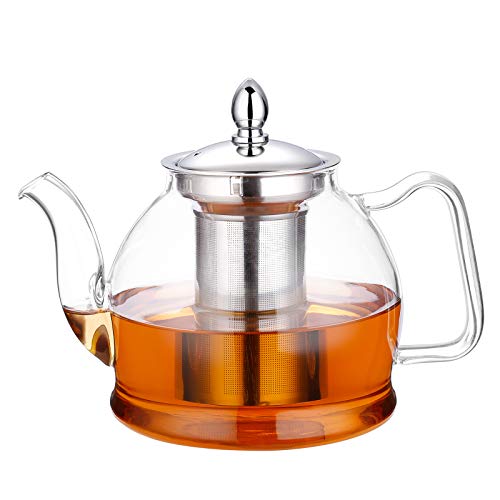
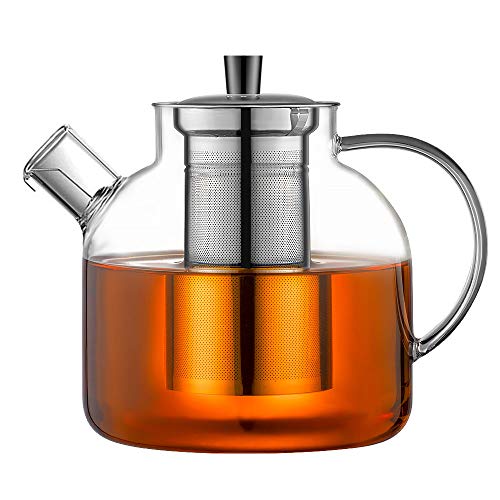
How the Five Compare on the Numbers
A pour over kit needs hot water in the vessel, so the first question about a glass teapot is what you are allowed to heat it on. Four of these five publish a stovetop claim. One publishes none at all, and its listing is the only one here that never mentions heat except to say the glass is heat resistant.
The conditions attached matter as much as the permission. HIWARE publishes a medium heat source and a fill limit of 1000 ml. Aquach publishes a trivet rule and a warning against dry burning. STNTUS publishes a range of -20 C to 150 C and a water level scale on the glass. PARACITY publishes -68 F to 302 F.
What the table cannot give you is a spout figure. Not one of these five publishes a spout diameter, a pour rate or an angle, which for a kit built around controlled pouring is the missing specification. Three of them describe the spout in words instead: non-dripping, eagle beak, and drip-free.
What Each Maker Lets You Heat
The two with real instructions
HIWARE publishes the longest list of heat sources in this pool: microwave, gas and electric stovetops at a medium level, reheating by either route, an open flame tea warmer, and the refrigerator or direct sunlight for cold brewing. It then publishes the limit that makes the rest safe, which is not to fill beyond 1000 ml while boiling.
Aquach publishes fewer routes and better care. Gas or electric ranges, with two conditions stated plainly: do not let the pot burn dry when empty, and stand it on a dry trivet rather than a cold surface when it comes off the heat. Thermal shock is how borosilicate pots actually break, and Aquach is the only listing here that names the mechanism.
The two with numbers instead
STNTUS publishes a range rather than a routine, -20 C to 150 C, and adds the most practical feature in this group: a water level scale marked on the glass itself. On a 1200 ml pot described as four to six cups, being able to see the level while pouring water in is worth more than another bullet about materials.
PARACITY publishes -68 F to 302 F alongside stovetop, microwave and dishwasher permission on a 20 ounce pot it says brews one to two cups. A 302 F ceiling is below the temperature of a dry burner, which is the reason every listing that permits a stovetop also asks for moderate heat, whether or not it says so.
The Pot You Should Not Heat
What Primula publishes instead
Primula publishes a 40 ounce pot in heat resistant borosilicate glass with a protective holder, a non-slip silicone base, a drip-free pour spout and a removable fine mesh stainless filter, and its instructions are to add tea, pour in hot water slowly and let it brew. There is no stovetop claim, no microwave claim and no temperature figure anywhere.
That is a coherent design rather than an omission. A pot with a silicone base and a plastic holder is built to receive boiling water from a kettle, which is exactly what a pour over kit does, and Primula publishes the one thing none of the others does: the entire teapot is dishwasher safe, not just the top rack, and not with a caveat.
Why the distinction matters in a kit
If you already own a kettle, direct heat is a feature you will use once. The pot’s real job is to hold near-boiling water without cracking and to release it cleanly. Judged that way, Primula’s silicone base and drip-free spout do more work than PARACITY’s 302 F ceiling, and its 1.1 pound weight sits in the middle of this group.
If you do not own a kettle, the calculation reverses completely and only HIWARE, Aquach, STNTUS and PARACITY are candidates. HIWARE is the one that publishes both a stovetop route and a microwave route with instructions for each, which makes it the most flexible of the four on paper.
Capacity, Washing and the Figures That Do Not Fit
From one cup to a table of eight
Capacity ranges further here than on any other axis. PARACITY publishes 20 ounces and calls it one to two cups. HIWARE publishes 1000 ml, also given as 33 ounces. STNTUS and Primula both publish 40 ounces, with STNTUS adding four to six cups. Aquach publishes 85 fluid ounces, also given as 2500 ml, for group servings.
Aquach is also the only one that publishes the figures a pour over routine needs: 8.5 inches tall so it fits a refrigerator shelf, and a 4.3 inch opening, which is what decides whether a gooseneck kettle spout can reach inside comfortably. Nobody else publishes either figure.
Where a dimension field is nonsense
PARACITY publishes dimension fields of 21.65 by 19.29 by 18.5 inches for a pot it describes as holding 20 ounces and brewing one to two cups. No 20 ounce teapot is a foot and a half in any direction, and this page uses the capacity and the weight of 0.7 pounds instead, which together make it the smallest object in this group.
The other four publish fields that describe a teapot. HIWARE’s 5 by 5.3 by 9 inches and STNTUS’s 5.31 by 5.31 by 9.06 are both tall narrow bodies, Aquach’s 8 by 6 by 8 matches the 8.5 inch height it states in words, and Primula’s 7.25 by 5.75 by 6.75 fits a wide pot with a side holder.
Which One Fits Your Kitchen
The kit with no separate kettle. HIWARE publishes a 1000 ml pot at 1.21 pounds that can go on gas or electric at medium heat, into a microwave, onto a tea warmer or into the refrigerator, with an instruction not to fill past 1000 ml while boiling.
The kit that serves a table. Aquach publishes 85 fluid ounces at 1.8 pounds, 8.5 inches tall with a 4.3 inch opening, stovetop safe with a trivet, refrigerator safe for cold brew, and every part dishwasher safe. It is the only listing that explains how these pots break.
The cook who wants to see the level. STNTUS publishes 1200 ml as four to six cups with a water level scale on the glass, a range of -20 C to 150 C, and a thickened handle, at 0.95 pounds. It permits a dishwasher and then asks you not to use one.
The one or two cup brewer. PARACITY publishes 20 ounces, or 650 ml, at 0.7 pounds, with -68 F to 302 F, stovetop and microwave use, an eagle beak spout and a wide mouth for hand washing. Ignore its dimension fields entirely.
The kit built around a kettle. Primula publishes a 40 ounce pot at 1.1 pounds with a protective holder, a non-slip silicone base, a drip-free spout and a removable mesh filter, and the entire pot is dishwasher safe. It publishes no heat source of any kind.
What We Could Not Verify
All the figures above come from these makers’ own listings. Here is what they leave out.
- No spout diameter, pour rate or angle from any of the five.
- No temperature figure from three of the five, including two that permit a stovetop.
- No opening diameter from four of the five, which decides kettle access.
- No height from four of the five, so refrigerator fit is unknown.
- No usable dimension fields on one of the five.
- No infuser depth or mesh size from any of them, only the steel grade.