How the Five Compare on the Numbers
Four of the five live pages on this pool already rank on stated heat resistance, and for good reason: the figures are printed on almost every listing. What none of them looks at is the other half of daily use, which is that a handle cover sits where fat spits and gets picked up with greasy hands. Every one of these five publishes a cleaning instruction, and no two of them say the same thing.
CALIDAKA is the only cotton cover and it names a cycle. Webake states dishwasher safe. Patelai and EVAHOM both offer a sink or a dishwasher. PDETVEO says wipe clean or wash with soap and water. Three of the five also publish a warning attached to the cleaning, and those warnings are more specific than most of the heat claims on this sheet.
What the table cannot tell you is how any of these behaves after twenty washes. No listing publishes a wash count, a shrinkage figure or a statement about the grip texture wearing down, and the cotton cover is the only one that says a cleaning method can damage it at all. Nor does any listing here state how tightly the sleeve grips once the silicone has been through a dishwasher.
What Each Maker Says to Do With a Greasy Cover
One Cotton Cover and One Named Wash Cycle
CALIDAKA is the only cover on this page that is not silicone, and that changes the cleaning question entirely. It states a cotton blend with a terry cloth lining, detailed stitching on the edges so it is not easy to tear, and that the sleeve is washable and reusable. Then it gives the cycle: machine wash with cold water on gentle, and tumble dry low.
It is also the only listing in this pool that says what will ruin it. Do not bleach and do not run it through a hot dryer, the listing states, because that will damage the cover. On a page where three listings publish a heat limit to the degree and none of them says how to wash the thing, that instruction is the most practically useful sentence here.
Three Silicone Sleeves and a Dishwasher
Webake makes the cleanest claim: food-grade silicone, and dishwasher safe, stated without a caveat. Patelai and EVAHOM both say the same thing at greater length and add a sink as an alternative, each attributing it to a smooth non-stick surface that stops food residue lingering, and each stating the sleeve can be washed by hand in warm water or by dishwashers.
PDETVEO is the vaguest of the five. It states that the sleeve is sturdy, resists deformation from high heat, and can simply be wiped clean or washed with soap and water. That is two methods and no detail, and nothing about a dishwasher, which for a silicone part is the question most buyers actually have.
The Fit Nobody Publishes Except Two
A Handle Length Range and an Inner Diameter
Webake opens its listing with the figure that decides whether the purchase works: a handle length of 4.4 to 5.4 inches and a width no greater than 1.15 inches, with a warning that a handle shorter than 4.4 inches may be loose and unsafe and a wider one may not fit properly. That is the only stated fit envelope in this pool and it is stated before anything else.
PDETVEO publishes the other kind of fit figure, an inner diameter of 3 cm which it also gives as 1.2 inches, for the round handle of a Chinese wok. It is the only inner diameter published here, and it is also the reason this listing is a different product: a flat cast iron skillet handle is not a 30 mm rod.
A Thickness Figure That Cannot Be a Sleeve
Webake is the only listing that publishes its own thickness, 0.5 inches, alongside 5.4 by 1.15. Against that, Patelai’s dimension fields read 2.24 by 5.3 by 0.04 inches and EVAHOM’s package fields read 1.57 by 3.66 by 0.01. A sleeve that a 1.15 inch handle slides into is not four hundredths of an inch thick, and it is certainly not one hundredth.
Several other listings in this pool carry the same flat figure, so it looks like a field filled in from a flattened sleeve or left at a default. This page quotes those triples only as what they are and ranks nothing on them. Where a maker writes the size into a sentence, as Webake and PDETVEO both do, that sentence is used instead.
Heat Limits and Where They Disagree
446 at One End and 475 at the Other
Three of the five publish a limit and they are close together. EVAHOM states 475 degrees F or 250 degrees C, Patelai 464 degrees F or 240 degrees C, and Webake states not to use the sleeve above 230 degrees C, which it converts to 446 degrees F. All three conversions are consistent at the hot end, so the figures can be compared directly.
CALIDAKA publishes no figure at all, which is awkward because it makes a comparative claim instead: the thick cotton material, it states, gives better heat resistance and durability than a silicone skillet handle cover. That may be true and there is nothing on the listing to check it against. PDETVEO also publishes no number, stating only that its heat resistance is superior.
One Listing Whose Cold Limits Do Not Convert
Patelai states its range as -104 to 464 Fahrenheit and, in the same breath, -40 to 240 degree centigrade. The hot ends agree. The cold ends cannot, because -40 degrees C is the one temperature that reads the same on both scales, so it is -40 degrees F and not -104. One of the two cold figures is wrong and the listing gives no way to tell which.
It matters less than it would on a hot limit, because nobody freezes a handle cover, and it is worth naming because Aissmmeio publishes the identical silicone specification elsewhere in this pool and states only the Celsius range. Where two listings describe the same part and one of them adds a figure that does not convert, the figure is the thing to drop.
Which One Fits Your Kitchen
You want the cover in the wash, not the sink. CALIDAKA publishes a cotton blend with a terry lining, four pieces at a stated 6 by 3 inches, machine washable cold on gentle with a low tumble dry, and states that bleach or a hot dryer will damage it.
You want to know it fits before it arrives. Webake publishes a handle length of 4.4 to 5.4 inches and a width up to 1.15 inches, a sleeve of 5.4 by 1.15 by 0.5 inches, dishwasher safe food-grade silicone and a hanging hole, with a 446 degree F limit.
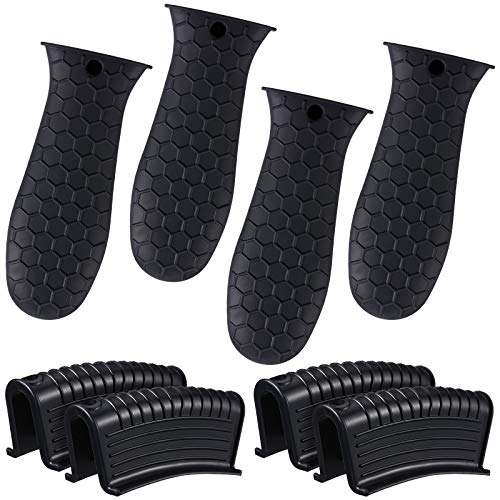
You have two pans with two handles each. Patelai publishes eight pieces, four main sleeves at 5.3 by 2.24 inches and four assist brackets at 3.6 by 1.6, with a honeycomb grip, a hanging hole and washing by hand or dishwasher, at 0.67 pounds for the set.
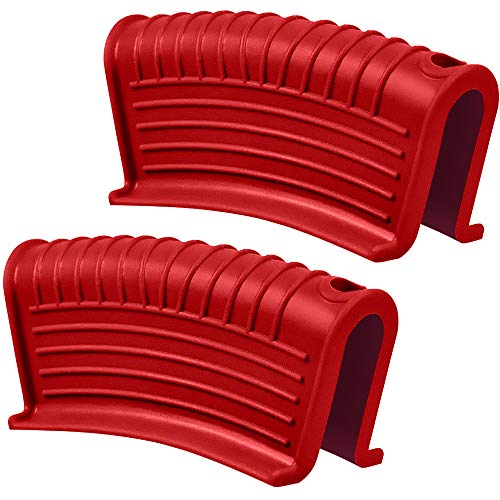
You only need the assist loop covered. EVAHOM publishes two assist handle holders with an internal protruding stripe to stop them loosening under a heavy pan, rated to 475 degrees F, washable in warm water or a dishwasher. It publishes no sleeve size.
Your pan handle is a round wok handle. PDETVEO publishes a 3 cm or 1.2 inch inner diameter on a sleeve stated at 14 cm by 3.6 cm, which it also gives as 5.5 by 1.42 inches, with an anti-slip particle texture and a wipe or soap-and-water clean.
What We Could Not Verify
These are the figures the five listings do not publish, or publish twice in ways that disagree, and nothing above has been supplied in their place.
- No listing publishes a wash count, a shrinkage figure or anything about the grip wearing.
- CALIDAKA publishes no heat limit while claiming better heat resistance than silicone.
- PDETVEO publishes no heat limit, only that its heat resistance is superior.
- A credible thickness from four of the five, since Webake publishes the only one and two others carry a 0.04 or 0.01 inch figure instead.
- Patelai states -104 degrees F against -40 degrees C, which are not the same temperature.
- EVAHOM publishes no size for its sleeve and no weight for the pair.