How the Five Compare on the Numbers
A ravioli wheel is a blade, an axle and a handle, and the interesting thing about this pool is how differently the makers describe those three parts. Most listings in this category say stainless steel and move on. Among these five, four name an actual grade, and the grades are not the same: 18/10, 430, 304 and high carbon stainless all turn up in a set of five tools.
What follows from the material is the cleaning rule, and here the pool thins out. Two of these five clear a dishwasher in plain words. The other three publish a method instead, and two of those three have wooden handles that nobody except one listing says anything about keeping dry. That is the specification this page turns on.
What the table cannot tell you is how deep a crimp any of these leaves. Not one listing in this pool publishes a flute count or a flute depth, and the flutes are the whole point of a ravioli wheel: they seal the dough as well as decorate it. Nor does any listing publish a blade thickness, so the four named steel grades cannot be compared on anything but the name.
Four Steel Grades in One Drawer
18/10, 430 and 304
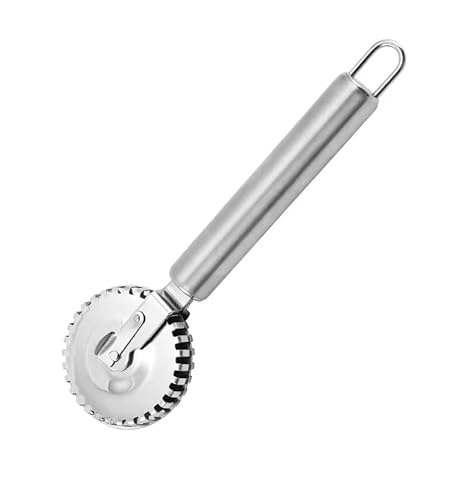
Kuchenprofi names 18/10 stainless steel and calls it a material used by professional chefs in some of the finest kitchens in the world, then states in the same bullet that the utensil is dishwasher safe. The tool is all metal, stated at 7 inches with published fields of 1.5 by 2 by 7.75, and the listing dates the brand to Germany in 1923.
MyHoome names 430 and yayaboqu names 304, which are different alloys with different corrosion behavior, and both listings tie the number to rust resistance rather than to sharpness. yayaboqu goes further than either of the others on materials, naming 304 stainless, food grade zinc alloy and a contoured wood handle as three separate components of one tool.
High Carbon and Unnamed
LLMSIX takes the fourth route, stating a high carbon stainless blade and tying it to sharpness and durability rather than to corrosion. That is a real distinction: a higher carbon content buys an edge and costs some rust resistance, which sits oddly beside the listing’s own instruction to rinse the wheel under water after every use and its silence about drying it.
XINBADA is the only one of the five that leaves the grade out, describing polished stainless steel that resists rust and an axle that keeps the wheel from wobbling. Across the wider pool that is the norm rather than the exception, and several listings name no material at all beyond stainless steel and a wooden handle.
The Handle Decides the Washing Rule
Two Listings Say Dishwasher
The two picks that clear a dishwasher are also the two with no wood in them. Kuchenprofi is stainless throughout, and MyHoome names no handle material at all while describing an ergonomic grip. In both cases the instruction is a single clause at the end of a materials bullet, which is exactly where a buyer looks for it.
It is worth noting what that costs. An all metal handle has nothing soft to hold, and Kuchenprofi’s own bullet leans on the ergonomic shape rather than on a grip material to make up for it. MyHoome publishes no dimensions whatsoever, so the tool that is easiest to wash is also the one you cannot measure against a drawer.
One Says Dry It Right Away
XINBADA is the only listing in this pool that treats the handle as a part with its own needs. It states that the beech wipes down with a damp cloth, that dense grain resists moisture, and that the tool should be hand washed and dried right away to keep the wood from swelling. That is three sentences about wood care on a listing for a pastry wheel.
The other two wooden handled picks say nothing of the kind. yayaboqu describes a polished surface that allows quick cleaning and a contoured wood handle, with no note joining the two. LLMSIX tells you to rinse the wheel under water and never mentions the wooden handle attached to it. Both are reasonable tools with an instruction missing.
What the Pool Leaves Unsaid
Brass With No Instructions
A La Gondola listing elsewhere in this pool is made of brass and natural wood, described as made in Italy by skilled artisans, with no cleaning instruction anywhere in the listing. Brass tarnishes, and a brass wheel that has been through dough and then left wet is the one tool in this category that genuinely needs a sentence about care. It does not get one.
A Tredoni listing, also made in Italy, says only that it is super comfortable and easily cleaned, which is an adjective rather than a method. A SHANGSKY wheel pairs zinc alloy with an oak handle and states the grooves do not easily stick to flour dough and are simple to clean, which is closer to useful and still stops short of naming water or a machine.
A Santoprene Handle and a Nulled Weight
Two Norpro listings in this pool publish the most complete sizes in the category, at 7 by 3 by 0.75 inches for one and 7 by 3 by 0.5 for the other, both with dual heads pairing a fluted wheel and a flat one. One names its grip material as Santoprene, the only polymer named anywhere in this pool, and neither publishes a washing rule.
One of those two also carries a weight field close enough to zero that the pipeline discarded it, on a tool whose published dimensions are 3.5 by 8.5 by 1 inches. That is the familiar pattern in this category: real sizes, real materials, and a cleaning instruction that simply was not written.
Which One Fits Your Kitchen
The cook who wants it in the machine. Kuchenprofi names 18/10 stainless and states dishwasher safe in the same bullet, on an all metal cutter and crimper stated at 7 inches with fields of 1.5 by 2 by 7.75 and 0.2 pounds. No wood, no polymer, and no wheel diameter published.
The cook who wants it simple. MyHoome names 430 stainless and says to place the tool in the dishwasher after use, on a cutter that seals, crimps and cuts ravioli, pierogi, dumplings and empanadas in one motion. Published at 0.24 pounds, with no dimensions of any kind.
The drawer you reach into blind. yayaboqu states protected edges to prevent finger cuts, a 2 inch fluted wheel and a 5.5 inch total length, in 304 stainless with food grade zinc alloy and a contoured wood handle. Fields of 1.18 by 5.51 by 0.1 inches at 0.1 pounds, and no dishwasher guidance.
The quick rinse at the sink. LLMSIX states a high carbon stainless blade, that the flutes do not accumulate dirt, and that a rinse under water is enough after use. Published at 0.11 pounds. It publishes no dimensions and says nothing about the long wooden handle it sits on.
The buyer who wants a choice of wheel. XINBADA publishes five variants, with a long or short beech handle and a 2 inch or 1.5 inch crinkle wheel, plus a 3 inch double wheel pairing smooth and crinkle edges. Fields of 3 by 6.5 by 0.1 inches at 0.15 pounds. Hand wash and dry it at once.
What We Could Not Verify
Everything above comes from the makers’ own listings. These are the things a cook cleaning up after pasta needs and the published data does not supply.
- Three of these five publish no dishwasher guidance in either direction, and two of those three have wooden handles.
- MyHoome and LLMSIX publish no dimensions at all, so drawer fit on both rests on the words compact and lightweight.
- No listing in this pool publishes a flute count or a flute depth, so how firmly any of these seals a ravioli is unstated.
- No listing publishes a blade thickness or a hardness, so four named steel grades cannot be compared on anything but their names.
- XINBADA’s own bullet warns that sizes vary across its five variants and asks you to check before ordering, so the wheel you receive is not fixed by the listing.
- A brass and wood listing elsewhere in this pool publishes no cleaning instruction at all, on the one material here that tarnishes.