How the Five Compare on the Numbers
A banneton liner is a circle of cloth. It has no moving parts, no temperature rating worth arguing about and, in four of these five listings, no published thickness. So a page about fitting them into a full baking cabinet has one measured figure to work with, and it is the carton they arrive in.
That turns out to be more interesting than it sounds. Two packs here hold six liners each and publish exactly the same 9.84 inch square footprint, and one carton is eight times as deep as the other. One pack holds a hundred liners in a box thinner than either. One holds four silicone baskets and is the only one of the five that publishes a folded size.
What the table cannot tell you is how thick any of these cloths is on its own. A liner folded into quarters and slid between two baking sheets takes a real amount of room, and no listing on this page publishes a fabric weight, a thread count or a thickness. The carton is a proxy, and it includes the packaging as well as the cloth.
Two Packs of Six, Two Different Cartons
The Same Footprint, Eight Times the Thickness
Boao and Koackl both sell six round cloth liners and both arrive in a 9.84 inch square carton. Boao’s is 0.08 inches deep. Koackl’s is 0.67. That is the clearest comparison on this page because every other variable is held still: same count, same shape, same footprint, and one box you could post through a letterbox against one you could not.
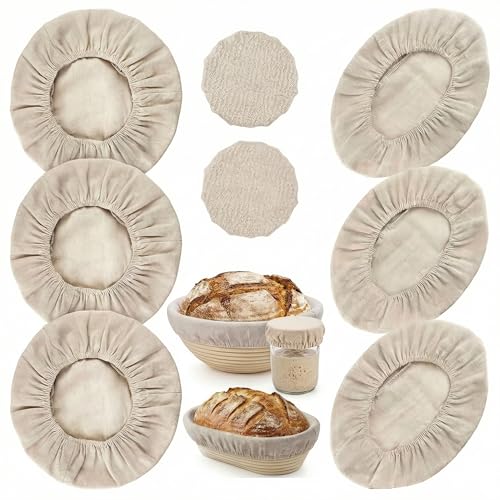
Neither listing publishes a fabric weight, so the explanation has to come from the descriptions. Boao’s liners are untreated flax linen and fabric, stated soft and free of dye. Koackl’s are dense cotton with a textured finish, and the listing ties that texture directly to release: dust with flour and the dough comes away. Density is the likely difference and neither maker measures it.
What a Package Figure Can and Cannot Tell You
A carton includes cardboard, a bag and sometimes an insert, so it overstates the cloth. It also understates the problem, because a liner used once and folded damp does not go back as flat as it arrived. Both effects pull in different directions and neither is published, which is worth saying before anyone plans a drawer around 0.08 inches.
What the figure does do is separate packs that are genuinely different. Thrymme’s carton is 0.28 by 4.03 by 2.79 inches for three liners, whose three figures stop at 4.03 inches where every other pack here reaches 9.84 or more. Boao’s is flatter and wider. Those are two real answers to two different storage problems, and both are measured rather than described.
The Only Pick That Publishes a Folded Size
Silicone Baskets at 10 by 1.3 Inches
Honeydak is the one listing of the five that measures its product in both states. The oval basket is stated at 10.24 by 5.91 by 3.35 inches open and 10 by 1.3 inches once collapsed, and the listing says outright that folded it will fit even the smallest kitchens. Four baskets arrive in four colors, each with a liner of its own.
It is also the only pick with a temperature range, stated safe for a refrigerator, a dishwasher, a microwave and an oven, and the only one that can go from proofing to baking without a transfer. The cost is mass: 2.33 pounds against 0.09 to 0.69 for everything else here, because silicone baskets are not cloth.
A Temperature Pair That Does Not Convert
The same listing states the baskets withstand temperatures from minus 100 to 450 degrees Fahrenheit and gives minus 40 to 230 Celsius in the same bracket. The upper pair is correct. The lower pair is not: minus 40 Celsius is minus 40 Fahrenheit, not minus 100, and the two figures cannot both describe the same limit.
This page quotes the range as published and flags the mismatch rather than picking the flattering end. For a proofing basket the cold end matters, because a retard in a refrigerator is the normal use and a freezer is not far behind. What the listing establishes beyond doubt is that the silicone will take a domestic freezer; how much further is unclear.
A Hundred Liners and Where They Live
One Listing Ships a Storage Bag
ZHIVEZEN is the pack that makes this axis worth measuring. One hundred non woven liners arrive in a carton of 0.75 by 19 by 6 inches at 0.69 pounds, with a storage bag supplied that carries a hang tie, so the whole hundred can hang on a hook rather than occupy shelf. The liners stretch to a stated 21 inches, which covers most basket shapes in one size.
The listing then undermines itself in a way worth naming. It describes the liners as disposable, says there is no need for cleaning, and in the same first bullet states that they can also be washed and reused. A non woven fabric is a single use material by design, so the honest reading is that the pack is disposable and the reuse line is optimism.
Cartons That Cannot Be Right
One of these five figures does not survive a second look. Boao publishes 9.84 by 9.84 by 0.08 inches for six cloth liners, and 0.08 inches is the thickness of a single sheet of fabric rather than six folded ones. Koackl publishes the same 9.84 inch square at 0.67 inches for the same count of cloths, and that is the figure that reads like a real box.
Thrymme’s carton is the other one to read carefully. It measures 0.28 by 4.03 by 2.79 inches and holds three liners stated to fit 9 inch bannetons, so a 9 inch cloth cannot lie flat inside it and has to arrive folded. That is fine for a cloth and good for a shelf corner, but it means the carton figure describes the fold and not the liner.
Which One Fits Your Kitchen
The shallow drawer. Boao publishes 9.84 by 9.84 by 0.08 inches for six round liners for 10 inch baskets, in untreated flax linen stated free of dye, with the cloth itself at 10 by 3.15 inches. It states the basket is not included, and publishes no weight.
The baker who bakes weekly. Koackl gives six 9 inch liners in dense cotton with a textured finish, machine washable on a gentle cycle, published at 0.19 pounds. Its carton is 9.84 by 9.84 by 0.67 inches, and its bullets disagree about whether the set is three pieces or six.
The one free corner on the shelf. Thrymme’s carton is 0.28 by 4.03 by 2.79 inches, stopping at 4.03 inches where every other pack here reaches 9.84 or more, holding three 9 inch cotton linen liners with elastic edges. Published at 0.09 pounds, the lightest of these five.
The kitchen with no room for baskets. Honeydak’s four silicone ovals fold to a stated 10 by 1.3 inches from 10.24 by 5.91 by 3.35 open, each with a liner, stated safe in a refrigerator, dishwasher, microwave and oven. Published at 2.33 pounds, the heaviest of these five.
The baker who does not want to wash anything. ZHIVEZEN’s hundred non woven liners stretch to a stated 21 inches and arrive in a 0.75 by 19 by 6 inch carton at 0.69 pounds, with a storage bag and a hang tie. Treat them as disposable despite the listing’s second thought.
What We Could Not Verify
Everything above comes from the makers’ own listings. These are the things a baker short of shelf needs and the published data does not supply.
- Not one of the five publishes a thickness or a fabric weight for the liner itself, so the carton is the only measured stored size.
- No listing states how flat a liner folds after use, which is not the same thing as how it arrived.
- Koackl’s title and first bullet say six liners and a later bullet says a 3 piece set, with nothing reconciling them.
- Honeydak states minus 100 degrees Fahrenheit beside minus 40 Celsius, and those are not the same temperature.
- ZHIVEZEN calls the same non woven liners disposable and washable in one bullet, so how many bakes one liner survives is unstated.
- Boao publishes no weight, so the pack whose carton reads 0.08 inches deep cannot be compared on mass with the other four.