How the Five Compare on the Numbers
A chocolate mold is a sheet, and a sheet is filed rather than stood up. That makes thickness the figure a cabinet actually feels, and on this page it runs from 0.19 inches to 1.2. YunKo’s fields give 0.19, Vrthske states 0.59 in words, La Chat 0.70 for each of four molds, SAINT NIEVE 1 inch and BTYMS 1.2 with the lid fitted.
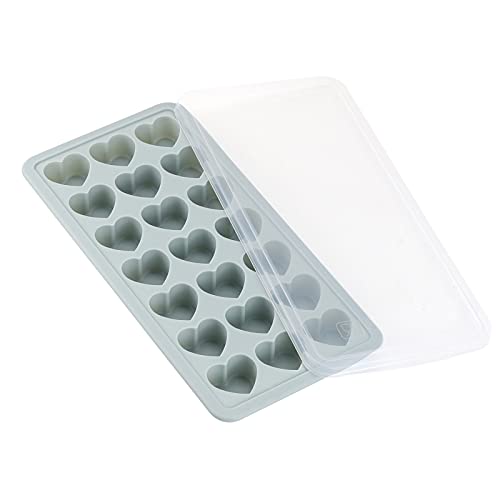
Only one of the five says anything about stacking. BTYMS states the trays are stackable and do not take up a lot of space, alongside a lid that attaches easily and can serve as a base for carrying a filled tray. The other four are flexible sheets that could be stacked and whose makers never mention it.
What the table cannot tell you is how deep any cavity is. No listing here publishes a cavity depth, a cavity volume or the size of the finished piece, so a mold stated at 1 inch thick and one stated at 0.59 cannot be compared by what they produce. Two listings call themselves deep or thick and neither attaches a figure to the word.
Thickness Is the Cabinet Figure
From 0.19 Inches to 1.2
YunKo sits at one end and it is a different kind of object: a single bow mold at a stated 3.1 inches square, with published fields giving 0.19 inches. That is a sheet that goes in with the spatulas rather than on a shelf, and the listing describes it as soft and thick, which is a claim about the silicone rather than a measurement.
At the other end BTYMS publishes 1.2 inches and SAINT NIEVE 1 inch. On BTYMS that figure includes the lid, so the tray itself is thinner and the listing never says by how much. On SAINT NIEVE the inch is the mold, and its own bullet explains why: approximately 30 by 20 by 2.6 cm, thicker and deeper than regular chocolate molds for chunky premium-style bars.
One Listing That Says the Trays Stack
BTYMS is the only listing in this group to address storage directly, stating that the trays are stackable and do not take up a lot of space. It pairs that with the most complete lid description here: the lid attaches easily, stops spillage in the freezer, keeps food fresh, and can be used as a base to transfer a filled tray before becoming a cover once the cubes set.
It also publishes the caution that goes with silicone, stating that the trays are not rigid like plastic and suggesting a board or the lid underneath when carrying one. That is the honest version of what stackable means on a flexible tray, and it is the reason this listing carries the tallest published figure on this page.
Where Each Maker Contradicts Itself
Three Cold Limits That Cannot Be Right
Minus 40 is the one temperature that reads the same in Fahrenheit and Celsius, which makes it easy to check a published range. La Chat states a range of minus 104°F to plus 466°F and then gives the same range as minus 40°C to plus 230°C. Neither end converts: minus 40°C is minus 40°F, and 230°C is 446°F rather than 466.
BTYMS states minus 104°F to 446°F with no Celsius pair, so only the hot end can be checked, and it is right. YunKo states minus 40°F to 446°F and is the only listing on this page whose range holds at both ends. SAINT NIEVE states minus 40°F to 392°F as minus 40°C to 200°C, which also holds.
Two Listings With Two Footprints
Vrthske gives its size a bullet of its own, stating that the overall mold is 10.63 by 6.69 by 0.59 inches with ample space for eight uniform bars. Its published dimension fields read 6 by 10 by 0.5. This page uses the maker’s sentence, because it is specific, labeled overall and tied to a cavity count.
La Chat’s gap is smaller and more honest about itself. It states roughly 8.30 by 4.10 by 0.70 inches while its fields read 4.1 by 8.7 by 0.7, and it adds in the same bullet that each mold size is a little different, because four different styles arrive. So 0.70 inches is a representative figure rather than a measurement of any one mold.
What Comes Out of the Mold
One Cavity, Eight, Three and Twenty-One
The cavity counts here describe four different jobs. BTYMS has twenty-one heart cavities and is sold as an ice tray as much as a chocolate mold, naming gelatine, candy, jello shots and baby food. Vrthske has eight rectangular bar cavities and names chocolate bars, caramel bars, wafer bars, butter sticks and energy bars.
SAINT NIEVE has three, and states they are deeper than usual for chunky premium-style bars or large candy pieces. YunKo has one bow. La Chat supplies four molds of different styles and never counts the cavities in any of them, which for a purchase sold on variety is the figure a buyer would most want.
A Second Temperature Limit on One Listing
SAINT NIEVE publishes something none of the others do: a limit on the chocolate rather than the mold. After stating heat resistance from minus 40°F to 392°F, it adds that to maintain the holographic effect you should keep the chocolate temperature below 50°C. That is a working instruction and it is the only one on this page.
It matters because the same listing states that the holographic optical texture comes from a nano-textured surface achieving color-shifting effects without pigments or coatings. A surface texture that fine is the sort of thing hot chocolate would flatten, and the maker says so rather than leaving a buyer to discover it on the second batch.
Which One Fits Your Kitchen
The drawer is the only space left. YunKo publishes a 3.1 inch square bow mold with fields giving 0.19 inches of thickness, in food grade silicone stated safe from minus 40°F to 446°F, oven, dishwasher and refrigerator named, at 0.09 pounds.
You want a batch of bars from one sheet. Vrthske publishes eight bar cavities in a sheet it states is 10.63 by 6.69 by 0.59 inches, at 0.1 pounds. It publishes no temperature figure and no cleaning method, and its fields disagree with its own sentence.
You want several shapes from one purchase. La Chat publishes four different molds at roughly 8.30 by 4.10 by 0.70 inches each, in platinum food grade silicone, hand wash or dishwasher, at 0.49 pounds. Its stated temperature range does not convert.
You want thick bars and a shiny finish. SAINT NIEVE publishes three deep cavities at approximately 30 by 20 by 2.6 cm with a nano-textured holographic surface, dishwasher, freezer, oven and microwave safe, at 0.73 pounds. Keep the chocolate below 50°C.
You want a lid and a stack. BTYMS publishes twenty-one heart cavities under a lid that attaches and doubles as a carrying base, states the trays are stackable, and publishes 10.47 by 5.1 by 1.2 inches at 0.42 pounds.
What We Could Not Verify
These are the figures the five listings do not publish, or publish twice in ways that disagree, and nothing above has been supplied in their place.
- No listing publishes a cavity depth, a cavity volume or the size of the finished piece.
- Vrthske states heat resistance without publishing any temperature figure.
- La Chat’s Fahrenheit and Celsius ranges do not convert at either end.
- BTYMS states minus 104°F with no Celsius pair to check it against.
- Vrthske’s own sentence gives 10.63 by 6.69 by 0.59 against fields of 6 by 10 by 0.5.
- Four of the five make no claim about stacking or nesting.