How the Five Compare on the Numbers
Seven live pages on this pool rank by heat range, by footprint, by capacity, by what arrives in the set, by how the chocolate comes out, by cabinet fit and by drawer fit. None of them asks what happens after the chocolate comes out. That is the free question here, and it turns out to separate these five more sharply than any of the dimension figures do.
Four of the five state that a dishwasher is safe and then stop. One describes washing by hand. One publishes a remedy for the only fault silicone reliably develops, which is holding a smell, and it is also the only listing that names a part of its own purchase that must be kept away from heat.
What the table cannot tell you is how any of these behaves once chocolate has set in a corner. Every cleaning claim here is a permission, not a description, and the only procedural writing on the page is about smell rather than residue. Nobody publishes whether a cavity has a radius at the bottom or a square corner, which is the difference between rinsing and scrubbing.
Permissions, Methods and One Actual Procedure
Four Say Yes and One Says How
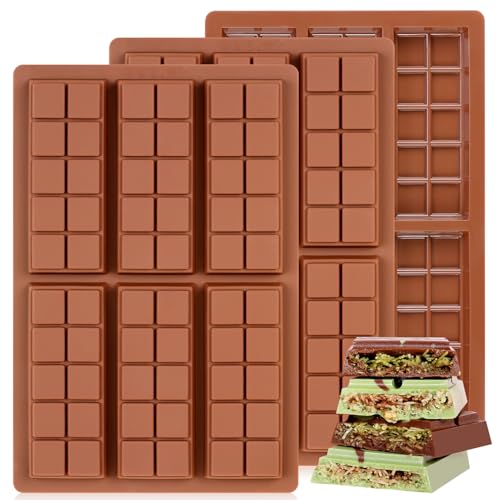
Fimary is the only listing here with a cleaning instruction in the ordinary sense. Its bullet reads that you simply hand wash the thick chocolate bar mold with soap and water, or toss them in the dishwasher for quick and convenient cleaning. Two options, one of them described. That is a low bar and four listings do not clear it.
The others state a permission and move on. Sakolla’s heat bullet ends with oven, microwave, dishwasher and freezer safe. AIERSA’s material bullet says microwave, oven, dishwasher and refrigerator safe, easy to use and clean. HKNMTT’s ends with the words Dishwasher safer. Szxc’s first bullet ends with these ice cube trays are diswasher safe. Both of those last two are misspellings of the same claim.
The One Bullet That Reads Like a Manual
Szxc publishes something no other listing on this page attempts. Under a heading about removing silicone smell it states that some silicone items start to have a chemical smell after a period of constant use, and then gives two fixes: put the empty trays in an oven at 375 degrees for 30 to 45 minutes, or soak them overnight in vinegar and then wash them.
It also tells you what to expect while doing it, that you will smell a strong odor during the oven cycle and that it goes away quickly, and it adds the warning that makes the whole thing usable: do not put the lids in the oven, because the lids are not heat resistant. That is one bullet doing more honest work than the cleaning claims of the other four put together.
The Parts Nobody Mentions Again
Lids, Pipettes and Where a Permission Stops
Two of these purchases are not entirely silicone. Szxc includes two hard PP plastic lids, stated food grade and BPA free, whose job is to let a filled tray go into a freezer without spilling. AIERSA includes a lid for each of its two trays plus a pipette, which is presumably for filling 32 small cavities without flooding them.
In both cases the dishwasher claim attaches to the trays. Szxc excludes its lids from heat, clears its trays for a dishwasher and says nothing about washing the lids themselves. AIERSA never mentions the pipette after listing it in the contents. A pipette that has had melted chocolate through it is the single hardest item to clean in any of these five boxes, and it has no instruction at all.
Cavity Count Is a Cleaning Figure
None of these listings presents cavity count as a cleaning cost and all of them should. AIERSA is 32 cavities to a tray at about 0.625 inches on a side, and its title and its contents bullet disagree on whether one tray or two arrive. Sakolla is three trays of 12 cavities at 2.1 inches across and 1 inch deep. Szxc is two trays of 15 and does the arithmetic itself, stating 30 cubes at one time.
Large shallow cavities rinse. Thirty two small cubes to a tray do not, and the smaller ones here are the ones a brush cannot reach into properly. HKNMTT and Fimary publish no cavity count at all, one being a four pack of bar molds and the other a set of three, which on a page about cleaning is the figure most worth having.
Where the Numbers Argue With Themselves
Three Thicknesses for One Mold
HKNMTT’s second bullet manages to state its mold size three ways. It says the molds are sized at 6 by 3.1 by 0.4 inches, then that the 0.5-inch height and 0.2-inch thickness offer a sleek design, then warns that this thinner profile is not ideal for filling. A mold cannot be 0.4, 0.5 and 0.2 inches deep at once, and the listing never resolves which figure belongs to what.
Its published dimension fields make it worse rather than better, reading 7.09 by 8.66 by 7.87 inches. Nothing that is 0.4 inches thick by its own account is 7.87 inches in any direction, so those fields are a carton. The maker’s own 6 by 3.1 inch figure is the one this page uses, and the thickness is treated as unknown.
A Range With No Scale, and a Listing With No Figures
Szxc publishes a working temperature range of minus 40 to 464 degrees and names no scale for either end. On its own that is unusable, though the other four listings all publish minus 40°F to 446°F or 450°F, which places it. This page reports it as published rather than assuming a scale the maker did not write.
Fimary is the opposite problem. It publishes the clearest cleaning instruction on this page and no dimension for the mold, the cavities or the set, only 6.6 by 10 by 0.59 inches for the package. Its bullets describe a variety of shapes and sizes without listing one of them, so you know exactly how to wash a thing whose size is unstated. At a published 0.22 pounds it is the lightest of these five.
Which One Fits Your Kitchen
Using the molds constantly. Szxc, the only purchase that publishes a fix for the smell silicone picks up over time, with an oven cycle at 375 degrees for 30 to 45 minutes or an overnight vinegar soak. Keep its PP lids out of the oven, as it says.
Washing up by hand. Fimary, the only listing that names a method: soap and water, or the dishwasher if you prefer. A set of three deep bar molds you press from beneath at a published 0.22 pounds, with no dimensions published.
Freezing in batches. AIERSA, 32 cavities to a tray with a lid, stated so you can date and flavor-mark a cavity and stack trays in the freezer. Thirty two small cavities is a lot to wash, and the pipette it includes has no instruction.
Making chocolate covered cookies. Sakolla, three trays of 12 cavities at 2.1 inches across and 1 inch deep holding a stated 1.5 oz, on a 10.7 by 7.3 inch tray. Published at 0.79 pounds, with a dishwasher permission and no method.
Making plain thin bars. HKNMTT, a four pack whose maker says outright that the thin profile is not ideal for filling. Its cleaning claim is two misspelled words, and its own bullet gives three different thicknesses for the same mold.
What We Could Not Verify
Every item below was looked for across all five listings and is not published:
- Any description of how to clean a cavity by hand on four of the five; Szxc’s only hand step is an overnight vinegar soak for odor.
- Whether AIERSA’s pipette is reusable, and how it is meant to be cleaned after melted chocolate.
- Whether Szxc’s PP lids may be washed in the dishwasher it clears for the trays.
- Any dimension from Fimary for the mold, the cavities or the set of three, beyond a package figure of 6.6 by 10 by 0.59 inches.
- Which of HKNMTT’s three thickness figures, 0.4, 0.5 or 0.2 inches, describes the mold.
- The scale on Szxc’s stated working range of minus 40 to 464 degrees, which names neither Fahrenheit nor Celsius.