How the Five Compare on the Numbers
Five live pages on this pool rank by grind settings, weight, footprint, what is in the box and how much bean a hopper holds. None of them asks what the maker says to do after the grinding stops. That is the free question on this pool, and unusually for a specification page the answer is a sentence rather than a figure, because all five makers publish one and no two agree.
Ranked that way the five split completely. One clears a part for a dishwasher. One publishes a mechanism that twists to clean the chamber walls. One answers with a lid that stops grounds escaping. One forbids immersion in water and prescribes a damp cloth. One tells you to grind uncooked white rice through its ceramic burrs.
What the table cannot tell you is whether the three machines in the middle may be washed. A removable chamber is only useful if you know what may be done with it once it is out, and neither Mr. Coffee nor SHARDOR states that. Nothing here publishes whether a blade or a burr can be taken out, which is where the oil and the stale grounds actually collect.
What Each Maker Says to Do
The One Dishwasher and the One Refusal
Hamilton Beach is direct about it: the grinding bowl is removable for easy filling and pouring, it sits on a durable stainless steel base, and it is dishwasher safe. That is the only permission to put any part of any of these five into water, and it is published as its own bullet rather than buried in a material description.
Aromvel publishes the opposite, and publishes it just as plainly: always unplug before cleaning, wipe the bowl and the base with a damp cloth, do not immerse in water. Between those two positions sit three listings that never raise the subject, which in practice means the cautious reading applies and nothing gets rinsed until the maker says it may be.
A Mechanism, a Lid and a Bag of Rice
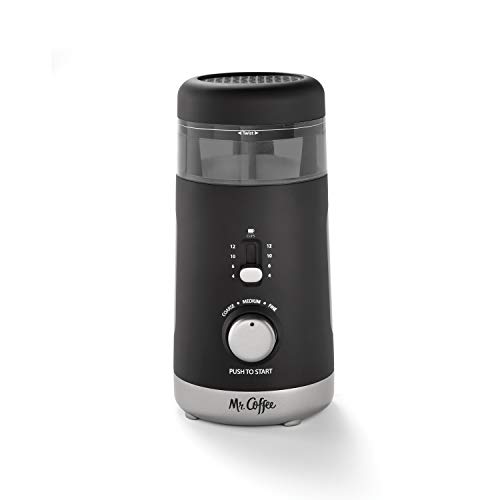
Mr. Coffee answers with hardware. Its chamber cleaning system is listed as a feature in its own right and is described as twisting to clean grounds from the chamber walls, which is the exact place a blade grinder packs fine grounds. It is the only moving part on this page whose stated job is cleaning, and it works whether or not water is allowed near the machine.
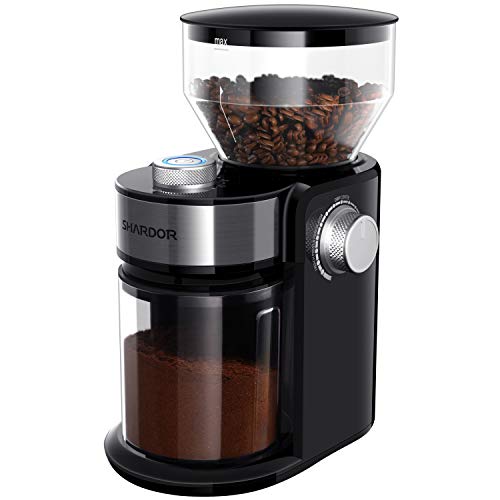
SHARDOR answers earlier in the process with an anti-spill lid on a removable grounds chamber, stated to help control powder scattering, and a brush for the micro-grounds that get out anyway. ByteX answers last, with a routine rather than a part: grind uncooked white rice to remove residual grounds and odors and keep the ceramic burrs clean.
Blades, Burrs and Where Grounds Hide
Three Blade Machines and Two Burr
Hamilton Beach, Mr. Coffee and Aromvel all publish stainless steel blades. A blade grinder throws grounds upward, so residue ends up on the lid, on the chamber wall and around the blade boss, and two of those three are addressed by the published instructions: the wall by Mr. Coffee’s twisting chamber, the bowl by Hamilton Beach’s dishwasher claim. Nobody states how the blade itself is cleaned.
SHARDOR runs a flat burr mill and ByteX a ceramic burr turned by a crank. Burrs hold grounds in the gap between them, which is why ByteX publishes a rice cycle. SHARDOR publishes 16 micro-adjusted settings and a brush and nothing at all about the burrs, which is the larger omission of the two, because a motor sits under them.
What Removable Actually Covers
Four of the five state that something comes out. Hamilton Beach names the grinding bowl, Mr. Coffee the grinding chamber, SHARDOR the grounds chamber, and ByteX unscrews from the jar so the whole grounds container separates. Aromvel names nothing removable, which lines up with a listing that tells you to wipe rather than dismantle.
In every case the removable part is the vessel, not the cutter. No listing on this page says a blade or a burr may be taken out, and none publishes a cleaning interval either, so how often any of this is meant to happen is left to you. For a setup used daily that is the gap that matters most, because stale coffee oil is a taste problem before it is a hygiene one.
Cleaning as a Consequence of Dosing
Grinding Less Leaves Less
Two listings publish a dose control and say plainly why. Mr. Coffee has a 4 to 12 cup selector described as grinding only what you need, and SHARDOR has a 2 to 14 cup timer with a one-touch automatic stop. Ground coffee that is never made is residue that never has to be cleared, so a selector is a cleaning feature as much as a convenience one.
The other three are open loops. Hamilton Beach and Aromvel grind while the button is held and stop when it is released, and ByteX turns until you stop turning. Aromvel at least publishes timings for what it expects: coarse in 12 to 15 seconds, medium in 20 to 25, fine in 35 to 40, with a note not to run past 40 seconds continuously.
Spices Are the Reason Any of This Matters
All five of these listings sell the machine for spices and herbs as well as coffee, and only one acknowledges what that does. Aromvel states that the bowl must be cleaned thoroughly after grinding spices to prevent flavor transfer, which is the plainest reason on the page to care about cleaning at all: peppercorn residue in a coffee grinder is tasted in the next cup.
Hamilton Beach lists peppercorns, fennel, sesame, flax and chia by name and publishes no warning of that kind, though its dishwasher safe bowl is the strongest answer to the problem. SHARDOR and Mr. Coffee do not raise it. ByteX sells only coffee grinding, which is the one case on this page where flavor transfer cannot arise.
Which One Fits Your Kitchen
Cleaning by machine. Hamilton Beach, for the one dishwasher safe part published on this page. The grinding bowl comes out for filling and pouring, goes in a dishwasher, and the cord hides under the base so there is nothing loose to wipe around.
Cleaning without water. Aromvel, which tells you exactly what to do and what not to do: unplug, damp cloth on the bowl and base, no immersion. It is the only listing that publishes a prohibition rather than leaving you to guess.
Grinding for a whole pot. Mr. Coffee, for the chamber cleaning system that twists grounds off the walls plus a 4 to 12 cup selector. A blade machine used at full dose packs its walls, and this is the only listing with a part for that.
Grinding fine for espresso. SHARDOR, for 16 micro-adjusted settings on a flat burr mill with an anti-spill lid and a brush. Accept that no burr cleaning method and no dishwasher claim are published, and that it publishes 2.12 pounds.
Keeping it simple. ByteX, a manual crank burr that screws onto a regular mouth mason jar. There is no motor to keep dry, the jar is the grounds container, and the stated upkeep is a cycle of uncooked white rice through the burrs.
What We Could Not Verify
Every item below was looked for in all five listings and is not published:
- Whether the blade or the burrs on any of these five may be removed for cleaning.
- Whether Mr. Coffee’s removable grinding chamber or SHARDOR’s removable grounds chamber may be washed in water at all.
- Any cleaning interval, so how often the chamber, the lid or the burrs should be cleared is left unstated by all five.
- Any washing method for ByteX beyond the rice cycle, including whether the stainless steel body may be rinsed.
- Whether Aromvel’s lid, which it tells you to brush, is covered by the same prohibition on immersion as the bowl and base.
- How SHARDOR’s flat burrs are meant to be cleared, on the one listing here with a burr set and a motor under it.