How the Five Compare on the Numbers
A prep station grinds more than once. Someone makes a pot before school, someone else grinds peppercorns for a marinade at noon, and the same bowl gets a second bean charge before dinner. That pattern turns one published sentence into the deciding fact: what the maker says about how long the motor may run, and whether the machine ends the cycle or leaves that to the person holding the button.
Two of these five publish a timer that stops the grind. Two publish a number of seconds and ask you to stay under it. The fifth publishes a grinding speed and nothing about a limit. The table below sets those statements beside the bean charge, the claimed cup yield, the motor rating where one exists, and the published weight and field dimensions for each of the five.
What the table cannot tell you is whether a stated ceiling means the motor is weaker or the maker is simply more careful in print. DR MILLS and Aromvel are the only two that commit to a number, and committing to one is not evidence of a shorter duty cycle. The three that stay silent may stop sooner. Silence is not a specification, and this page treats it as missing rather than as permission.
Who Decides When the Grinding Stops
The Two That End the Cycle for You
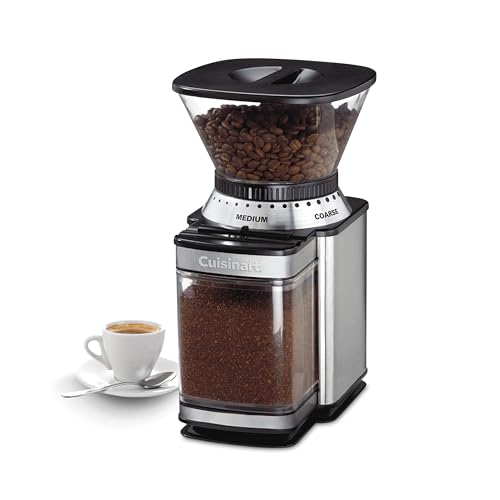
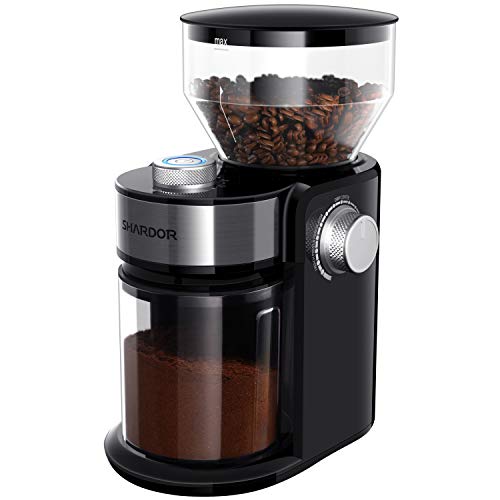
Cuisinart states that its one-touch power bar sits separate from the grinder body and that an internal electric timer shuts the unit off when the grind cycle is complete. SHARDOR states an electric smart timer dial that lets you select two to fourteen cups, runs hands-free and shuts off when finished. In both cases the person at the station starts it and walks away, which is the difference that matters when three other things are cooking.
Neither maker publishes how long that cycle actually lasts at any setting, so the timer is a promise about who stops the machine and not about elapsed seconds. SHARDOR adds a dual safety interlock that requires both the bean hopper and the grounds chamber to be locked before the burrs turn, which is the only two-point interlock stated among these five and a reasonable thing to want on a counter children reach.
The Three That Run While You Hold the Button
DR MILLS states that you hold the button for working and can watch the grind through the lid, and it is the only listing here that publishes what happens when you overdo it: a thermal switch with overheating protection, a recommended grinding time of less than 30 seconds in one cycle, and roughly 30 minutes of rest before it will work again if abnormal use stops it. That is unusually candid documentation.
Aromvel states one-touch operation where you press to start and release to stop, with a lid safety lock that halts the blade the moment the lid opens, and it asks you not to run the motor continuously for more than 40 seconds. Amazon Basics publishes neither a hold instruction nor a ceiling. Its only time figure is a claim that it grinds 30 grams for drip brewing in 10 seconds.
What a Prep Station Asks of a Grinder
Spices in the Same Bowl as the Beans
Every one of these five is sold as a coffee and spice grinder, and a shared prep station will use both jobs. Aromvel is the only listing that raises the consequence in print: it tells you to clean the bowl thoroughly after grinding spices to prevent flavor transfer, and it names peppercorns, dried herbs and dry spices. Amazon Basics lists grains and nuts as well, without saying anything about transfer.
Cuisinart and SHARDOR are burr mills, and neither says whether spices are allowed at all. Cuisinart states that its 8 oz bean hopper and bean chamber are fully removable for use and cleaning, and SHARDOR states a removable grounds chamber with an anti-spill lid. Removable parts help, but a burr set is not a bowl you can wipe out, and both listings leave the spice question unanswered.
Grinding for a Pot and Then Grinding Again
The published cup claims scale very differently. Cuisinart claims 4 to 18 cups from its grind chamber and is the only listing here that defines a cup, stating approximately 5 oz and noting it varies by brewing technique. SHARDOR claims 2 to 14 cups. DR MILLS claims about 7 cups from 50 grams. Aromvel claims 1 to 2 cups from 65 grams, which is a different scale entirely.
Read those beside the bean charges and one of them does not sit easily. Aromvel publishes 65 grams, more than the 50 grams DR MILLS publishes, yet claims 1 to 2 cups where DR MILLS claims about 7. Neither maker says what strength or brew method it assumed, so the two numbers are not comparable, and a family filling a full carafe should lean on the stated bean charge instead.
The Figures the Makers Leave Out
Motor Ratings Published Twice and Missing Three Times
Only two of the five publish anything about the motor. DR MILLS states 150 W at 120 V and 60 Hz. Aromvel states a 180 W motor at 30,000 RPM. Both of those are blade grinders, and both are the listings that also publish a run ceiling, which suggests the makers who quantify the motor are the makers who quantify its limits. The two burr mills publish neither figure.
That leaves a real gap for a prep station. Without a wattage or a duty cycle from Cuisinart, SHARDOR or Amazon Basics, there is no published basis for guessing how many back-to-back batches any of them will take. The timer tells you the machine will stop. It does not tell you how soon you may start it again, and no listing here fills that in.
Counter Space and Weight at a Shared Station
Weight matters at a station because a grinder gets lifted to pour and shoved aside to make room. Cuisinart publishes 4.5 pounds, the heaviest of these five. Aromvel publishes 1.18 pounds, the lightest, and the other two blade grinders both publish 1.54 pounds. A heavier body is steadier under a blade or a burr, and of these five only DR MILLS states a non-slip base designed to stabilize the body while grinding.
The published dimension fields separate the group just as sharply. Cuisinart publishes 12.25 by 8.75 by 7.5 inches and SHARDOR 5.0 by 7.0 by 9.5 inches, while the three blade grinders publish first two figures between 3.4 and 4.0 inches. None of these listings says which field is which, so treat those as three numbers the maker published rather than as a footprint you can plan a shelf around.
Which One Fits Your Kitchen
The household that brews a full carafe every morning. Cuisinart. An 8 oz hopper, a claim of 4 to 18 cups, a stated definition of a cup at approximately 5 oz, and a timer that shuts the unit off without anybody standing over it.
The cook who wants a set-and-leave dial. SHARDOR. You choose two to fourteen cups on a timer dial, it runs hands-free and stops itself, and both the hopper and the grounds chamber must be locked before the burrs will turn.
The person who wants the rules written down. DR MILLS. It is the only listing here that publishes a run limit, a rest period and a thermal cutout, which tells you exactly what the maker expects rather than leaving you to guess.
The station that grinds spices as often as beans. Aromvel. It names the flavor transfer problem, gives three timed grinds by brew style, publishes 180 W and asks for no more than 40 seconds of continuous running.
The second grinder kept for one quick batch. Amazon Basics. Its published claim is narrow and useful: 30 grams of beans for drip brewing in 10 seconds, a clear safety lid, and nothing else stated about time or limits.
What We Could Not Verify
These are the things we went looking for in the published listings and did not find:
- How long a cycle lasts on Cuisinart’s internal timer or on SHARDOR’s cup dial, at any setting.
- Any wattage, voltage or motor speed for Cuisinart, SHARDOR or Amazon Basics.
- Whether Cuisinart or SHARDOR authorizes grinding spices in a burr mill at all.
- Any rest period between batches for four of the five, DR MILLS being the exception.
- What brew strength lies behind Aromvel’s 1 to 2 cup claim or SHARDOR’s 2 to 14.
- Which published dimension field is the width and which is the depth, for any of the five.