How the Five Compare on the Numbers
The grinder is the whole reason to buy one of these, and no two listings describe theirs in the same terms. Hausmojo publishes 44 settings on a conical burr. Gevi publishes 8 grind settings and 3 strength levels on a burr. De’Longhi names a conical burr and gives no count. Breville says the grinder is adjustable without naming its type. Horavie publishes six timed runs of a blade, 6 to 16 seconds.
Brew volume splits the same way. De’Longhi publishes five cup sizes from 8 oz to 24 oz plus a 3 oz espresso style pour. Horavie publishes six sizes from 6 to 16 oz. Gevi brews 2 to 10 cups. Breville names a carafe, a tall cup or a travel mug with a 12 cup carafe supplied. Hausmojo brews into a 51 mm portafilter and publishes no cup volume at all.
The row that matters most is the one where the units do not match. A count of burr positions, an unnamed adjustment range and a number of seconds on a blade are three different kinds of claim, and nothing in any listing converts one into another. Two of the five publish no weight, two publish no tank capacity, and only two state a warranty, so the table is as much a map of the silences as of the specifications.
What a Grind Setting Means on Each of These Listings
Burr Positions You Can Count
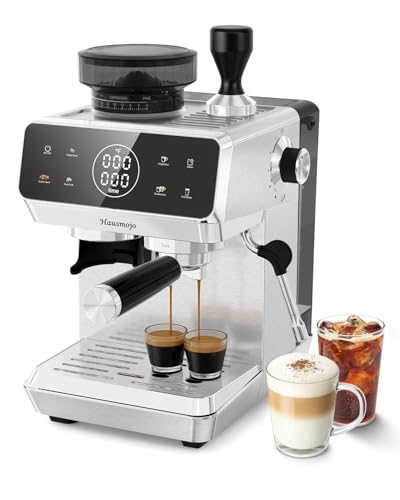
Hausmojo publishes 44 settings on a conical burr and pairs them with a display that shows grind time, extraction time and temperature while the shot runs. That is the only listing here that claims to show you what the machine is doing rather than only what you asked it to do, and 44 positions is a wider adjustment range than any other figure in this pool.
Gevi is the other one that counts. It publishes 8 grind settings and 3 strength levels, which are separate controls doing different jobs, and it adds pre brew saturation before the main pour. De’Longhi names a conical burr too, and then publishes no setting count at all, leaning instead on one touch operation and a dosing system it calls Bean Extract Technology.
Seconds of Run Time Is Not a Grind Size
Horavie publishes six grind settings that turn out to be six lengths of time, 6 to 16 seconds, on a blade fitted inside the reusable basket. A blade chops for as long as you let it, so a longer run gives a finer average and a wider spread of particle sizes at the same time. The listing does describe it honestly, as grind time rather than grind size.
Breville sits in between and publishes the least about it. Its grinder is described as integrated and adjustable, with the output adjustable to suit any bean, and the type is never named. There is no number of positions and no range. What it does publish is the part nobody else does, a bean hopper holding half a pound, so it is the only listing that says how much coffee sits above the grinder.
Espresso, Drip and One Cup at a Time
The One Pressure Machine in the Pool
Hausmojo is not a drip machine at all. It is a 20 bar pump espresso machine with low pressure pre infusion, a 1500 W manual steam wand for microfoam, and a 51 mm barista kit with a portafilter, a tamper and single and double baskets. It also publishes a dedicated cold brew function and a 61 oz removable tank, the largest published tank capacity here.
That makes it the only pick where the drink you get depends on your own technique. The other four grind and brew on a cycle you start once. If you want lattes and flat whites from beans, this is the only listing in the group that publishes a steam wand, and it is one of only two that state a warranty, one year limited.
Three Drip Machines That Size a Brew Differently
De’Longhi publishes the clearest ladder of sizes, 8, 12, 16, 20 and 24 oz, plus a 3 oz espresso style pour, across five brew styles it names Light, Gold, Bold, Over Ice and Espresso Style. Gevi works in carafe terms instead, 2 to 10 cups, with a button that adjusts the water to coffee ratio for the amount you asked for rather than making you dose by hand.
Breville takes a third approach and sizes the brew by what you put under it, a 12 cup dual wall thermal carafe, a tall cup or a travel mug, with Steep and Release timing intended to keep the same balance whichever you choose. It also publishes the one figure that makes a drip machine practical to live with, a 60 oz tank stated as 12 cups.
Published Figures That Do Not Add Up
Sixteen Pounds in a Box Six Inches Across
Breville publishes a weight of 16.09 pounds beside dimension fields of 4.92 by 3.35 by 6.42 inches. No machine with a hopper holding half a pound of beans and a 12 cup carafe fits inside that space, so the dimension fields on this listing describe something other than the machine. Its size field says only Medium, so there is nothing on the listing that gives a usable footprint.
The honest consequence is that this pick cannot be compared on size with the other four, and no claim about its footprint appears on this page. The weight is plausible for a grind and brew with a thermal carafe, so that is the figure treated as real here, and the dimension fields are the ones set aside.
Two Listings That Argue With Themselves
Horavie publishes dimension fields of 6.02 by 12.5 by 13.38 inches and then says in its own words that the machine measures 4.69 inches across and 11.42 inches high. Those are the maker’s words, so they are the ones used here. Its size field reads 47.35 oz, which is the tank rather than the machine, and its feature text rounds the same tank to 47 oz.
Gevi is the counter example and deserves credit for it. Its published fields read 8.37 by 12.36 by 16.93 inches, its size field reads 12.4 by 8.4 by 16.9, and a feature bullet repeats 12.36 by 8.38 by 16.93 and tells you to measure your cabinet clearance before buying. Three statements of the same figure that agree is the rarest thing in this pool.
Which One Fits Your Kitchen
Espresso, lattes and cold brew from one machine. Hausmojo is the only pressure machine here, 20 bar with pre infusion, 44 burr settings, a 1500 W steam wand, a 61 oz tank and a 51 mm barista kit. It is one of only two picks that state a warranty.
Cup sizes that actually match your mugs. De’Longhi publishes 8, 12, 16, 20 and 24 oz plus a 3 oz espresso style pour, over five named brew styles, from a conical burr with one touch dosing. At 19 pounds it is the heaviest published weight here, so give it a permanent spot.
A pot for the whole household. Breville grinds into a 12 cup dual wall thermal carafe, or a tall cup, or a travel mug, from a hopper holding half a pound of beans with a 60 oz tank behind it. Ignore its dimension fields.
Grind and strength as separate controls. Gevi publishes 8 grind settings and 3 strength levels, brews 2 to 10 cups, includes a reusable filter instead of paper, and is the one listing whose three separate size statements agree with each other.
One cup at a time, beans or pods. Horavie takes whole beans, ground coffee or k pods, brews 6 to 16 oz in six steps from a 47 oz tank, and grinds with a blade in the basket for a chosen 6 to 16 seconds rather than at a chosen grind size.
What We Could Not Verify
Six things a buyer would want from these five listings and cannot get.
- Breville’s dimension fields, 4.92 by 3.35 by 6.42 inches, cannot describe a 16.09 pound machine with a 12 cup carafe, and its size field says only Medium, so no footprint for it appears on this page.
- Two of the five publish no weight at all, so the espresso machine and the 10 cup drip machine cannot be weighed against the three that do.
- No listing publishes a brew temperature. Hausmojo displays temperature on screen without stating what range it works in, and the four drip machines say nothing.
- Grind settings are counted in burr positions on two listings, in seconds on a third, and not at all on the other two, and nothing converts between those units.
- Two of the five state a one year limited warranty and the other three state none. There is no stated service life, no descaling interval and no replacement part information on any of the five.
- A sixth grind and brew machine was left out because it publishes three grind settings without naming its grinder type, and both machines it would have displaced publish theirs. Two more were excluded outright, one a drip maker with no grinder at all, the other a grind and brew whose feature text describes tamping espresso and lists its fabric type as plastic.