How the Five Compare on the Numbers
Sixteen brewers sit on this fact sheet and most of them are a glass carafe with something wrapped around its neck. Melitta pairs a plastic cone with a stainless carafe at 2.24 lb. MAVO adds a kettle. Cosori publishes 34 ounces in a decanter with a wooden sleeve at 1.7 lb. All good sets, and none of them is a thing you put in a drawer.
So this page asks a narrower question than the category does. How many separate pieces does the purchase create, which of those pieces does the maker itself refuse to put in a dishwasher, and does the brewer commit you to keeping a stack of paper somewhere. One of these five answers all three questions at once, and it does it by not being glass.
What the table cannot tell you is how any of these drips: no maker publishes a flow rate, a hole size or a brew time beyond Roogaluckeep’s claim of under three minutes. It also cannot separate a dripper from its carafe, because every dimension field here covers whatever the listing considers the product, and not one of the four glass sets publishes its dripper on its own.
What Actually Goes in the Drawer
The One Piece That Fits
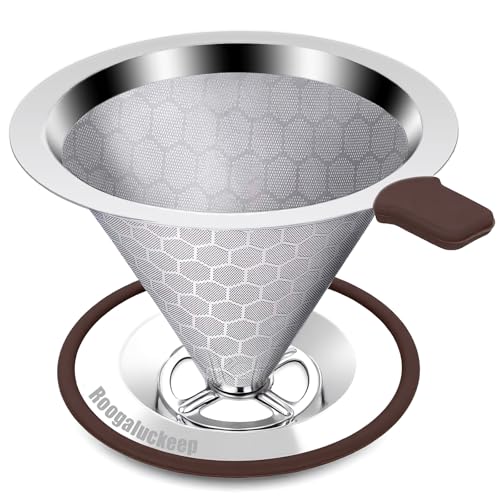
Roogaluckeep is a paperless dripper made entirely of food grade 304 stainless steel, with a 600 mesh screen and precision spiral ribs, and the listing states plainly that it is a one piece design with no assembly required. At 4.51 by 4.53 by 3.35 in and 0.16 lb it is the lightest thing on this page by a wide margin, and the only one with no glass and no wood in it.
It also brews into whatever mug you own, and publishes the figure that decides whether that works: a rim diameter of 2.5 to 3.5 in. That is the single most useful specification on this page for a drawer owner, because it means the purchase adds one object and borrows the rest. The cost is that it publishes no volume, describing its output only as one to two cups.
Four Brewers That Belong on a Shelf
The other four are all glass, and a glass carafe is a cabinet object however tidy the drawer is. Bodum publishes 17 oz at 0.69 lb, Rsoilch 15 oz at 0.65 lb, Lalord 20 oz at 1.32 lb, and Chemex ten cups measured at 5 oz each with a body of 5.12 by 5.12 by 9.25 in. None of them is unsuited to a kitchen, and none of them is drawer material.
What they do put in a drawer is their accessories. A cork sleeve, a walnut collar, a glass lid and a stack of paper filters are all small, dry things that have to live somewhere, and the maker’s own washing rules decide whether that somewhere has to stay dry. That is the part of these purchases the listings actually address, and two of the four address it directly.
The Pieces That Must Stay Dry
Cork, Suede and a Walnut Collar
Bodum draws the line more clearly than anyone else here. Its bullets state that the carafe and filter are dishwasher safe, and then state on its own line that the cork sleeve with suede cord is not. That is two sentences doing the work of a care label: the glass goes in the machine, the cork and the cord come off first and dry on the counter before they go anywhere else.
Lalord goes further and explains the consequence. Its precautions bullet states that wooden handles are not suitable for high temperature containers such as microwaves or dishwashers, because the wooden part of the handle may fall off, and asks you to wipe dry after hand washing. A walnut collar that can come off is a part worth keeping away from standing water, which makes a dry drawer the right home for it.
Two That Are Only Glass and Steel
Rsoilch takes the other route, claiming an all glass dripper and carafe with zero plastic components and stating that the set is dishwasher safe and effortless to clean. Nothing on it is soft, so nothing on it needs separate treatment. The odd note is that its own title names a plastic part while the bullets insist on none, and the listing never reconciles the two.
Chemex removes soft parts by design: this is the glass handle series, so where other brewers have a wooden collar or a cork band it has glass fused to glass. The listing states non porous borosilicate that will not absorb odors or chemical residues, and that brewed coffee can be covered and refrigerated for reheating. It publishes no dishwasher guidance at all, which on a one piece glass vessel is a surprising silence.
What the Purchase Commits You to Storing
A Hundred Sheets, and a Box With None
Lalord ships a hundred sheets of conical type 02 paper, made from pure wood pulp and stated to be unbleached and free of chemicals, and points out that replenishing them is easy. That is a real quantity of paper to find a home for, and it is also the only pick here that arrives ready to brew and stays ready for a hundred brews without another purchase.
Chemex is the opposite. The listing names four bonded filter types and then states that filters are not included, so the brewer cannot be used on the day it arrives. For an organized kitchen that is worth knowing in advance, because the paper is not optional on this design: the filter is the whole reason the cone is shaped the way it is.
Permanent Mesh and What It Publishes
Three of the five need no paper at all. Roogaluckeep states a 600 mesh 304 stainless screen with spiral ribs, built into the body. Bodum states a permanent stainless mesh that lets the coffee’s oils through instead of absorbing them. Rsoilch states a reusable stainless filter that eliminates disposables. Between them that is three purchases that add nothing to a drawer over time.
What none of them publishes is how long a mesh lasts, or how it is cleaned when the holes begin to hold oil. Bodum at least sets the mesh’s washing in context by stating that carafe and filter are both dishwasher safe. Roogaluckeep publishes no washing statement of any kind, which is the one gap in an otherwise unusually specific listing.
Which One Fits Your Kitchen
A drawer and a favorite mug. Roogaluckeep, the only single piece here, 304 stainless at 0.16 lb, with a 600 mesh screen and a published mug rim range of 2.5 to 3.5 in. It publishes no volume and no washing instruction.
A carafe you want to machine wash. Bodum, 17 oz at 0.69 lb, with a permanent steel filter and the clearest split on this page: glass and filter in the dishwasher, cork sleeve and suede cord out of it.
A set that arrives ready to brew. Lalord, 20 oz and 600 milliliters at 1.32 lb, with a glass lid, a hundred unbleached paper sheets and a stated water range of 185 F to 203 F. Its walnut collar must be kept dry.
A brewer with no soft parts at all. Chemex, glass handle rather than collar or band, ten cups measured at 5 oz each, coffee that can be covered and refrigerated. Buy filters at the same time, because none arrive.
A kitchen avoiding plastic. Rsoilch, 15 oz of glass and steel at 0.65 lb with a reusable mesh, stated dishwasher safe and rated from minus 30 F to 450 F. Its title and its bullets disagree about plastic.
What We Could Not Verify
Each of these is a question I took to the five listings and did not get an answer to.
- Any dimension for a dripper on its own, which is the only part of a glass set a drawer could hold.
- Whether the Bodum cork sleeve and suede cord can be removed from the carafe at all, since only their washing is addressed.
- How Roogaluckeep is meant to be washed, on a listing that publishes a mesh count, a rim range and a weight but no cleaning line.
- What the Chemex 0.31 lb figure measures, given that the maker’s eight cup glass model publishes 1.3 lb.
- Whether Rsoilch contains a plastic part, since its own title and its own bullets say different things.
- How long any permanent stainless mesh here is expected to drain properly, on three listings that all sell permanence as the point.