How the Five Compare on the Numbers
Seven live pages on this pool rank by the ring set, by how many loose rings a drawer gains, by what the maker says the pin is for, by cleaning and by the size of the largest item in the box. None of them reads the handle. A rolling pin transfers a whole body’s weight through two grips, so on an accessibility page the handle is the specification.
Read that way these five separate cleanly and one falls outside the group entirely. Two makers claim reduced hand strain, one of them by naming wrist angle as the cause. Two claim their handles let you apply maximum pressure. The fifth has no handles at all, and its listing never uses the word.
What the table cannot tell you is the barrel diameter of any of these, and on this page that figure matters twice over. It decides how wide a hand has to open to grip PEASUG, which has no handles, and it decides how much dough moves per turn on all five. Not one listing publishes it.
What the Makers Say About Hands
The One Listing That Names the Problem
YIHONOBLE’s opening bullet is unusual for this pool because it starts with a fault rather than a feature. It states that traditional straight rolling pins force awkward wrist angles, and then offers contoured, non-slip handles that promote a natural grip. It goes on to name who it is for: beginners, seniors, or anyone with joint discomfort, and repeats that in a later bullet about arthritis.
It also claims a figure, a reduction in hand strain of up to 30 percent, and attributes it to trials the listing does not describe in any way. That is a claim this page reports rather than relies on. The shape argument stands on its own without it, because wrist angle on a straight pin is a real constraint and no other maker here acknowledges it.
Ergonomic Wood and a Long Session
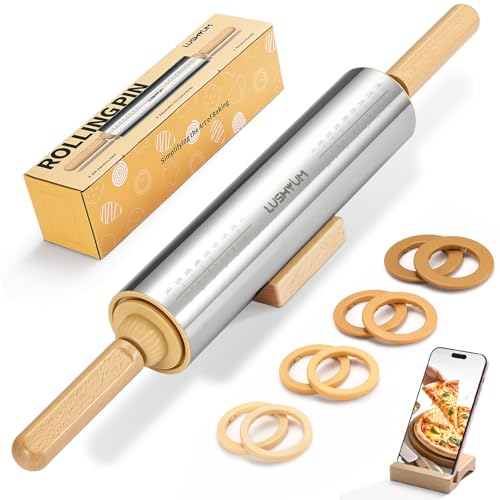
LUSHYUM makes the quieter version of the same case. Its handle bullet states that ergonomic wooden handles provide a comfortable, secure grip and help reduce hand strain, that the screw-on design keeps the handles securely connected, and that the balanced structure helps distribute pressure evenly during rolling. The last of those is a different claim from the other two: consistency rather than comfort.
NASNAIOLL approaches it through time rather than shape. Its first bullet states that the handle does not need flipping, that the design is labor saving, and that it can be held for a long time without tiring. Its second states that secure and sturdy handles let you apply maximum pressure. Between them those describe a pin for a long session, and it publishes the lowest weight here at 0.64 pounds.
Pressure, Length and the Pin With No Handles
Two Pins Built for Force
Geesta and NASNAIOLL both use the phrase maximum pressure and both mean leverage. Geesta states that an extended handle design ensures maximum pressure can be applied, and it publishes the figures that show what extended means: 14 inches of roller against 23 inches with the rings and handles fitted. That difference is where the leverage comes from.
NASNAIOLL publishes the same idea in three parts, stating a total length of 15.15 inches, a rolling section of 7.9 inches and a handle section of 3.5 inches. It is the only listing on this page to give a handle figure at all. LUSHYUM gives 20.2 inches overall and a 10.4 inch barrel, so its handles account for the rest without being measured.
A Barrel You Hold Directly
PEASUG is the outlier and it is instructive. It states a seamless one-piece stainless steel design that is corrosion and oxidation resistant and easier to clean than wooden or aluminum alternatives, and at no point does it mention a handle. Its nearest statement about holding it is that the surface feels smooth and sturdy in your hand.
On a page about accessibility that has two sides. A one-piece pin has no joint to work loose, nothing to unscrew and nothing to lose, which the four handled pins cannot all say. Against that, both hands rest on the rolling surface, so the grip has to open around whatever the barrel diameter is, and pressure comes from the wrists rather than through a lever.
What Happens Between Passes
One Pin That Does Not Roll Away
LUSHYUM publishes the most thoughtful small feature on this page. Its two-in-one stand is stated to hold the rolling pin securely between passes to keep it from rolling across the countertop, and to work as a phone or tablet holder for hands-free recipe viewing. A metal pin that rolls off a counter is both a broken toe and an interrupted bake, and three of these five publish nothing to rest it on.
Geesta includes a wooden holder with its five colored rings. YIHONOBLE, NASNAIOLL and PEASUG publish no rest, no stand and no hook. On YIHONOBLE that is a curious gap, because it is the listing that identifies limited grip as its audience and the moment a pin is set down is exactly when a weak grip loses it.
Handles That Go Inside the Pin
LUSHYUM also publishes the only storage idea for the handles themselves, stating that they can be removed after use and stored neatly inside the hollow stainless steel barrel, keeping the pin and handles together while reducing drawer space. That is the answer to the problem Geesta’s own figures describe, a pin that is 14 inches alone and 23 inches once the handles and rings are on.
The screw-on design that makes it possible is also its own risk, because a threaded joint under repeated pressure can loosen and no listing on this pool publishes a fit, a thread or a torque. LUSHYUM states only that the design keeps the handles securely connected. PEASUG’s seamless body is the opposite trade, no joint and no removable anything.
Which One Fits Your Kitchen
Baking with painful wrists. YIHONOBLE, the only listing that names awkward wrist angles as the problem and seniors and joint discomfort as the audience, with contoured non-slip handles. Published at 1.72 pounds, the heaviest here, and its 30 percent figure is unexplained.
Needing the pin to stay put. LUSHYUM, for ergonomic wooden handles stated to reduce hand strain, a stand that holds the pin between passes, and handles that store inside the barrel. About 20.2 inches overall with a 10.4 inch barrel.
Rolling for an hour at a time. NASNAIOLL, which states the handle needs no flipping and can be held a long time without tiring, at a published 0.64 pounds. It publishes 15.15 inches total, 7.9 rolling and 3.5 of handle, and no ring sizes.
Working stiff or cold dough. Geesta, with an extended handle stated for maximum pressure, five rings from 2 mm to 13 mm and a wooden holder. It publishes 14 inches of roller and 23 assembled, and no weight at all.
Wanting nothing that can come loose. PEASUG, a seamless one-piece stainless pin of 17 inches at a published 1.1 pounds with four rings. There are no handles, so both hands go on the barrel and it makes no claim about grip.
What We Could Not Verify
Every item below was looked for across all five listings and is not published:
- A barrel diameter on any of the five, which decides how far a hand has to open on the handle-free pin.
- A handle length on four of the five, leaving only NASNAIOLL’s 3.5 inch figure.
- Any weight for Geesta, on the pin whose stated purpose is applying maximum pressure.
- What trials produced YIHONOBLE’s claimed 30 percent reduction in hand strain.
- Any thread, fit or torque figure for LUSHYUM’s screw-on handles.
- Ring sizes for NASNAIOLL, which publishes none on an adjustable rolling pin.