How the Five Compare on the Numbers
A shallow cabinet does not care how wide a funnel’s mouth is. It cares about the one figure the funnel cannot be laid down under, and canning funnels split cleanly on that: two of these five are silicone and are published to collapse, and three are rigid cones that keep their shape whether the door shuts or not. That is the specification this page ranks by.
The published dimension fields are the starting point and not the answer, because on two of these listings the third figure is measuring something else. The table sets the fields beside whatever size the maker writes out in words, the mouth and stem figures where they exist, the storage claims, the stated material and the published weight for all five.
What the table cannot tell you is what any of these measures when it is put away. Only two listings say anything about a stored state at all, and neither of them publishes a collapsed figure. For the three rigid funnels the fields are all there is, and on a cone the field a shallow cabinet cares about is not labeled, so the reader is left to infer it from the shape of the thing.
What a Shallow Cabinet Actually Closes On
The Two That Are Published to Lie Flat
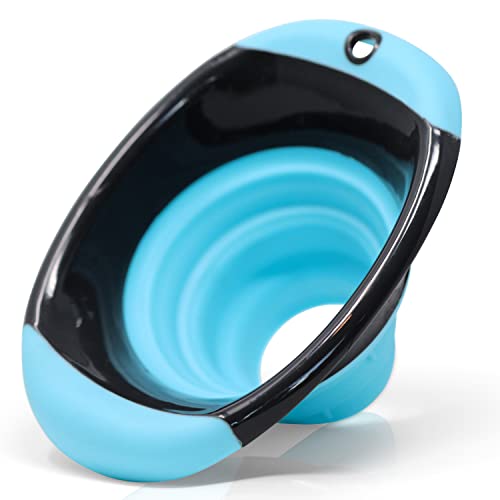
Brewing America is the clearest on the point. Its listing states that the funnel stores flat for fitting in tight places, that it fits in your drawers, and that it takes up less space than big, clumsy metal or plastic funnels. It also states a hole for hanging from a hook, so it has two published answers to the storage question rather than one, and a published field of 1.9 inches.
KongNai makes the same claim in fewer words: expand to use, collapse to store, and you can hang it on the wall or put it away in a drawer. What it does not do is publish a figure for the collapsed state, and its own dimension fields read 4.7 by 4.7 by 4.5 inches, which describes a funnel standing open. A collapsible funnel with no collapsed figure is a claim without a number.
The Three Rigid Cones and Their Third Figure
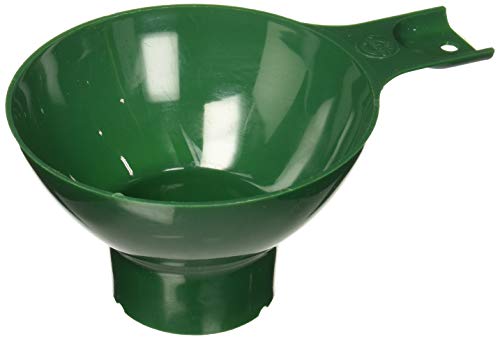
BEAMARKER, CADAVO and Pisol keep their shape. Their published fields read 4.84 by 4.84 by 2.01 inches, 5.8 by 6.2 by 2.3 inches and 5.9 by 6.88 by 2.55 inches. On a canning funnel the two larger figures are almost certainly the mouth and the overall span across a handle, and the third is what is left, but not one of the three listings labels its fields, so none of that is stated anywhere.
CADAVO supports the reading directly by publishing a 5.8 inch wide mouth in its feature text, which is exactly its first field. Pisol publishes a 2.08 inch neck diameter and no mouth figure at all, so its 5.9 and 6.88 inch fields cannot be tied to anything the maker says. That is the practical problem with buying a funnel for a cabinet: the number you need is the one nobody names.
Where the Fields and the Maker Disagree
A 2.01 Inch Figure That Is the Stem
BEAMARKER’s third dimension field reads 2.01 inches, and its own bullet says what that figure is: a 4.84 inch mouth and a 2.01 inch stem. So the field a reader would take for the funnel’s depth is the diameter of its outlet. The size line on the same listing gives a different triple entirely, 6.5 by 4.84 by 2.97 inches, which is the only set of three figures here that describes the whole article.
This page uses the maker’s own 6.5 by 4.84 by 2.97 inch line and treats the 2.01 inch field as the stem it says it is. That matters for a shallow cabinet, because 2.01 and 2.97 inches are a full inch apart and only one of them is a dimension of the funnel. Where two published figures conflict, the sentence the maker wrote wins over the field a listing filled in.
A Collapsible Funnel Published at 4.5 Inches
KongNai’s fields are the mirror image of the same problem. Its third figure, 4.5 inches, is larger than the third figure of any rigid funnel on this page, which is the opposite of what a collapsible funnel should read. The explanation is almost certainly that the fields describe the funnel expanded, since that is the state a photograph is taken in, but the listing never says so.
So neither silicone funnel here can be compared with a rigid one on the published numbers. Brewing America’s 1.9 inch field may be its flat state or may be its open depth, and there is no sentence to settle it. The honest conclusion is that collapsibility is a stated feature on both, and that the size of the saving is not published by either maker.
Storing a Funnel Somewhere Other Than a Shelf
A Hook, a Handle and a Hole
Three of these five publish a way to get the funnel off the shelf entirely. Brewing America states a hole for hanging from a hook. CADAVO states that the funnel is designed with a handle so it can be easily hung on the wall and carried. KongNai states that you can hang it on the wall or put it away in a drawer. For a shallow cabinet that is often the better answer.
BEAMARKER and Pisol publish nothing of the kind. BEAMARKER describes an ergonomic handle for grip during use, which is not the same as a hanging provision, and Pisol describes no handle at all. Neither listing mentions a hook, a hole, a rail or a wall, so if the cabinet is the only option those two have to fit inside it as they are.
What the Material Does to the Stack
The material decides whether several of these can share a shelf. Brewing America states extra thick silicone with grip inlay in the handles, thick enough that the maker says the body stands on its own. KongNai states food grade silicone with a published heat range of minus 40 C to 250 C, the only temperature figures anywhere in this group of five.
The three rigid funnels are plastic and steel. BEAMARKER states high-quality plastic, lightweight but sturdy, and publishes 0.09 pounds. CADAVO states food grade stainless steel with a polished bottom edge that will not scratch you. Pisol states 304 food-grade stainless steel described as corrosion resistant, rust proof and non-bending. Rigid cones nest into each other; silicone ones do not, and no listing addresses nesting at all.
Which One Fits Your Kitchen
The cabinet with almost no clearance. Brewing America. It is the only listing that says outright that the funnel stores flat and fits in drawers, and it adds a hole for a hook as a second answer if the shelf is still too tight.
The reader who wants the whole funnel measured. BEAMARKER. Its size line gives 6.5 by 4.84 by 2.97 inches, the only three-figure description of a complete funnel here, plus a stated 4.84 inch mouth and a 2.01 inch stem.
The kitchen with a spare hook and no shelf space. CADAVO. Stainless steel with a handle the maker says will hang on a wall, a stated 5.8 inch wide mouth, and a polished bottom edge described as safe to handle.
The cook filling regular and wide mouth jars from one funnel. Pisol. A 2.08 inch neck diameter the maker says suits both jar types, in 304 stainless described as leak proof and non-scratching, at 0.22 pounds.
The drawer that gets a funnel and a lot else. KongNai. Silicone that expands to use and collapses to store, published for minus 40 C to 250 C, with a 1.6 inch opening the maker warns is wider than most.
What We Could Not Verify
These are the things we went looking for in the published listings and did not find:
- A collapsed thickness for either silicone funnel, which is the whole point of buying one.
- Which of the three published fields is the mouth and which is the depth, on any of the five.
- Any mouth figure for Brewing America, Pisol or KongNai.
- Whether BEAMARKER’s plastic may go in a dishwasher, which the other four all state.
- Any heat rating for four of the five, KongNai’s minus 40 C to 250 C being the only one.
- Whether the two stainless cones nest inside each other, which no listing here mentions.