How the Five Compare on the Numbers
Six yogurt makers were in this pool and one is not here. Party Desserts publishes two 2-liter inner buckets in its bullets and 2 quarts in its own title, which are different volumes, and then publishes no temperature, no timer figure and no dimensions. It includes a strainer, as Bear does, and there is nothing else on the listing to compare.
Among the five that remain, the split is not features but candor about heat. Fermentation is a temperature problem: too cool and nothing sets, too warm and the culture dies. Two listings publish the range their machine will hold. The other three, including the one designed specifically for 36 hour ferments, describe a steady temperature and never say what it is.
What the table cannot tell you is what any of these cost to run. No listing publishes a wattage, and a machine holding 110 degrees for 48 hours is drawing power the whole time. Nor does any listing publish a temperature accuracy or a variation figure, which on a culture that dies a few degrees too warm is the specification that separates a good machine from a lucky one.
The Temperature Nobody Has to Publish
Two Ranges, Four Degrees Apart
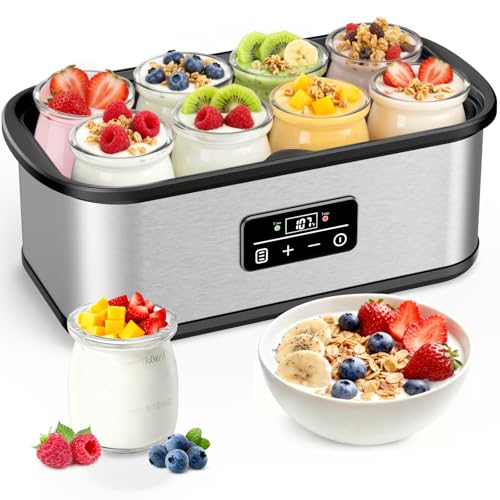
GDOR publishes 68 to 131 degrees Fahrenheit and cewajbaa 68 to 127. Both start in the same place, which is cool enough for a slow culture, and GDOR’s ceiling is 4 degrees higher. Both pair the range with a 48 hour timer and a readout showing the set values, which is what makes the range usable rather than decorative.
That pairing is the point. A range without a display means guessing, and a display without a range means reading a number you cannot interpret. These two listings are the only ones in the pool that publish both, and cewajbaa adds a clear top cover so the set can be judged by eye as well.
Three Machines That Promise Steadiness
Ultimate is the most interesting omission. Its whole listing is built on temperature stability, stating that long low-temperature ferments are where delicate cultures get ruined and that its TruTemp system holds a steady temperature for up to 48 hours, exactly the conditions for a 36 hour L. reuteri ferment. It never publishes what that temperature is or what it can be set to.
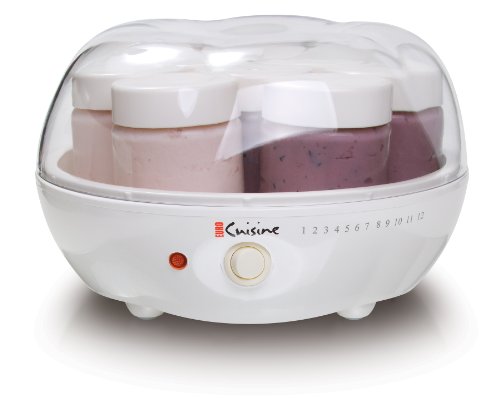
Bear states the temperature is constant for each function automatically, which means the machine chooses rather than you. Euro Cuisine publishes no temperature information at all, offering an on and off switch, an indicating light and a time reminder. All three may hold temperature perfectly well; none of the three lets you check.
Jars, Quarts and How You Will Eat It
Eight Small Jars
GDOR and cewajbaa each supply 8 BPA-free glass jars of 6 ounces, and Euro Cuisine seven of the same size. The argument is variety: each jar can take a different milk, a different starter or a different flavor in one run, and each one goes into the refrigerator with its own lid rather than being decanted.
The cost is washing up and portion size. Six ounces is a single serving, so a family eating yogurt daily will run the machine often, and eight jars plus eight lids go through the sink each time. cewajbaa and Bear both state their containers are dishwasher safe; GDOR and Euro Cuisine do not.
Two Quarts at Once
Ultimate goes the other way, with two 1-quart glass containers making about eight 1-cup servings per batch, which is a week of breakfasts in one run and two containers to wash. It also states you can use one ounce of each batch to start the next, which is how a long culture is kept going without buying starter again.
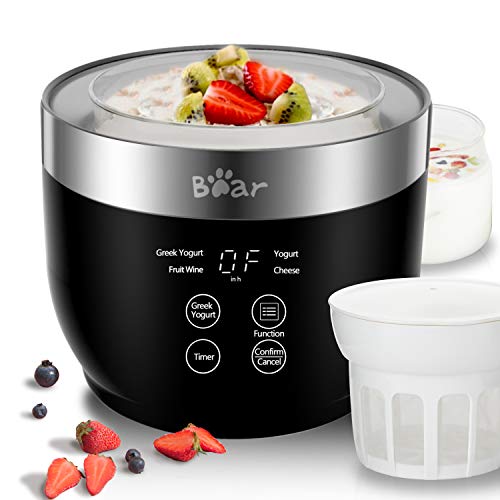
Bear supplies two 1 quart glass containers as well, plus a 304 stainless inner pot for the machine itself, which is the only stainless cooking surface in this pool. Its size field describes the containers as 2 by 33.8 ounces where its bullet says 1 quart each, two ways of saying nearly the same thing.
Greek Yogurt, Other Ferments and the Figures That Fail
Straining Is a Separate Job
Bear is the only machine here that ships a strainer, a 100-mesh food-safe one, and its listing is honest about what happens next: you will need to use the strainer and manually strain the whey out to turn plain yogurt into Greek. That is an accurate description of the process and the only mention of mesh size in the pool.
Euro Cuisine says the same thing without supplying anything, suggesting you simply strain to your desired thickness. GDOR frames thickness as a function of temperature and time rather than of straining, which is partly true and does not replace a cloth. Ultimate and cewajbaa do not raise the subject.
What Else Goes in the Pot
Bear publishes the widest set of uses: Greek yogurt, cheese, fruit wine, kefir, plant-based yogurt and enzymes, with the choice of fermentation agent left to you. That versatility is the reason for the 304 stainless pot and the 14 hour microcomputer timer, which suits an overnight ferment rather than a two day one.
Ultimate is specific in a different way, naming L. reuteri and L. gasseri and the 36 hour ferment those cultures need. Those two listings describe opposite machines: one that does many fermentations for less time, and one that does a single fermentation for longer than anything else here.
Where the Published Sizes Break Down
Bear’s dimension fields read 76.38 by 76.38 by 72.83 inches, which would be a walk-in cupboard. Its own bullet gives 7.6 by 7.6 by 7.3 inches, so the fields are millimeters in the wrong unit, and even read as millimeters they come out near 3 inches, which is too small. The maker’s sentence is the figure used here.
Euro Cuisine and Ultimate are the only two picks whose fields describe plausible machines, 9.5 by 9.5 by 5.75 inches and 7.6 by 14.37 by 5.71. GDOR and cewajbaa publish no dimensions at all, and GDOR publishes no weight either, so on that pick nothing about the physical object is stated.
Which One Fits Your Kitchen
Anyone who wants to control the ferment. GDOR publishes 68 to 131 degrees Fahrenheit, a 48 hour timer, a digital display, auto shut-off and a stainless steel body across 8 BPA-free glass jars of 6 ounces. It publishes no weight, no dimensions and no strainer.
A cook who judges yogurt by eye. cewajbaa pairs 68 to 127 degrees Fahrenheit and a 48 hour timer with an LED display of both values and a clear top cover, across 8 dishwasher-safe 6 ounce glass jars, at 4.21 pounds.
A long culture kept going for months. Ultimate holds temperature for up to 48 hours, names L. reuteri and L. gasseri, makes 2 quarts in two 1-quart glass containers, includes a recipe ebook and carries an unlimited lifetime warranty. It never publishes the temperature itself.
A kitchen that ferments more than yogurt. Bear has a 304 stainless inner pot, a 100-mesh Greek strainer, a 14 hour timer, an LED display, auto shut-off with a buzzer and dishwasher-safe containers, and also makes cheese, kefir and fruit wine at 3.5 pounds.
Someone who wants one switch. Euro Cuisine has an on and off switch, an indicating light, a time reminder and a transparent lid, with seven 6 ounce glass jars and BPA-free lids, at 9.5 by 9.5 by 5.75 inches and 4.0 pounds. It publishes no temperature at all.
What We Could Not Verify
Every figure above comes from the makers’ own listings. These are the things we went looking for and could not source.
- Three of the five publish no temperature range, including the one built around 36 hour ferments.
- No listing publishes a wattage, so the cost of holding temperature for 48 hours is unknown.
- No listing publishes a temperature accuracy or variation figure.
- Bear’s dimension fields are in the wrong unit, leaving only its own 7.6 by 7.6 by 7.3 inches usable.
- GDOR publishes no weight and no dimensions, and cewajbaa publishes no dimensions.
- Only Ultimate publishes a batch volume in quarts and servings, and only it publishes a warranty.