How the Five Compare on the Numbers
This is the one category on the site where the qualifier is a real specification rather than a figure of speech. A pressure cooker is either an appliance that occupies a socket for the length of a braise, or a pot that occupies a burner and nothing else. Four of these five are pots. One is an appliance, and it is the only one that publishes what it would draw.
So the ranking runs on two published facts: whether the cooker needs an outlet, and if it does not, exactly which cooktops the maker will vouch for. MICHELANGELO names five. Presto names four. T-Fal’s 6.3 quart says all stovetops. T-Fal’s 22 quart canner names two and by naming them rules the rest out. Instant Pot names 1000 watts at 120 V and 60 Hz.
What the table cannot tell you is what the electric pick draws while it holds pressure rather than while it heats. Instant Pot publishes 1000 watts, 120 V and 60 Hz for the base, and nothing about duty cycle, so a reader who is counting amps on one circuit has the peak figure and not the average. None of the other four draws anything at all, which is the whole point of them.
The Four That Run on a Burner
MICHELANGELO Publishes the Most and Needs the Least
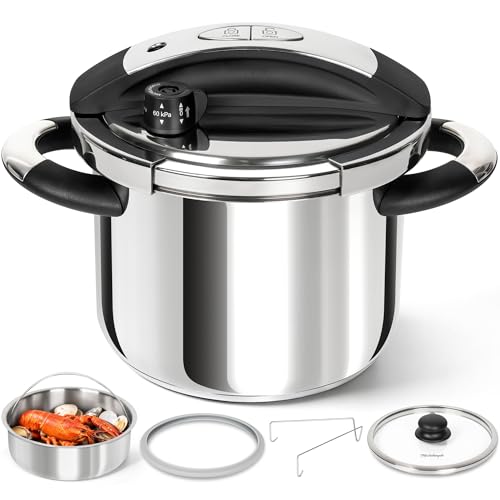
MICHELANGELO is the only pick here that publishes an operating pressure, and it publishes two: 9 PSI, given also as 60 kPa, for vegetables, seafood and steaming, and 15 PSI, given also as 100 kPa, for beans, rice, stock, stews and tougher meats. A pressure selector turns with one hand. For a cook who has no socket to give up, a pot that publishes its own numbers is worth more than a preset menu.
It is also the only pick that publishes a base construction: a 7 mm tri-ply bottom of three layers, described as keeping the base flat on the burner and distributing heat across the pot, in an 18/8 stainless body with an uncoated cooking surface. Named cooktops run to five, gas, electric, ceramic, glass and induction, and the set arrives with a glass lid, a basket, a rack and a spare gasket.
Presto and T-Fal Cover the Rest of the Hobs
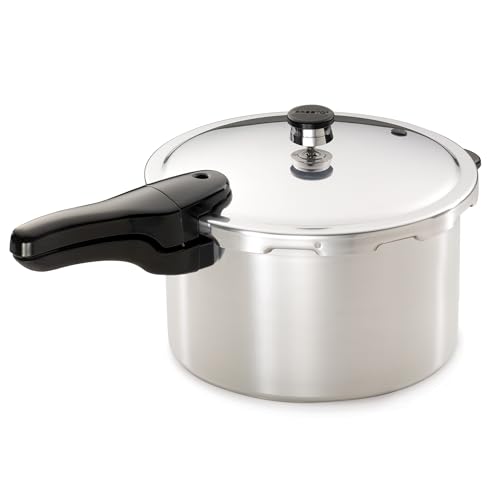
Presto’s 8 quart cooker names gas, electric, smooth-top and induction ranges, and at a published 5.75 lb it is the lightest pot on this page by a wide margin. It publishes an automatic pressure regulator with no figure attached, a cover lock indicator that will not let the lid open until pressure has fallen, and a claim of cooking 3 to 10 times faster than ordinary methods.
T-Fal’s Clipso at 6.3 quarts states compatibility with all stovetops, induction included, and leads on the lid rather than the heat: it opens and closes with one hand, there is an adjustable pressure valve instead of loose weights, and the maker names a five-point safety system. It publishes 7.7 lb, a recipe book and a steam basket, and no pressure figure at all.
The One Restriction Worth Reading Twice
T-Fal’s Canner Names Two Cooktops and Stops
The 22 quart T-Fal canner is the only pick on this page that narrows rather than widens. Its bullet states compatibility with gas and electric coil cooktops, and by naming the coil it quietly excludes the smooth glass and induction surfaces the other three pots accept. On a modern flat hob that is a reason not to buy it, and the listing is doing you a favor by saying so.
Everything else about it is scaled for preserving: 22 quarts, the largest capacity here, two canning racks for stacking jars, a step-by-step canning guide, support for both the pressure method for low-acid foods and boiling-water canning for high-acid ones, and a one-year warranty. It publishes three PSI settings without publishing what any of the three are, which is an odd gap on a canner.
Why Cooktop Wording Matters More Than It Looks
Four pots, four different phrasings, and they are not interchangeable. All stovetops is a blanket claim. Gas, electric, ceramic, glass and induction is a list, and a list is auditable. Gas, electric, smooth-top and induction is a shorter list that reaches the same places by different names. Gas and electric coil is a fence.
None of the four publishes a base diameter, which is the figure that actually decides whether a pot sits properly on an induction ring or a small gas burner. MICHELANGELO comes closest with its 7 mm tri-ply base and a statement about staying flat. For the other three you are trusting the compatibility sentence and nothing underneath it.
What the Electric Route Costs in Watts
Instant Pot Publishes the Figure, and It Is Not Small
The Instant Pot Duo is here as the honest counterweight. It states 1000 watts at 120 V and 60 Hz, UL and ULC listed, with over 10 safety mechanisms including overheat protection and an easy seal safety lid lock, and it replaces seven functions with one base: pressure cook, slow cook, saute, steam, rice, yogurt and keep warm. It publishes 6 quarts, 12.6 by 13.0 by 12.2 inches and 14.6 lb.
That 1000 watts is the price of the convenience, and it is not the ceiling in this pool either. Two other electric cookers here publish more: a 1200-watt heating system on one and 1600W at 120V with a US plug on a 12.8 quart commercial unit. If the free socket is shared with a kettle or a toaster, those are the figures to hold against the four pots above.
What the Electric Listings Leave Out
Two of the electric cookers in this pool publish no wattage at all, one an 8 quart stainless model and one a 6 quart ceramic nonstick multicooker, both of which publish dimensions and neither of which publishes a weight. For a page about outlets that is the one specification an electric appliance must state, and the absence is the reason neither is a pick here.
One other listing was set aside for a different reason: a replacement handle kit with a Bakelite handle and a pressure regulator valve, published with a chimney thread of 0.23 in, given also as 6 mm. It is a spare part for a cooker rather than a cooker, so it is not comparable to anything else on this page, however well documented it happens to be.
Which One Fits Your Kitchen
The cook who wants published pressures and no plug. MICHELANGELO. 6.3 quarts, given also as 6 L, with 9 PSI and 15 PSI settings, a 7 mm tri-ply base, 18/8 stainless, five named cooktops, a glass lid, a basket, a rack and a spare gasket at 11.44 lb.
The smallest burner and the lightest pot. Presto. 8 quarts at a published 5.75 lb, named for gas, electric, smooth-top and induction ranges, with an automatic pressure regulator and a cover lock indicator, and a claim of 3 to 10 times faster cooking.
The cook who struggles with lids. T-Fal Clipso. 6.3 quarts of stainless steel stated compatible with all stovetops including induction, opening and closing with one hand, with an adjustable pressure valve, a five-point safety system, a steam basket and 7.7 lb.
The preserving season on a coil burner. T-Fal Canner. 22 quarts, the largest here, with two canning racks and a canning guide, supporting both pressure and boiling-water canning, and stated for gas and electric coil cooktops only, at 14.77 lb.
The kitchen that can spare one socket. Instant Pot. 1000 watts at 120 V and 60 Hz, UL and ULC listed, seven cooking functions in a 6 quart base with over 10 safety mechanisms, published at 12.6 by 13.0 by 12.2 inches and 14.6 lb.
What We Could Not Verify
These are the things we went looking for in the published listings and did not find:
- What the Instant Pot draws while holding pressure, as against its 1000 watt peak.
- An operating pressure for Presto, T-Fal Clipso or Instant Pot, none of which publishes one.
- The three PSI values the T-Fal canner says it offers as settings.
- A base diameter for any of the four stovetop pots.
- Whether the Presto 8 quart body is the aluminum of its title or the stainless steel of its bullets.
- A dimension field of any kind for MICHELANGELO, which publishes only a weight.