How the Five Compare on the Numbers
The five split into two groups by heat source. Presto and T-Fal are stovetop canners whose makers publish jar counts and name the USDA pressure canning method. Instant Pot, Midea, and Cosori are electric countertop units whose makers publish function counts and cooking modes instead. That single difference decides more purchases than any dimension on the sheet.
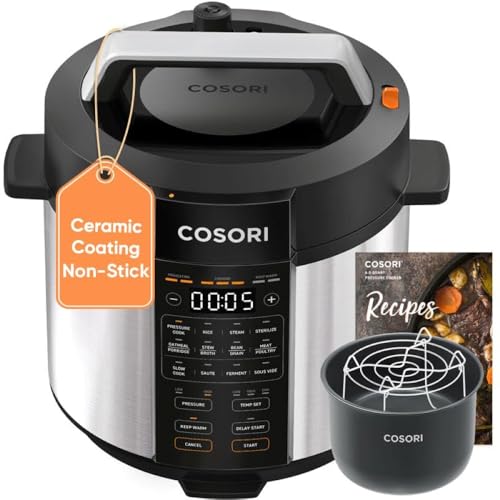
Within the electric group, the published differences are function count and capacity. Midea lists 12 functions in an 8 quart pot. Instant Pot lists 7 functions across 13 one-touch programs in a 6 quart pot. Cosori lists 9 functions, including sous vide and sterilize, in a 6 quart pot. None of the three publishes a jar count.
The table does not tell you how any of these cook. No one here has used them, and no maker publishes a tested cooking time for a specific recipe. It also cannot tell you whether a 6 quart electric unit and a 23 quart stovetop canner are substitutes, because they are not: one fits on a burner and holds jars, the other sits on a counter and holds dinner.
Canning Capacity and What Each Maker States
Published jar counts
Only two of the five publish a jar count. The Presto 01781 lists 26 half-pints, 20 pints, or 7 quarts. The T-Fal 22 Quart lists 24 half-pints, 16 wide-mouth pints, 18 pint jars, or 7 quarts. Those are the numbers to compare if preserving is the job, because they describe how many sealed jars come out of one batch.
The three electric models publish no jar count at all. The Instant Pot Duo and Cosori 6QT state 6 quart cooking capacity, and the Midea states 8 quarts. A maker that publishes no jar count is not making a canning claim, and this guide will not invent one for them.
The USDA statement
The Presto sheet states that pressure canning is the only method recommended safe by the US Department of Agriculture for canning vegetables, meats, poultry, and seafood. The T-Fal sheet states that it preserves low-acid foods using the USDA-recommended pressure canning method. Both are the makers’ own wording, repeated here as published.
No electric model on this sheet makes that statement. The Instant Pot, Midea, and Cosori sheets describe pressure cooking, slow cooking, rice, yogurt, and similar modes. That is a difference in what the manufacturer claims, not a judgment about what the appliance can do.
Electric Function Counts and Inner Pot Materials
How many modes each maker lists
Midea publishes the longest list: 12-in-1 functionality covering pressure cook, saute, steam, slow cook, oatmeal, soup, rice, bean chili, and yogurt. Instant Pot publishes 7 cooking functions and 13 one-touch smart programs. Cosori publishes 9 functions but names more of them, including sous vide, sterilize, and ferment, which the other two do not list.
Function count is not a quality measure. It is a count of what the maker chose to name on the specification sheet. A buyer who wants yogurt should note that Instant Pot and Midea both list it. A buyer who wants sous vide should note that only Cosori lists it.
Stainless steel, ceramic, and aluminum
Instant Pot states an 18/8 stainless steel inner pot with a tri-ply bottom. Midea states a stainless steel inner pot and describes stainless steel as non-reactive. Cosori states a ceramic coating inner pot that is dishwasher safe. Those three materials behave differently with acidic food, and each maker describes its own choice.
Presto and T-Fal both state aluminum construction. Presto describes warp-resistant heavy-gauge aluminum for fast, even heating. T-Fal describes durable aluminum for even heating and easy maintenance. Neither publishes a coating specification beyond the material name.
Footprint, Weight, and Counter Fit
What the dimensions decide
Midea publishes the smallest footprint of the five at 11.6 inches wide, 11.1 inches deep, and 11.6 inches tall. Instant Pot publishes 12.6 by 13.0 by 12.2 inches. Presto publishes 17.5 by 13.5 by 15.5 inches, and T-Fal publishes 15.39 by 19.33 by 16.26 inches, the largest published depth and height of the five. Cosori publishes no dimensions.
Those numbers matter for cabinet clearance and burner space. They do not describe cooking capacity. A buyer with a narrow cabinet should compare the Midea and Instant Pot figures directly, and should treat Cosori as unverifiable until the maker publishes dimensions.
Weight and handling
Cosori publishes the lightest figure of the five at 11.9 lb. Presto publishes 12.0 lb. Instant Pot publishes 14.6 lb, and T-Fal publishes 14.77 lb, the heaviest of the five. Midea publishes no weight, so it cannot be ranked on this measure.
Weight matters most for a stovetop canner that has to be lifted onto a burner while full, and for an electric unit that has to be moved out of a cabinet. The T-Fal, at 14.77 lb empty, is the heaviest published figure here, and its 19.33 inch depth is the largest on the sheet.
Which One Fits Your Kitchen
Home canners preserving low-acid food. The Presto 01781 states the USDA-recommended pressure canning method and publishes a 7 quart jar capacity, plus a dial gauge that registers the full range of processing pressures for higher altitudes.
Canning in stacked batches. The T-Fal 22 Quart ships with two canning racks and a step-by-step guide, and its maker states compatibility with gas and electric coil cooktops. Check the 19.33 inch published depth against your burner space first.
Buyers who want the most named programs. The Instant Pot Duo lists 13 one-touch smart programs across 7 cooking functions, with an 18/8 stainless steel pot and a tri-ply bottom the maker describes as suitable for searing.
Buyers who want the longest function list and an 8 quart pot. The Midea 8 Quart lists 12 functions, a stainless steel inner pot, and the REALSAFE SYSTEM. Its published footprint is the smallest of the five, though the maker publishes no weight.
Buyers who want sous vide and sterilize modes. The Cosori 6QT is the only one of the five whose maker lists sous vide, sterilize, and ferment. It publishes 12 safety features and a weight of 11.9 lb, but no dimensions.
What We Could Not Verify
Several figures a buyer would want are absent from the manufacturers’ published material. These are the gaps, stated plainly rather than estimated.
- Midea publishes no weight for the 8 Quart model, so it cannot be compared on that measure.
- Cosori publishes no width, depth, or height for the 6QT, so cabinet fit cannot be checked.
- Imusa publishes no width, depth, or height for the 7 Quart stovetop cooker.
- No maker on this sheet publishes a wattage figure for any electric model.
- No maker publishes a tested cooking time for a named recipe, only percentage claims against slow or traditional cooking.
- No electric model publishes a jar count, so canning capacity cannot be compared across the three countertop units.