How the Five Compare on the Numbers
A coffee shelf is usually the one stretch of worktop with a cupboard right above it, which makes a grinder an awkward purchase. The published heights on this fact sheet start at 4.13 inches and the biggest figure on it is more than three times that, while the footprints of every blade grinder here sit within an inch of each other. Width is not the constraint. The gap under the cabinet is.
Read that way, the sheet sorts into three groups. A crank lid at 4.13 inches. A cluster of blade grinders, four of which are the picks here at 5.9, 6.6, 6.9 and 7.13 inches. And the burr machines, which are tall by construction, because a hopper sits above a burr sits above a chamber. Every burr grinder on this sheet publishes a height above every pick on this page.
The figure this table cannot give you is the one that actually decides the purchase: how much room you need above the grinder to get the lid off and back on. Every electric model here is top-filled, several publish a lid-locking safety switch, and not one publishes a clearance. A grinder whose body nearly fills the gap is a grinder you take off the shelf to fill.
The Heights, Group by Group
The Crank Lid at 4.13 Inches
Only one listing manages it and it does so by not being a whole grinder. ByteX publishes a stainless steel lid with a ceramic burr and a manual crank, 4.13 inches high and 0.49 pounds, designed to screw onto any regular mouth mason jar. The jar is the hopper and the catch cup at once, and the maker publishes the adjustment method: remove the gold nut, the handle and the round piece, then rotate a gear-shaped piece along a threaded rod.
On a shelf its honest height is 4.13 inches plus the jar, which the listing cannot publish because the jar is yours. A tall jar can more than double that total and a squat one barely adds to it, and the listing gives no guidance either way. What it does guarantee is no socket: the maker names camping, travel and a power outage, and it is the only grinder on this sheet that works during one.
Where the Shortlist Lives
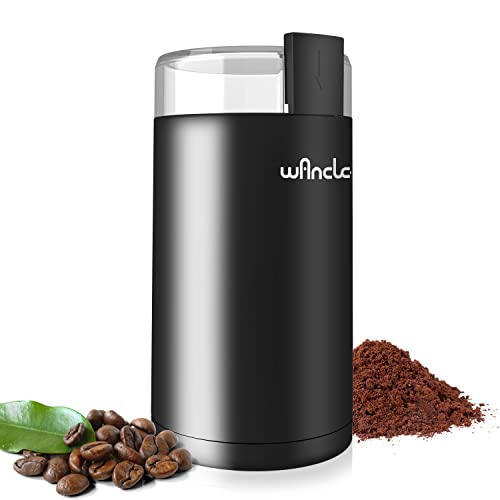
This is where the shortlist lives. Aromvel publishes 5.9 inches on a 3.4 by 3.6 inch base, with a 180W motor at 30,000 RPM and a 2.3 oz or 65 g charge for 1 to 2 cups. Wancle publishes 6.6 inches square at 3.5 inches, 60 g of beans, 150 watts, 120 VAC and 60 HZ. Amazon Basics publishes 6.9 inches and 30 grams ground in 10 seconds.
Two listings in the same band are not picks here. Secura publishes a 50 g capacity it says makes enough for 12 cups, a more generous claim than Amazon Basics makes for a similar charge. Mr. Coffee’s automatic publishes the lowest electric height on the sheet, and pays for it with a base that takes more counter than anything else in that band.
Charges, Cups and Which Unit the Maker Chose
Four Ways of Saying the Same Thing
This sheet cannot agree on how to describe a hopper. Wancle publishes 60 g. Aromvel publishes 2.3 oz and 65 g together. Amazon Basics publishes 30 grams and 1 ounce. Secura publishes 50 g. Two of the burr machines publish a hopper in ounces instead, the third only a cup range, and several blade grinders publish no bean figure at all.
Hamilton Beach and both Mr. Coffee models publish no bean weight at all, only the coffee each of them brews, counted in cups. Those claims are useful in their own way and they are not comparable with grams, because a cup figure assumes a dose nobody states. On a shelf where the machine is already chosen, the bean weight is the figure that tells you whether one pass is enough.
The One Listing That Publishes Seconds
Amazon Basics publishes that it grinds 30 grams or 1 ounce of beans for drip brewing in 10 seconds. That is the only grind time in the pool and it is worth more than it looks, because a blade grinder’s grind is set by how long you hold the button, so seconds are the setting. Every other blade grinder here describes one-touch operation and publishes no duration.
Aromvel is the only listing to publish a limit in the other direction, asking you not to run it continuously beyond a stated period and to keep the beans under the MAX line. That is a sentence about a small motor doing repeated work, which is exactly what a 2.3 oz charge means for anyone brewing a jug.
Why the Burr Machines Are Not Here
Height Is Built Into the Design
OXO publishes the biggest figure on this sheet, with stainless conical burrs and a removable hopper given in ounces. It is the best-documented grinder here and it stands more than three times as high as the ByteX, because beans have to fall through a burr into a chamber and each of the three stacks on the last. Its base takes more counter than any pick on this page.
SHARDOR publishes metallic flat burrs, a timer set in cups and a dual safety interlock on both the hopper and the chamber, in a body higher than every pick here. Cuisinart publishes 18 grind settings, a hopper in ounces and a removable grind chamber, and its height is the closest any burr grinder on this sheet comes to a low gap. It pays for that with a base that takes more counter than anything else on the sheet.
What You Give Up
Grind consistency, and the ability to set it. None of the five picks on this page publishes a grind setting: ByteX adjusts by moving a burr along a threaded rod with no numbered positions, and the four blade grinders control the grind with the button. The parent page on this site ranks this pool by published grind adjustment, from 15 settings on the OXO to a single on and off button, and it reaches a different answer for that reason.
If the cupboard is high enough, the burr machines win on the thing a grinder is for. This page exists because on a lot of coffee shelves the cupboard is not high enough, and a grinder too tall for the shelf lives on the floor of a pantry and gets used once a week rather than every morning.
Which One Fits Your Kitchen
The gap is tighter than any electric grinder here. ByteX publishes a 4.13 inch crank lid with a ceramic burr that screws onto a regular mouth mason jar, at 0.49 pounds and no socket. Add the height of whatever jar you use.
One or two cups, every morning. Aromvel publishes 5.9 inches on a 3.4 by 3.6 inch base, a 2.3 oz charge, a 180W motor and a brush and scoop. Respect its run-time note.
You want to know what it draws. Wancle publishes 6.6 inches, 3.5 inches square, 60 g of beans, 150 watts, 120 VAC and 60 HZ, at 0.84 pounds. One button and no settings.
You want to know how long it takes. Amazon Basics publishes 6.9 inches and 30 grams ground in 10 seconds behind a clear safety lid, at 1.54 pounds, the heaviest of these five.
A full jug from one pass. Hamilton Beach publishes 7.13 inches and enough grounds for up to 12 cups, and it also grinds peppercorns, fennel, sesame, flax and chia. No bean weight and no wattage published.
What We Could Not Verify
Every figure above is a manufacturer’s own published number or sentence. These are the things we went looking for across all sixteen listings and did not find.
- A lid clearance. Every electric grinder here is filled from the top and none publishes the gap needed above it.
- A bean charge for Hamilton Beach or either Mr. Coffee model, which publish a cup count and no weight.
- A wattage for thirteen of the sixteen listings. Only Aromvel, KRUPS and Wancle publish one.
- A grind time for fifteen of the sixteen. Only Amazon Basics publishes one, at 10 seconds for 30 grams.
- A total height for the ByteX on a shelf, since that is 4.13 inches plus a mason jar the listing does not supply.
- A noise figure from any of the five picks. Secura, which this page did not pick, is the only listing on the sheet that publishes decibels.