How the Five Compare on the Numbers
A replacement filter is a disc of woven steel and there is exactly one thing about it you notice every morning: how much sediment ends up in the last inch of the cup. Almost every listing in this pool says fine mesh. Far fewer put a figure on it, and the figures they do publish are not in the same units as each other.
Two of these five publish a mesh count of 100. One publishes a percentage instead, claiming 99 percent of used grounds stopped. One publishes a count of layers rather than a fineness, at four levels including a nylon one. One publishes nothing beyond the words fine mesh, and it is the only pick of the five that publishes neither a diameter nor a weight.
What the table cannot tell you is whether a 100 mesh screen from one maker filters like a 100 mesh screen from another. Mesh count describes openings per inch of weave and says nothing about wire thickness, so two screens with the same count can pass different amounts of fine silt. No listing in this pool publishes a wire gauge, an aperture in microns, or the method behind the 99 percent claim.
The Two Listings That Publish a Count
One Hundred Mesh, Twice, Described Differently
Attsky states up to 100 mesh ultra fine screen and adds that it is far better than a general French press mesh filter. Ruilida states a 100 count fine mesh screen and says it is far superior to other generic mesh filters on the market. Both are six packs at a published 4 inch diameter, and both add a reinforced center ring to keep the disc flat under the plunger.
The phrase up to is doing work in one of them. Attsky’s figure is a ceiling rather than a specification, which on a pack of six screens leaves open whether every disc is the same. Ruilida states its 100 count flatly, and is the only pick here that also publishes the center hole, at 5/16 of an inch, which is the figure that decides whether the disc sits on your plunger rod at all.
What a Mesh Count Does Not Tell You
Mesh count is openings per linear inch, so it fixes the pitch of the weave and nothing else. A coarse wire woven at 100 openings per inch leaves smaller gaps than a fine wire at the same count, and neither listing publishes a wire diameter. That is why two screens can share a figure and behave differently in the cup.
Nobody in this pool publishes the figure that would settle it, which is an aperture in microns. Ruilida is the one listing to publish anything else measurable about the weave, naming a heavy gauge steel, and heavy gauge points the wrong way for fineness: thicker wire at the same count means less open area, not more.
Two Makers Answer a Different Question
A Percentage Instead of a Count
YMMIND publishes no mesh count and instead claims a higher density filter screen that filters 99 percent of used coffee grounds. That is an outcome rather than a specification, and the listing never says what the other 1 percent is, how it was measured, or what grind it was measured at. A coarse grind passes almost nothing; an espresso grind passes a great deal.
What YMMIND does publish is the most filters, at eight, and the smallest diameter, at 3.6 inches, which it pairs with a compatibility note for 34 ounce and 3.75 inch wide presses. Eight screens at 3.6 inches is the largest count of discs in one purchase on this page, and it is aimed at a narrower press than the 4 inch picks.
Four Levels, One of Them Nylon
Easyworkz answers with layers rather than fineness, publishing an innovative four level filtration kit and then listing what arrives: one stainless steel spiral disk, one ultra fine micro nylon mesh, and one stainless steel mesh screen. Three pieces stack into the four levels, and one of them is not metal at all.
The nylon is the interesting part and the least explained. It is the only non steel filtering element in these five listings, and nothing is published about its temperature tolerance, its own fineness or how long it lasts against boiling water. Easyworkz is also the only pick here that publishes a weight, at 0.09 lb for the set, and package figures of 3.31 x 0.16 x 3.31 in.
What Happens When Nothing Is Published
The Pick With No Figure At All
MEET GREAT publishes six 304 stainless filters and describes a fine mesh design that effectively filters out coffee grounds. There is no mesh count, no percentage, no layer count, no diameter, no weight and no package figure. Its size field reads STANDARD. It states compatibility with 1 to 8 cup presses, which is the widest compatibility claim on this page and the least checkable.
It earns its place because it is what most of this pool looks like. Eleven of the sixteen listings here publish no fineness figure of any kind, and a page that showed only the four that do would suggest the category is better documented than it is. What MEET GREAT publishes that the others do not is a detachable structure, stated to allow quick rinsing.
Where the Diameter Goes Missing Too
Two of these five publish no diameter. Easyworkz names a press volume of 1000 ml and 8 cups instead, and MEET GREAT names a range of 1 to 8 cups. Elsewhere in this pool the same 34 ounce jug is served by screens published at 3.6, 3.82 and 4 inches, so a volume is not a substitute for a diameter.
The three picks that do publish one publish 4 in, 4 in and 3.6 in, and all three tell you to measure your existing filter before ordering. That instruction appears on more listings in this pool than any fineness figure does, which is a fair summary of what these makers are confident about.
Which One Fits Your Kitchen
The drinker who wants the finest figure published. Attsky states up to 100 mesh on six 4 inch screens with a reinforced center ring. Read the words up to as a ceiling rather than a promise, because the listing does not say every disc in the pack is the same.
The drinker replacing a worn screen today. Ruilida publishes a 100 count mesh, a 4 inch diameter and a 5/16 inch center hole, which is the only listing here that gives you both figures you need to know it will fit. Six screens, with a ring to stop the edge fraying.
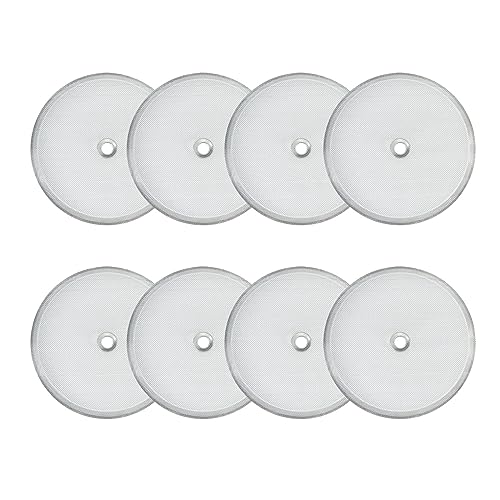
The drinker with a narrower press. YMMIND publishes 3.6 inches, states a fit for 34 ounce and 3.75 inch wide presses, and supplies eight screens in heavy gauge 304 stainless. Its filtration claim is 99 percent of used grounds, with no method given.
The drinker replacing the whole assembly. Easyworkz publishes a four level kit of a spiral disk, an ultra fine nylon mesh and a steel mesh screen, for most 1000 ml 8 cup presses, at 0.09 lb. It is the only pick with a non metal filtering layer and the only one with a published weight.
The drinker who just needs six spares. MEET GREAT publishes six 304 stainless filters, a detachable structure for rinsing, and a compatibility claim for 1 to 8 cup presses. It publishes no fineness, no diameter and no weight, which is normal for this pool rather than unusual.
What We Could Not Verify
These are the figures a buyer would want and this pool does not publish.
- No listing publishes a wire gauge or an aperture in microns, so two screens with the same mesh count cannot be compared.
- YMMIND claims 99 percent of used grounds and never says at what grind or by what method.
- Attsky says up to 100 mesh, and never says whether every disc in the six pack meets it.
- Easyworkz publishes a nylon filtering layer with no temperature tolerance, fineness or service life.
- Two of the five publish no diameter at all, and a press volume is not a substitute for one.
- Eleven of the sixteen listings in this pool publish no fineness figure of any kind.