How the Five Compare on the Numbers
Eight live pages already rank this pool: by the adjustable width range, by the clearance the maker asks for above the rack, by published width and depth, by what stops the rack moving, by published capacity, by the washing instruction, by how much of the rack goes to tools rather than plates, and by the parts list. All eight assume the rack lives over the sink permanently.
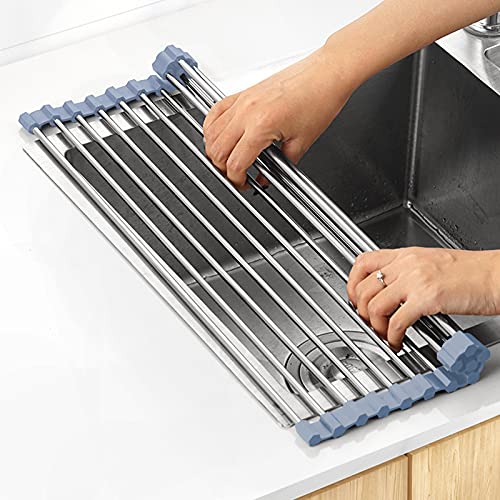
Some of these do not have to. Three of these five are roll-up racks and all three say in their own bullets that they roll for storage, one of them naming a cabinet. The figures behind that are 0.4 inches and 0.5 inches of published profile against 4.9 and 4.5 inches on the two rigid frames, which is the difference between a drawer item and a fixture.
What the table cannot tell you is what any of the three roll-ups measures once it is rolled. Every one of them publishes a flat figure and describes rolling it up, and not one publishes the diameter of the roll, which is the figure a drawer actually needs. The 0.4 and 0.5 inch fields are the unrolled thickness and nothing more.
What Happens When the Dishes Are Dry
Three Racks Roll
Both MECHEER listings publish the same instruction in the same words: soft silicone and a foldable design make the rack easy to unfold for use and to roll up for storing when not in use, and then, unusually, they name the destination. Roll up the rack and put it in your cabinet. That is the only listing text in this pool that tells you where the rack goes when it is not over the sink.
Tomorotec publishes the same mechanism and a different reason for it: quickly and easily roll it up for storage, helping to declutter your kitchen. It is also the one that spends its bullets on what the rack is made of rather than on where it goes, naming 304 stainless steel and calling out 201 stainless as what other makers settle for.
Two Are Rigid Frames
JASIWAY and Simple Trending are both small in-sink racks rather than spans, and neither folds. JASIWAY publishes 13.4 by 9.8 by 4.9 inches with adjustable support bars that let it sit inside the sink or hang over the edge. Simple Trending publishes 10.5 inches deep by 4.5 inches high with support bars extending from 14.25 to 25.7 inches.
Both are more useful while the dishes are wet and useless once they are dry. Neither listing contains a storage sentence of any kind, and a 4.5 inch frame with ten recessed plate spaces does not go in a drawer. They earn their place here because they are the only racks in this group small enough to live in the sink itself, which is the alternative to a drawer.
Two MECHEER Listings, One Design
The Figures That Separate Them
MECHEER appears twice in this pool with bullet text that is identical except for one line. One listing publishes 17 inches by 13.7 inches and the other 17.5 inches by 11.8 inches, so they are genuinely different objects: one is nearly two inches deeper across the sink and the other reaches half an inch further along it. Everything else is word for word the same.
That includes a frame of 18 pipes in 304 stainless steel connected with silicone, a stated support bearing of 33 lb, heat resistance to 400 F given also as 204 C, dishwasher safe, and the same list of second jobs: a drying mat, a fruit bowl, and an anti-slip cooling rack for hot pots or bakeware. Their weight fields read 0.75 lb and 0.7 lb.
A Field That Reads 0.39 Three Times
The 17.5 inch listing has all three dimension fields reading 0.39, the same figure three times over, which is a placeholder rather than a measurement. Its own first bullet gives 17.5 inches by 11.8 inches, so we have used the maker’s sentence and discarded the fields. The sibling listing’s fields read 13.7 by 17.5 by 0.4 inches, which is consistent with its own sentence.
That accident is useful, because the working listing supplies the figure the broken one cannot: 0.4 inches of thickness for the same construction, the same 18 pipes and the same silicone. We have not transferred the figure onto the other listing, since the two publish different footprints and the thickness is not stated to be shared. It does tell you the order of magnitude involved.
What the Roll-Ups Give Up
No Plate Slots and No Caddy
Simple Trending publishes ten recessed spaces to keep plates stable, five cup holder positions and a utensil caddy with drainage holes. JASIWAY publishes a capacity of seven standard plates and two small cups, and says plainly that it is designed for one or two people and not for large families or big sinks. Neither MECHEER listing nor the Tomorotec publishes a plate count or a slot of any kind.
That is the trade. A roll-up rack is a flat grid of rods, so plates rest on it rather than standing in it, and nothing holds a bowl at an angle. MECHEER describes its product as a drying mat before it describes it as a rack, which is an honest summary of what a rolled grid of 18 pipes actually is.
A Mat That Takes Hot Pans
The flatness buys something back. Both MECHEER listings publish heat resistance to 400 F, given also as 204 C, and name using the rack as a cooling rack for hot pots or bakeware. Tomorotec states it is heat safe without a figure and adds cutting fruit and vegetables on it, and says the surface is suitable for both hand washing and machine washing.
Neither rigid rack publishes a heat rating at all, and Simple Trending publishes no washing instruction either. JASIWAY says its smooth wire frame rinses under the tap in seconds with no disassembly, which is the most specific cleaning sentence among the two frames and still less than either MECHEER gives.
Which One Fits Your Kitchen
You want the rack gone between washes. MECHEER’s 17 inch listing. A published thickness of 0.4 inches, 0.75 lb, and the only storage instruction in this pool: roll it up and put it in your cabinet.
You load it with cast iron. Tomorotec. 304 stainless steel with silicone edges, stated to support 70 lb with all rods in use, 0.5 inches thick and 0.8 lb, and it rolls.
Your sink opening is narrow across. MECHEER’s 17.5 inch listing, published at 17.5 by 11.8 inches in the maker’s own words. Ignore its dimension fields, which read 0.39 three times.
You wash for one or two people. JASIWAY. 13.4 by 9.8 by 4.9 inches, stated to hold seven plates and two small cups, with support bars that let it sit in the sink or over the edge.
You want plates to stand up. Simple Trending. Ten recessed plate spaces, five cup positions and a utensil caddy, 4.5 inches high, with bars extending from 14.25 to 25.7 inches.
What We Could Not Verify
These are the specifications we went looking for in all five listings and did not find.
- What any of the three roll-up racks measures once it is rolled, which none of them publishes.
- A thickness for the MECHEER 17.5 inch listing, whose fields read 0.39 three times.
- A heat figure from Tomorotec, which states only that it is heat safe.
- A steel grade from JASIWAY, and any material statement at all from Simple Trending.
- A washing instruction from Simple Trending.
- Why Tomorotec publishes 70 lb and both MECHEER listings publish 33 lb for a similar grid of rods.