How the Five Compare on the Numbers
A pasta rack has to fit a counter, so the size slot on the listing is where a buyer looks first. On these five it holds five different kinds of thing: a labeled set of three figures, a labeled pair, the material of the base, the material of the whole rack, and a sentence about the length of one arm. Only two of the five put a size of the rack there at all.
The dimension fields are no more consistent. One listing’s three fields are exactly the three figures its own bullet states. One publishes a stated height its field rounds differently. Two publish fields that contain none of the figures their bullets give. The fifth states no size in words anywhere, so its three fields are the only measurement of it that exists.
What the table cannot settle is which of the three fields is the standing height on the two listings whose bullets and fields do not overlap. Nor can it tell you how much pasta any of the five takes, because only Weston publishes a figure for the hanging run and the rest describe their capacity as large.
The Two Listings That Put a Size in the Slot
Cedilis Labels All Three Axes and Its Fields Agree
Cedilis is the benchmark on this page and it is also the odd product out. Its slot gives 16.5 in long, 12.6 in wide and 3 in high, with each figure labeled. Its third bullet repeats all three. Its dimension fields read 12.6 in, 16.5 in and 3 in, which is the same three figures reordered, so the slot, the sentence and the data all agree.
What it is not is an arm rack. Cedilis ships two stackable wooden trays with a plastic mesh floor, each standing on three supports, and the 3 mm mesh holes are what hold the pasta rather than a rod. Anyone wanting strands hung vertically should look elsewhere, but as a demonstration of what a complete size slot looks like it has no rival here.
Weston Labels Two Figures and One of Them Is a Rod
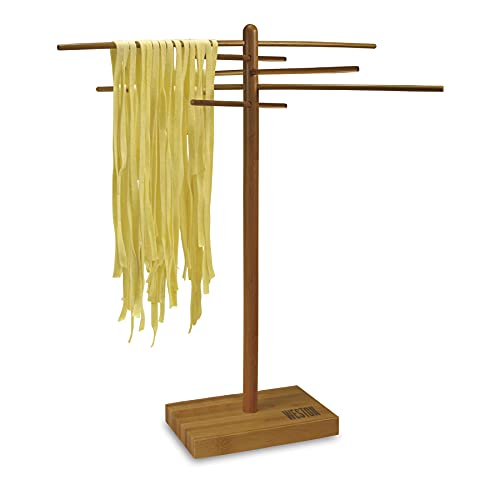
Weston’s slot reads 16 in tall and 14 in wide, which looks like the answer until you read the bullets. The 14 in is the length of each of the five rods that slide into the stand to make ten arms, so it is the span across the arms rather than the footprint. The base is published separately at 6 in by 4 in.
Its own height field reads 16.3 in against the stated 16 in, a rounding its listing never reconciles. The other two fields are 6 in and 1 in: the 6 in is the base figure and the 1 in matches nothing stated. Weston does publish the one capacity figure on this page, 66 in of hanging space, and it is the lightest here at 0.4 lb.
When the Slot Names a Material Instead
STWWO Puts Marble in the Slot and Three Figures in a Bullet
STWWO fills the slot with the words Marble Base, which tells you what the rack stands on and nothing about how much counter it needs. The figures are in a bullet instead: 18.5 in tall, a heavy duty 12 in round base and 21.5 in long arms. That is the most complete set of stated figures on this page after Cedilis.
The trouble is that its dimension fields contain none of them. The fields read 17.72 in, 11.81 in and 16.93 in, against stated figures of 18.5 in, 12 in and 21.5 in. Each field is close to a stated figure without matching it, and nothing on the listing says which set to trust. It is also the heaviest pick here at 3.31 lb, with 304 stainless steel arms.
KITCHENDAO Names the Material and Never States a Size
KITCHENDAO’s slot says Bamboo. Its title names the material, the rod count and the transfer wand, and none of its six bullets contains a measurement of any kind. So the only figures that describe this rack are its three dimension fields, 11 in, 11.8 in and 12.8 in, and a published weight of 1.26 lb.
There is nothing to check those fields against, which cuts both ways. No sentence contradicts them, and no sentence confirms them either. It publishes twelve rods, the most of these five, plus the transfer wand that no other pick here includes, so the listing is specific about what arrives and silent about how big it is.
The Slot That Is a Sentence About One Arm
Ferrochef Measures a Component and Declares Its Unit
Ferrochef’s slot is not a value at all but a clause: each arm is 13.8 inches, or 35 cm, long. It describes one of ten rods on a wall mounted rack, which is a genuinely useful figure and not the size of anything a counter has to hold. No other listing on this page puts a sentence in that slot.
It is also the only place on this page where a maker shows which unit it works in, by publishing both halves of one measurement. That matters for reading its own fields: 3.94 in, or 100 mm, then 19.69 in, or 500 mm, then 2.17 in, or 55 mm. All three are round metric figures rendered into inches, which is what a maker measuring in centimeters produces.
Why a Component Figure Cannot Stand In for a Size
The 13.8 in arm length appears in none of Ferrochef’s three fields, and that is the point. A reader who treated the slot as the product’s size would plan for a 13.8 in object and receive a folding wall rack whose three published fields are 3.94 in, 19.69 in and 2.17 in. The arm figure answers how long a strand can hang, not where the rack goes.
Eight of the sixteen size slots on this fact sheet hold a word with no figure in it, and four of those eight name a material rather than a size. That is half the sheet declining the question, which is why this page ranks by whether the slot can be read as a measurement before it ranks by any figure inside it.
Which One Fits Your Kitchen
You want the listing that leaves nothing to guess. Cedilis labels all three axes in its slot, 16.5 in long by 12.6 in wide by 3 in high, repeats them in a bullet and publishes the same three as its fields. Accept that it is two flat mesh trays at 1.5 lb, not a rack with arms.
You hang long strands and store the rack flat. Weston states 16 in of height, 66 in of hanging space, a 6 by 4 in base and ten arms from five 14 in rods, and breaks into seven pieces. It is the lightest here at 0.4 lb. Its height field reads 16.3 in rather than 16 in.
You want weight in the base rather than on the counter. STWWO states 18.5 in tall, a 12 in round base and 21.5 in arms in 304 stainless steel, and it is the heaviest pick at 3.31 lb. Its slot names marble and its fields disagree with all three stated figures.
You want the rack off the counter entirely. Ferrochef mounts on a wall, folds away, and publishes 13.8 in, or 35 cm, for each of its ten arms. Its fields read 3.94 in, 19.69 in and 2.17 in at 1.38 lb. It states no height and no capacity.
You want the most rods and a transfer wand. KITCHENDAO publishes twelve rods, anti slip feet and a wand, in natural bamboo at 1.26 lb. Its slot says Bamboo and its listing states no measurement anywhere, so plan against its fields of 11 in, 11.8 in and 12.8 in.
What We Could Not Verify
Each of these is something a buyer would reasonably want and no listing among these five publishes:
- Any measurement at all in KITCHENDAO’s own words. Its title and six bullets name a material, a rod count and a wand, and no figure.
- Which of STWWO’s two sets of figures is the rack. Its bullet states 18.5 in, 12 in and 21.5 in and its fields read 17.72 in, 11.81 in and 16.93 in.
- Why Weston’s slot says 16 in tall and its height field says 16.3 in. Neither figure is marked as the one to use.
- What Weston’s 1 in field measures. It appears in no bullet and in no part of the slot.
- A standing height or a footprint from Ferrochef. Its only stated figure is the length of one arm.
- A capacity figure from Cedilis, STWWO, Ferrochef or KITCHENDAO. Only Weston puts a number on the pasta, at 66 in of hanging space.