How the Five Compare on the Numbers
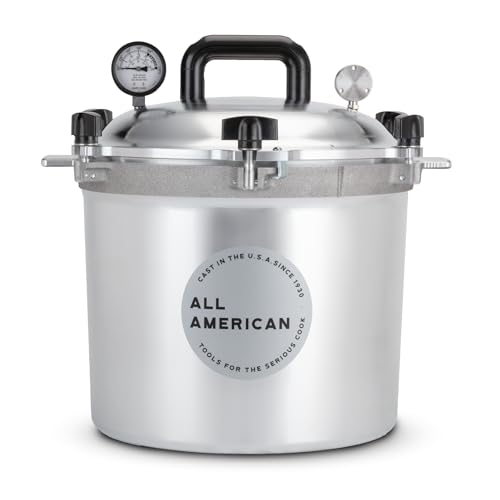
The five pressure canners on this sheet differ most in published capacity. The Presto 01784 is stated at 24.3 quarts, the Siftary at 24 quarts, the All American 921 at 21.5 quarts, the RVGMBO at 12 quarts, and the Hestroney at 10.6 quarts. Those two figures are the ends of the published range on this page.
Weight is published for only two of the five. The Presto 01784 is stated at 12.49 pounds and the All American 921 at 20 pounds. The RVGMBO, Siftary, and Hestroney do not publish a weight, so no comparison can be made for those three. Dimensions are likewise incomplete.
The table does not tell you how any of these canners performs. Nobody at Lush has used them, and the manufacturers publish capability, not results. A stated 24.3 quart size does not say how evenly the pot heats, and a stated 15 PSI does not say how steadily it holds. Read the figures as what each maker claims, not as outcomes.
Capacity and Jar Counts in Practice
What the published sizes mean
The Presto 01784 and the Siftary are the two large picks, published at 24.3 and 24 quarts. The gap between them is 0.3 quarts, which is small enough that jar count matters more than the quart figure. The Presto states 7 quarts, 20 pints, or 26 half-pints. The Siftary does not publish a jar count, so a buyer comparing the two has one stated number and one blank.
The All American 921 sits below both at 21.5 quarts and states about 19 pints or 7 quart jars. That is close to the Presto’s stated 7 quart figure but lower on pints, 19 against 20. The RVGMBO at 12 quarts and the Hestroney at 10.6 quarts are a different class, sized for smaller runs rather than a full day of preserving.
When a smaller published size is the right call
A 10.6 quart canner and a 24.3 quart canner are not competing for the same job. The Hestroney is published at 10.6 quarts, less than half the Presto’s stated size. For a household putting up a few jars at a time, the smaller published capacity means less water to heat and less empty space in the pot, though the manufacturer does not publish a weight to confirm how much lighter it is to lift.
The RVGMBO at 12 quarts sits between the two extremes and publishes something the others do not: a pressure range of 10 PSI to 15 PSI. If you want a stated low setting for delicate work and a stated high setting for meats, that published range is the only one on this sheet. The trade is capacity, since the Presto is published at 24.3 quarts against the RVGMBO’s 12.
Stove Compatibility and Sealing
Which makers state induction support
Three of the five publish induction compatibility: the Presto 01784, the RVGMBO, and the Siftary. The Presto adds gas, electric, and smooth top to its stated list. The All American 921 publishes gas, electric, or flat top stoves but does not state induction. The Hestroney publishes no stovetop types at all, so a buyer with an induction range has no stated confirmation for that model.
This is the one specification where a missing figure can stop a purchase outright. A canner that is not published as induction compatible may still work on an induction range, but the manufacturer has not said so, and this guide will not guess. Check the maker’s own listing before buying if your range is induction.
The gasket-free option
The All American 921 is the only pick whose published features describe a metal-to-metal sealing system with no gasket. The maker states that positive action clamping locks form a steam-tight seal without gaskets that need replacing. The other four do not state a sealing method, so whether they use a gasket is not published information and cannot be compared.
For a buyer who wants to avoid tracking down replacement gaskets, the All American’s stated design is the only one on this sheet that addresses the question. The cost of that design, by the published numbers, is weight: 20 pounds against the Presto’s 12.49 pounds, a difference of 7.51 pounds. The other three publish no weight at all.
Which One Fits Your Kitchen
Induction range owners. The Presto 01784, RVGMBO, and Siftary all publish induction compatibility. The Presto adds the largest stated capacity at 24.3 quarts and a 12.49 pound published weight, so it is the fullest answer if you also want volume.
Buyers who want no gasket to replace. The All American 921 is the only pick with a published metal-to-metal seal. It states about 19 pints or 7 quarts and weighs 20 pounds, so plan for the lift and the storage space.
Small-batch canners. The Hestroney is published at 10.6 quarts, the smallest here. The manufacturer does not publish a weight, jar count, or stove list, so confirm those with the seller before buying if any of them decides it for you.
Buyers who want a stated pressure range. The RVGMBO is the only pick publishing one, from 10 PSI to 15 PSI. It is 12 quarts, so it suits moderate batches rather than a full day of quarts.
Buyers who want the accessories included. The Siftary ships as a 7-piece kit with two stainless racks and one aluminum rack. It is published at 24 quarts, but the maker does not state a jar count, weight, or dimensions.
What We Could Not Verify
Several figures a buyer would want are simply not published by the manufacturers. These are the gaps.
- A pressure range in PSI for the Presto, All American, Siftary, and Hestroney. Only the RVGMBO states one.
- Jar counts for the RVGMBO, Siftary, and Hestroney. Only the Presto and All American publish them.
- Width, depth, and height for the Siftary and Hestroney. Both leave all three blank.
- Weight for the RVGMBO, Siftary, and Hestroney. No figure is stated for any of the three.
- A sealing method for the Presto, RVGMBO, Siftary, and Hestroney. Only the All American describes one.
- Stove compatibility for the Hestroney. Its published features name no stovetop type.