How the Five Compare on the Numbers
Every countertop ice maker on this page claims to clean itself. What separates them is whether the listing says how. One describes a pump that flushes residue and ships sachets to do it with. One names the procedure in plain words. One filters the water before it freezes. One asserts the function in a single clause. And one does not mention cleaning anywhere in its bullets.
That spread matters because the parts of these machines you cannot reach are the parts that spoil the ice. A reservoir, a pump and a length of internal tube are all inside the case, and the only access you have is whatever cycle the maker built and described. So the deciding specification here is published cleaning detail, not output.
What the table cannot tell you is how often any of this needs doing. Not one of the five publishes a cleaning interval, so the row that would actually plan your month is missing from every listing. It also cannot tell you what the Silonn or Frigidaire cycles do, because neither describes one.
What Self-Cleaning Means on Each of These
The two that describe a mechanism
Typhur’s listing is the only one that explains the hardware. It describes a high-pressure pump delivering a flush during the automatic cycle to remove residue, and it includes an 8-pack of cleaner solution so the cycle has something to work with. That is a claim you can picture, and the supplied consumable means the first clean does not depend on a separate purchase.
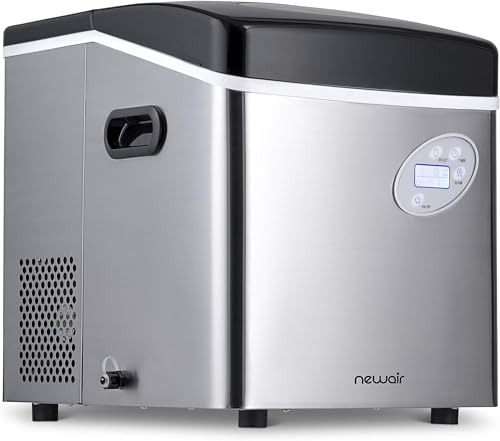
NewAir takes the other useful approach and publishes the procedure instead of the hardware. Its bullet says to add water and vinegar, press clean, and let the machine work, with no scrubbing needed. Between them these two cover the question from both ends: one tells you what the machine does, the other tells you what you put in it.
The two that assert it and the one that does not
FreezLabs publishes automatic cleaning in a list alongside forced ice removal and power failure memory, which places it as a convenience function rather than a described process. Its interesting cleaning claim is elsewhere: a built-in filter that purifies the water before it becomes ice. Silonn’s claim is a single clause naming an automatic self-cleaning function for hygienic maintenance, with no method and no consumable.
Frigidaire’s listing says nothing about cleaning in any bullet. It covers nugget texture, 15 minutes to first ice, 33 lbs a day, a 3 lb bin, fitting under a cabinet, and the useful warning that the machine does not keep ice frozen. On a page about keeping a machine clean, an absent instruction is the finding, and it is worth knowing before you put one somewhere awkward to reach.
The Water Going In and the Water Left Behind
Treating the input
Two listings here address water quality rather than cleanliness, and they do it in opposite ways. FreezLabs builds the treatment into the machine with a filter that purifies water before freezing. Typhur puts the job on you, stating that water with high minerals, impurities or added sugar can cause sandy-textured ice and recommending filtered or distilled water.
Both are honest positions and the Typhur note is the more useful sentence, because it names the symptom. Sandy ice is a water problem and no cleaning cycle corrects it. The other three listings say nothing about what to fill the tank with, which leaves the most common complaint about these machines unaddressed in their own documentation.
Getting the water out
Standing water is the reason an ice maker starts to smell, and it is addressed on only two of these five. NewAir publishes a sink-ready drain plug for emptying after each cycle, which is the single most practical cleaning feature on this page. FreezLabs lists a drainage pipe, drain plug, sealing rings, clamps and four adjustable feet in its accessory set.
Typhur, Silonn and Frigidaire publish no drainage provision at all. On a light machine that matters less, since Silonn at 14.55 lb can be carried to a sink and tipped. On Frigidaire at 21.1 lb, sitting under a cabinet by design, the absence of both a drain and a cleaning instruction is the combination to think about.
Size, Weight and Where Cleaning Actually Happens
The machines you can lift
Cleaning is easier when the machine can go to the water. Silonn is the lightest of the four that publish a weight, at 14.55 lb, with its own bullet stating 8.9 x 13.2 x 11.14 inches, and Typhur follows at 17.38 lb and 12.36 inches tall. Either can be picked up, emptied at a sink and wiped out without planning the operation in advance.
Frigidaire at 21.1 lb is a two-handed lift, and NewAir at 31.97 lb and 16.88 inches deep is one you would rather do rarely, which is exactly why its published drain plug earns its place. FreezLabs publishes no weight figure, and on a machine published at 13.48 x 28.35 x 13.85 inches that omission is the one you most want filled.
Where they are meant to sit
Frigidaire is sold on height, published at 14.8 inches and described as the right height to slide beneath kitchen cabinets. That is a genuine advantage for a counter and a genuine complication for cleaning, because a machine under a cabinet cannot be opened from above without pulling it out first.
FreezLabs is the opposite proposition, published at 13.48 x 28.35 x 13.85 inches with four adjustable feet and freestanding or under-counter placement. It wants bench run rather than headroom. Typhur and Silonn, at 12.36 and 11.14 inches tall, are the two that will fit under a wall unit and still lift out easily.
Which One Fits Your Kitchen
If you want the cleaning cycle explained. Typhur is the only listing here that describes the mechanism, naming a high-pressure pump that flushes residue, and it supplies an 8-pack of cleaner solution so the first cycle needs nothing bought separately.
If you would rather know the procedure. NewAir publishes what you actually do: water and vinegar in, press clean, no scrubbing. It also has the drain plug, which makes its 31.97 lb far less of an obstacle than it reads.
If your water is hard. FreezLabs is the one machine here that filters before freezing rather than cleaning afterwards, and it pairs that with a full drainage kit. Accept that no weight is published for it.
If it has to be carried to the sink. Silonn at 14.55 lb, with its own bullet stating 8.9 x 13.2 x 11.14 inches, is the lightest machine here that publishes a weight, which compensates for a cleaning claim that is only one line long.
If it must fit under a cabinet. Frigidaire is published at 14.8 inches tall and sold on exactly that, with 15 minutes to first ice. Go in knowing its listing publishes no cleaning instruction and no drain.
What We Could Not Verify
These are the things we went looking for in the five listings and could not source:
- How often any of the five cleaning cycles should be run. No listing states an interval.
- What the Silonn and FreezLabs automatic cycles actually do, since neither describes the process.
- What replaces the FreezLabs built-in filter, or how often, or what it costs to keep it working.
- The weight of the FreezLabs machine, which is the figure that decides whether it can be cleaned at a sink.
- Whether the Typhur cleaner sachets are required for the cycle or merely supplied with it.
- How Frigidaire intends its machine to be cleaned, since its bullets do not raise the subject.