How the Five Compare on the Numbers
Enameled cast iron sounds like a specification and behaves like a category. Across these five listings the word enamel covers a porcelain surface with a published exclusion list, a triple-layer coating, something described as non-stick, and a finish named only as enamel. One pot in this pool is not cast iron at all.
That is the deciding question here, because the coating is the part you cook on and the part that fails. No listing publishes a thickness, two publish a material or a layer count, and only two tell you how the maker wants it washed. Those are the rows worth reading before the capacity figure.
What the table cannot tell you is how thick any of these coatings is. No listing publishes a figure, so the triple-layer claim has nothing to be measured against. Nor does any listing say whether the enamel covers the exterior as well as the interior, which decides whether a scratch on the outside matters.
What the Word Enamel Is Doing in Each Listing
The two that describe the material
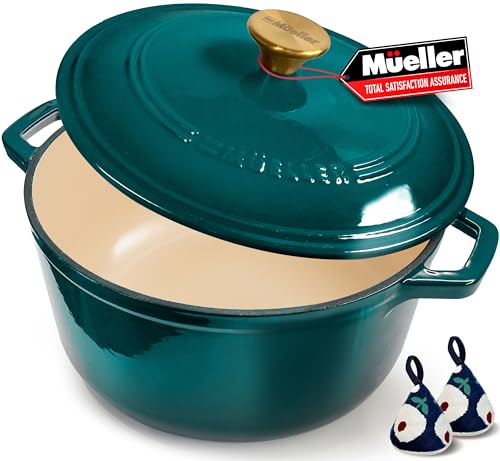
Mueller publishes the most specific account in this pool. It names the surface as high-gloss porcelain enamel and then states what it does not contain: zero PFOA, PTFE or synthetic coatings. That is an exclusion list rather than an adjective, and on a cooking surface it is the kind of claim a buyer can act on.
Overmont takes the other useful route and publishes a construction detail, a triple-layer enamel coating, along with the statement that no seasoning is required. Three layers of what is not specified and no thickness is given, so the claim is a count without a unit. It is still more than the word enamel on its own.
The two that describe a feeling
Lodge publishes enamel and the benefits of cast iron, heat retention and durability, without saying anything about the coating itself. For a maker with Lodge’s history that is a reasonable position, and it leaves a reader with no way to compare the surface against the pot next to it.
Fijinhom is the one that needs reading twice. Its listing calls the surface a non-stick coating and sells the pot as enameled cast iron, and those are not the same thing: enamel is fused glass and non-stick normally means an applied polymer. The listing does not reconcile the two terms, and that ambiguity is the single most useful thing to notice about it.
The Pot That Is Not Cast Iron
What tri-ply clad changes
Tramontina’s entry in this pool is tri-ply clad stainless steel with an aluminum core, sold as a 5 quart Dutch oven. There is no enamel, so there is nothing to chip, nothing to craze and no surface that fails. For anyone who has retired an enameled pot over a chipped interior, that is the whole argument.
What it gives up is mass. Cast iron works on stored heat, which is why the pots here weigh 12.41 to 17.2 lb at 5 to 7 quarts. Tramontina publishes no weight at all, and a clad stainless pot of that size is lighter by nature, so a long braise behaves differently: faster to respond, quicker to lose temperature when the lid comes off.
The lid caveat only it has
Every cast iron pot here publishes a 500 degree limit with no condition attached. Tramontina publishes 500F without the lid and 350F with the glass lid fitted, and that is a genuine constraint rather than a technicality, because a covered braise is the job this shape exists for.
The compensation is that you can see through it. A glass lid shows you a reduction or a rise without releasing the steam, which no enameled pot in this pool offers, and two of those publish self-basting lids precisely because they are opaque and the steam has to be put back deliberately.
Washing, Weight and Long-Term Use
The listings that tell you how to clean it
Enamel is damaged by the wrong abrasive rather than by use, which makes washing guidance more valuable than it looks. Lodge publishes both halves: the pot is dishwasher safe, and hand washing with warm soapy water and a nylon scrub brush is what the maker recommends. Naming the brush material is the useful part.
Fijinhom publishes a method too, saying to soak in warm water and then use a soft sponge or cloth. Mueller, Overmont and Tramontina publish nothing about washing, which on the two pots with the most specific coating claims is an odd omission: they describe the surface carefully and then leave its care undescribed.
Weight at matching capacity
The three 6 quart pots here weigh 12.41 lb, 12.5 lb and 14.88 lb. That is a spread of nearly two and a half pounds at identical capacity, and it is iron thickness. The 7 quart Overmont at 17.2 lb continues the pattern rather than breaking it.
Heavier is not better in the abstract. More iron holds a braise steadier and makes the pot harder to lift out of an oven with gloves on, which is the real daily cost. The 12.41 lb Fijinhom, published at 10.2 x 10.2 x 4.7 inches, is the one here that a cook with weak wrists can actually use, and 4.7 inches on one axis is the smallest figure any of these five publishes.
Which One Fits Your Kitchen
If you want to know what you are cooking on. Mueller publishes high-gloss porcelain enamel with zero PFOA or PTFE, 6 quarts at 12.5 lb, and the fullest cooktop list here including halogen and induction.
If you batch cook. Overmont publishes 7 quarts, a triple-layer enamel coating and a self-basting lid, at 17.2 lb and 12.6 inches on one axis so check your shelf.
If you want the care instructions in writing. Lodge publishes a dishwasher clearance, a recommended hand-wash method and the nylon brush to do it with, at 6 quarts and 14.88 lb.
If lifting is the problem. Fijinhom at 12.41 lb and 10.2 x 10.2 x 4.7 inches is the lightest cast iron pot here, with a published cleaning method, provided you accept its non-stick wording.
If you have chipped an enameled pot before. Tramontina is tri-ply clad stainless with a glass lid and a lifetime warranty, at 5 quarts, capped to 350F with the lid on.
What We Could Not Verify
These are the things we went looking for in the five listings and could not source:
- Any enamel thickness, so the triple-layer claim has nothing to be compared against.
- Whether the enamel on any of these pots covers the exterior as well as the interior.
- Washing guidance for three of the five, including the two with the most specific coating claims.
- A published weight for the stainless clad pot, which would show how much heat it stores.
- Whether Fijinhom’s non-stick coating and its enamel are the same surface described two ways.
- An oven limit for the Overmont, the only pot here with no published maximum temperature.