How the Five Compare on the Numbers
A glass top stove asks two things of a cast iron pan: that it be lifted rather than slid, and that the maker actually says it suits a ceramic surface. Only one listing in this pool answers the second question directly. The other four stop at induction, which is a related claim and not the same one.
The weight figures answer the first question for you. These five run from 4.8 lb to 14.75 lb, and on glass every repositioning is a lift rather than a nudge. So the deciding specifications here are the stated cooktop list and the published weight, with surface finish a distant third because it describes the face the food touches, not the side on the glass.
What the table cannot tell you is how flat any of these bases is. Not one of the five publishes a figure or a claim about the underside, and on a radiant glass surface that is the specification that governs contact and heat transfer. Every smoothness claim in this pool refers to the cooking face instead.
Only One Listing Names Your Cooktop
Ceramic, induction and the gap between them
EDGING CASTING publishes suitability for gas, electric, induction and ceramic, and that last word is the one a glass top owner is looking for. A glass or glass-ceramic cooktop is a ceramic surface with elements beneath it, which is a different arrangement from an induction coil even though both present a flat glass face.
Backcountry Iron publishes gas, electric and induction. Victoria publishes the stove, induction cooktops, the oven and a campfire. Lodge publishes that it is great for induction cooktops. None of those three names ceramic, so the compatibility is reasonable to infer and is not stated. Utopia Kitchen names no cooktop type at all.
Why the distinction is practical rather than pedantic
On induction the pan is the heating element, so the only requirements are ferrous metal and flat contact. On radiant glass the pan sits above a heating element and the glass itself takes the thermal and mechanical load, which is why cooktop makers warn about dragging and about overhang.
Cast iron satisfies both conditions easily, being both ferrous and flat. What it adds is mass, and mass on glass is handled by technique rather than by the pan. That is why the weight column on this page matters more than the finish column.
Three Listings Describe the Cooking Face, and Disagree
The one that claims smooth
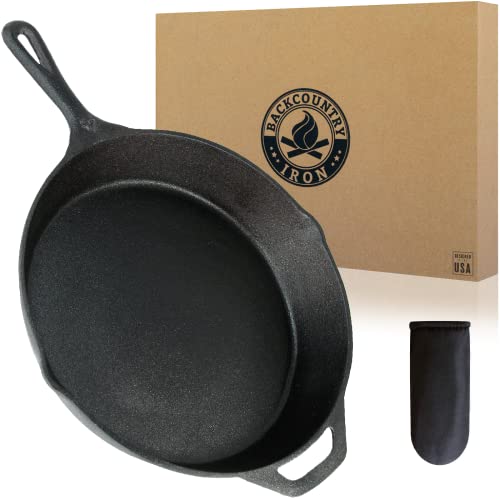
Backcountry Iron makes the boldest claim in the pool, publishing a smoother finish than other leading brands and inviting comparison with vintage Wagner and Griswold iron. That is a real position: older cast iron was machined smoother than most modern sand-cast pans, and a smoother face releases food sooner in a pan’s life.
The listing gives no roughness figure and names no brand it was measured against, so the claim is directional. A reader can act on it as a statement of intent rather than as a specification, and it is the only smoothness claim among these five.
The one that claims texture, deliberately
Victoria publishes the opposite: a textured preseasoned skin for easier release that builds seasoning with each use. That is not a concession, it is an argument. A textured surface gives polymerized oil more to grip, so the layer thickens faster and a pan that starts rougher can finish slicker.
Both positions are defensible and the choice is about time. A smooth pan performs better in month one. A textured pan is claimed to perform better by month six. On a glass cooktop neither claim touches the question that matters, because the finish described is on the face, not the base.
Handling a Heavy Pan on Glass
The case for two handles
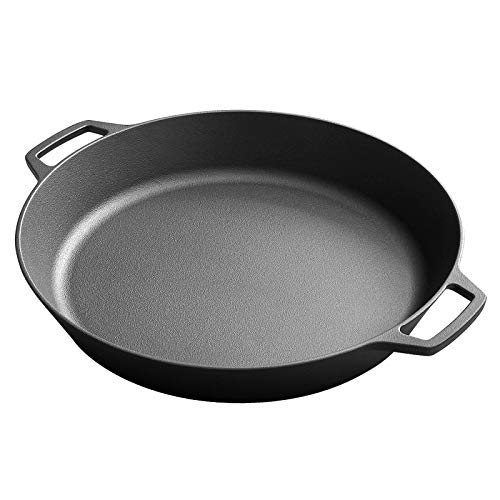
EDGING CASTING is the heaviest pan here at 14.75 lb and the only one with two integrated loop handles, one on each side. That combination is better than it first looks. A single long handle on a heavy pan is a lever, and levering a pan off a glass surface is exactly how the surface gets scratched.
With a handle on each side the pan goes straight up and straight down with the weight balanced between both hands. So the heaviest pan in this group is arguably the one designed for the most careful handling, provided you can manage 14.75 lb at all.
The case for simply being light
Victoria at 4.8 lb and Lodge at 5.35 lb solve the same problem by not creating it. Either can be picked up with one hand, repositioned and set down without a second thought, which on a glass top is worth more than any feature.
Utopia Kitchen at 7.87 lb sits in the middle, and its listing is the one that addresses handling directly, publishing specially balanced handles it says feel secure with or without oven mitts. On a glass top that is the right thing to describe, because a secure grip is what prevents a slide.
Which One Fits Your Kitchen
If you want the compatibility stated, not inferred. EDGING CASTING is the only listing here naming ceramic cooktops, with two loop handles to lift its 14.75 lb straight up off the glass.
If you want the smoothest cooking face. Backcountry Iron publishes a smoother finish than other leading brands at 7 lb on a 12 inch pan, and the clearest care instructions in the pool.
If lifting is the whole concern. Victoria at 4.8 lb is the lightest full-size pan here, with a thicker edge and a deep vessel for sauces.
If you want a lid with the pan. Utopia Kitchen supplies one at 7.87 lb on a 12 inch skillet, and publishes the fullest care sequence here: cool fully, wash gently, re-oil.
If you want to know exactly what the seasoning is. Lodge publishes 100 percent vegetable oil with no synthetic coatings, at 5.35 lb, with a three-step care routine.
What We Could Not Verify
These are the things we went looking for in the five listings and could not source:
- A base flatness figure or claim on any of the five, which is the specification that governs contact on glass.
- Whether ceramic cooktops are suitable for four of the five, which name only induction or less.
- A roughness figure behind either smooth-surface claim, or the brands one of them was measured against.
- A believable depth figure for the pan whose field reads 5 inches on a 12 inch skillet.
- Any maximum pan diameter for a domestic burner zone, which decides whether a 17 inch pan overhangs.
- Whether the two pans publishing no finish claim arrive machined or as-cast.