How the Five Compare on the Numbers
There is something worth saying before the figures. Almost nothing sold as a pickle weight is actually stainless steel. In this pool one listing puts steel under the brine and the rest are glass discs with a grip on top, so the honest specification to rank by is which material each maker names for the part that sits in the liquid, and what grade it is prepared to put in writing.
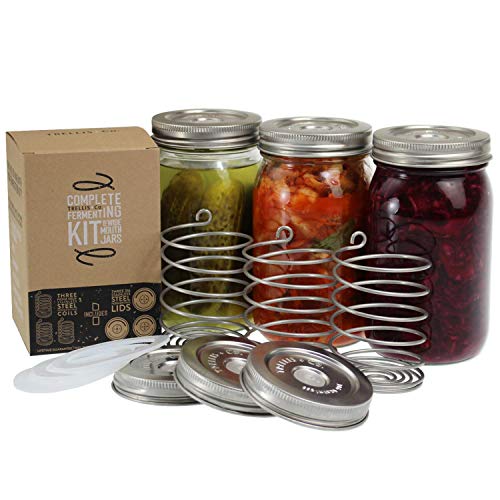
Trellis and Co. names 316 stainless steel for its lids and supplies stainless coils that press the vegetables down. Xileanalee and Elementi both name soda lime glass, the same glass as a mason jar, and both state lead free and non porous. Yesland names food safe glass that is lead free and non porous without naming the glass. Glolaurge names heavy glass and thick glass, and nothing further.
Two weight fields in that table are not usable and the page says so rather than quoting them as facts. Glolaurge publishes 700 in a pounds field for two glass discs, which is grams. Yesland publishes 0.44 pounds for nine weights that it states weigh 7 ounces each, which cannot both be true. In both cases the figure inside the maker’s own sentence is the one this page uses, and the field is set aside. No listing here publishes a glass thickness.
Steel Against Glass
The one pick with steel in the brine
Trellis and Co. is the only listing among these five that holds vegetables down with metal. The kit includes three 316 stainless steel fermentation lids with waterless silicone airlocks and three PickleHelix coils, and the maker’s argument is that commercial fermenting equipment is stainless steel and that this kit has the smallest amount of plastic available. The coil is described as easily removed for a quick bite.
The trade is that it publishes almost no figures. There is no coil diameter, no coil length, no weight for a single coil and no cleaning instruction. The dimension fields read 15 by 10 by 10 inches, which cannot describe a jar lid and is not used here. For a small batch, a coil also behaves differently from a disc: it pushes down along the whole jar rather than resting on the top of the pack.
What soda lime glass actually tells you
Xileanalee and Elementi both name soda lime glass and both make the same comparison: it is the same food safe glass as a mason jar. That is a useful sentence, because it means the weight is the same material as the vessel and will not transfer flavor or odor, and both listings state non porous and lead free alongside it.
Yesland states food safe glass that is lead free and non porous but never names the glass, and Glolaurge states heavy glass and thick glass with no safety statement at all. All four are glass discs with a grip, so the difference between them is entirely in what the maker will commit to, and on that scale Glolaurge commits to the least in this group.
Sizing a Weight to a Small Jar
The diameters, and which jars they name
Four of the five publish a diameter. Xileanalee and Yesland both state 2.75 inches, which Yesland writes as two and three quarter inches, and both name wide mouth mason jars. Elementi states 2.7 inches and goes further by naming the jar it fits, at 3.38 inches wide mouth, which is the only listing here to give both numbers.
Glolaurge is the outlier at 3.43 inches and says why: it is designed for Weck jars and for gallon jars. On a quart jar of sauerkraut that disc will not go in, so for small batch preserving it is the wrong size rather than a worse product. Trellis and Co. publishes no diameter at all, which for a coil is less of a gap than it would be for a disc.
How heavy one piece actually is
This is where the useful figures are, and they come from the sentences rather than the fields. Xileanalee states 7 ounces per weight on a disc of 2.75 inches by 0.8 inches. Yesland states 7 ounces, given also as 200 grams, on a disc of 2.75 inches by 1 inch. Glolaurge states approximately 11 to 13 ounces per weight, which is the heaviest single piece stated here.
Elementi publishes no per piece weight at all, only 1.6 pounds for the set of four, which works out slightly lighter per disc than either 7 ounce figure. Trellis and Co. publishes 0.85 pounds for three lids and three coils together, so the coil weight is unknown. For a small jar, a 7 ounce disc is the figure most of this pool converges on.
Getting It Back Out
Grips, knobs and coils
Every pick addresses retrieval, which is unusual for a pool this size. Xileanalee and Elementi both describe an easy grip handle and both add the same fallback: if the weight has sunk too deep, it can be retrieved with a fork. Yesland describes an upgraded knob handle and a smart bulge, and says it works whether your hand is dry, wet or halfway down the jar.
Glolaurge describes a built in easy lift handle that helps when the weight is wet or slippery. Trellis and Co. says the PickleHelix is easily removed for a quick bite, which is a different action: the coil comes out as a spring rather than being pinched out of the brine. None of the five publishes a grip size.
Washing up, and what the listings skip
Only two of the five say anything about cleaning. Xileanalee states dishwasher in the same bullet as its non porous glass claim. Elementi is the more specific, stating that the weights are suitable for top rack dishwashing or hand washing. Yesland, Glolaurge and Trellis and Co. publish no cleaning statement in either direction.
That is a real gap on a part that spends weeks in salt brine. Glass discs are simple objects and the risk is low, but the Trellis coil is a spring with turns that brine collects between, and it is the pick where a published cleaning instruction would matter most. The listing offers a downloadable fermentation guide instead.
Which One Fits Your Kitchen
You actually want steel under the brine. Trellis and Co. supplies three 316 stainless steel lids with waterless airlocks and three stainless coils, published together at 0.85 pounds. It is the only pick here that is not glass, and it publishes no diameter, weight per coil or cleaning route.
You want the disc measured both ways. Xileanalee states soda lime glass, 2.75 inches across, 0.8 inches thick, 7 ounces each, four to a set at 1.85 pounds, with a grip handle and the dishwasher cleared. It is the most completely documented small batch weight here.
You want to know the jar as well as the disc. Elementi states 2.7 inch soda lime glass weights for 3.38 inch wide mouth jars, four at 1.6 pounds, with top rack dishwashing or hand washing and a fork as the fallback for a sunken weight.
You ferment in several jars at once. Yesland supplies nine glass weights, each stated at 2.75 inches by 1 inch and 7 ounces, with a knob handle made for wet hands. Its 0.44 pound field cannot cover nine 7 ounce discs, so read the sentence rather than the field.
Your jars are gallons or Weck. Glolaurge supplies two weights of 3.43 inches, each approximately 11 to 13 ounces, with a built in lift handle. That diameter will not enter a quart jar, so it is the wrong size for a small batch and the right one for a big crock.
What We Could Not Verify
These are the figures a small batch weight would be judged on and the listings do not give.
- Any glass thickness, on any of the four glass picks.
- Any diameter, length or single piece weight for the Trellis and Co. stainless coil.
- Any cleaning statement from Yesland, Glolaurge or Trellis and Co.
- Why Yesland publishes 0.44 pounds for nine weights it states at 7 ounces each.
- Why Glolaurge publishes 700 in a pounds field, and what the pair actually weighs.
- A glass grade for Yesland and Glolaurge, both of which name only food safe or heavy glass.