How the Five Compare on the Numbers
The five wheels here are ranked by the published width and depth, because that is the counter a small kitchen gives up when the tool is set down. The Küchenprofi is published at 1.5 by 2.0 inches, so it covers the least counter of the five. The SHANGSKY is published at 1.54 by 6.3 inches, the Tredoni at 1.57 by 6.57 inches, and the MTOMDY at 1.5 by 6.7 inches. The Norpro is published at 3.5 by 8.5 inches, so it asks the most room.
Weight separates the group in a different way. The SHANGSKY and the Tredoni are each published at 0.09 pounds, the MTOMDY at 0.1 pounds, and the Küchenprofi at 0.2 pounds. The Norpro maker does not publish a weight, so it cannot be placed in that order. The TACGEA set publishes no width, depth, height or weight at all, which is why it is left out of the ranking.
The table does not tell you how any of these wheels behaves in dough, because nobody here has used them and the makers publish capability, not performance. It also does not tell you the blade diameter, the cut width, or the maximum dough thickness, because no maker on this sheet publishes those figures. What it does give you is the footprint, the weight and the stated function, which is what a small counter decision turns on.
Footprint and Storage on a Narrow Counter
The published figures that decide the choice
A cutting wheel is used flat and then set down, so the counter it occupies is the published width by the published depth. The Küchenprofi is published at 1.5 by 2.0 inches, which is the least counter of the five. The SHANGSKY is published at 1.54 by 6.3 inches, the Tredoni at 1.57 by 6.57 inches, and the MTOMDY at 1.5 by 6.7 inches. Those three sit in a narrow band.
The Norpro is published at 3.5 by 8.5 inches, so it asks the most room of the five. Its maker states it measures 7 by 3 by 0.75 inches and fits in a utensil drawer. If your counter is the constraint and your drawer is not, that stated drawer fit is the figure to weigh against the larger published footprint.
Height and handle length when the board is crowded
The Küchenprofi publishes a height of 7.75 inches, the Norpro 1.0 inch, and the Tredoni 0.87 inches. The SHANGSKY and the MTOMDY publish no height, so their standing footprint is unknown. A taller published height can mean the tool stands in a crock rather than lying on the counter, which is a storage choice rather than a cutting one.
Handle length is published for two of the five. The SHANGSKY states a 6.3 inch oak handle, and the MTOMDY states an oak handle on a 6.7 inch roller. A longer handle keeps the hand further from the board edge, which matters when the board itself is small and the wheel has to travel the full width of a sheet of dough.
What Each Wheel Is Stated to Do
Cutting, sealing and crimping
The Küchenprofi maker states the tool cuts, seals and crimps fresh pasta and pastry dough, and that it is made of 18/10 stainless steel. The Tredoni maker states the tool cuts, crimps, stamps and decorates, and that it is made in Italy. Those two are the only picks whose stated functions go beyond cutting alone, so each can stand in for a second tool on a counter that has no room for one.
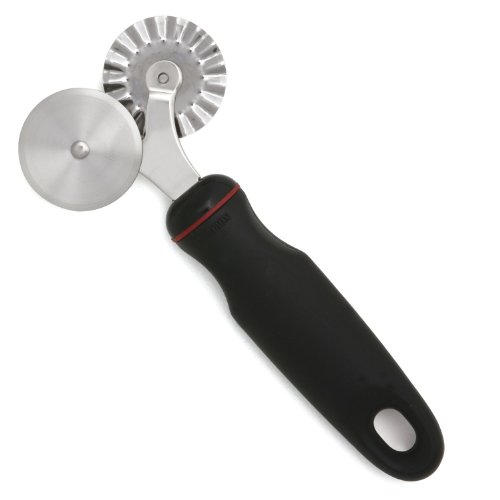
The SHANGSKY and the MTOMDY makers each state a fluted edge for cutting filled dough and noodles. The Norpro maker states two blades in one tool: a fluted wheel for scalloped edges and a smooth wheel for straight cuts. That is the only dual blade arrangement on this sheet, and it is the reason the Norpro appears here despite its larger published footprint.
Materials and handles as stated
The Küchenprofi states 18/10 stainless steel. The SHANGSKY and the MTOMDY each state a combination of zinc alloy and oak. The Tredoni states stainless steel and an ergonomic grip. The Norpro states stainless steel blades with a Santoprene handle contoured for left or right handed use. These are maker statements about construction, not results from use.
Weight follows material in the published figures. The SHANGSKY and the Tredoni are each published at 0.09 pounds, the MTOMDY at 0.1 pounds, and the Küchenprofi at 0.2 pounds. The Norpro publishes no weight. A lighter published weight is easier to lift and set aside when the counter is full, though the maker does not state how the weight is distributed along the handle.
Which One Fits Your Kitchen
You have almost no counter to give up. The Küchenprofi is published at 1.5 by 2.0 inches, the least counter of the five, and its maker states it cuts, seals and crimps. It is the pick when the board is small and the tool must come off the counter between passes.
You want the lightest tool in the hand. The SHANGSKY and the Tredoni are each published at 0.09 pounds. The SHANGSKY states a 6.3 inch oak handle, and the Tredoni states cutting, crimping, stamping and decorating. Either suits a cook who lifts the wheel often.
You want one tool to cut and crimp. The Tredoni maker states four functions: cut, crimp, stamp and decorate. The Küchenprofi maker states three: cut, seal and crimp. Both reduce the number of tools on a narrow counter, which is the point of choosing carefully here.
You want two blades without a second tool. The Norpro states a fluted wheel and a smooth wheel on one Santoprene handle. Its published footprint is 3.5 by 8.5 inches, the largest of the five, so it suits a small counter only if the tool lives in a drawer between uses.
You want a wide fluted roller. The MTOMDY states a 6.7 inch roller with fluted edges and a published weight of 0.1 pounds. It is published at 1.5 by 6.7 inches, so it lies in a narrow strip along the counter rather than spreading across it.
What We Could Not Verify
Several figures a buyer would want are not published by the makers on this sheet. These are the gaps I could not close from the listings.
- The TACGEA set publishes no width, depth, height or weight, so its footprint cannot be compared with the other five.
- The Norpro publishes no weight, so it cannot be ranked against the others on that figure.
- The SHANGSKY and the MTOMDY publish no height, so the standing footprint of each is unknown.
- No maker publishes a blade diameter, so the width of the cut cannot be compared across the five.
- No maker publishes a maximum dough thickness or a capacity, so the limits of each tool are unstated.
- No maker states how the published weight is distributed between the handle and the wheel.