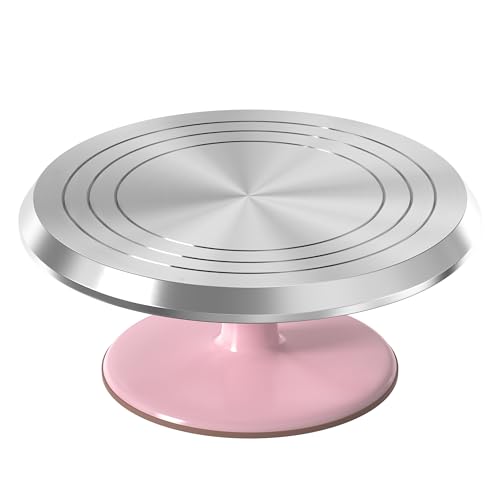
How the Five Compare on the Numbers
For small layer cakes the plate is rarely the problem. The base is. A 12 inch top holds a 6 inch cake with room to spare, but the stand still occupies counter, and the published width is the figure that states how much. The RICCLE and himaly each publish a 7.0 inch width. The Ateco and Fat Daddio’s publish 12.0 inches. The Winco publishes 13.0 inches, the largest width of the five picks.
Depth separates the RICCLE and himaly, which share a 7.0 inch width. The RICCLE publishes a 12.0 inch depth and the himaly publishes 12.2 inches, a difference of 0.2 inch. Published weights run from 1.8 lb for the Winco to 5.05 lb for the RICCLE. The Ateco and Fat Daddio’s sit in the middle at 4.8 lb and 3.97 lb.
The table does not tell you how any of these stands feels in use. Nobody at Lush has handled them, and no figure here describes performance. A stated bearing type is a claim by the maker, not a measurement. The published height is one of three dimensions and the sheet does not say which one is the object height, so treat it as a figure to compare, not as a confirmed measurement of the stand.
Footprint and the Small Cake
Why width and depth carry the decision
A small layer cake, say 6 inches across, leaves a wide margin on a 12 inch plate. The plate is not the constraint. The base is. The RICCLE and himaly each publish a 7.0 inch width, which is 5.0 inches less than the Winco at 13.0 inches and 5.0 inches less than the Ateco and Fat Daddio’s at 12.0 inches. That is the whole argument for putting them first on a narrow counter.
Depth narrows the field further. The RICCLE publishes 12.0 inches and the himaly 12.2 inches, a difference of 0.2 inch. The Ateco and Fat Daddio’s each publish 12.0 inches. The Winco publishes 13.0 inches. If the counter is shallow, the RICCLE, Ateco and Fat Daddio’s share the same published depth, and the width is what separates them.
What the weight figures say
The Winco publishes 1.8 lb, the lightest of the five picks. The himaly publishes 2.0 lb, a difference of 0.2 lb from the Winco. The Fat Daddio’s publishes 3.97 lb, the Ateco 4.8 lb and the RICCLE 5.05 lb, the heaviest of the five. A heavier stand is not automatically steadier, and the sheet makes no claim about stability for any of them.
Weight matters when the stand is lifted in and out of a cabinet. A 1.8 lb stand is easier to move than a 5.05 lb one, and the difference is 3.25 lb. For a stand that stays on the counter, the published width and depth decide more than the weight does. For a stand that travels to a class, the weight is the figure to read first.
Rotation and Grip as Stated
Bearing claims
The RICCLE states hidden stainless steel ball bearings and a full 360 degree rotation. The Ateco states an aluminum base and turntable with stainless steel ball bearings. The himaly states stainless steel bearings and 360 degree rotation. The Winco and Fat Daddio’s do not state a bearing type, so nothing can be said about how they turn. A stated bearing is a maker claim, not a measured result.
For a small layer cake the rotation matters less than it does for a tall tiered cake, because the decorator reaches less far across the plate. Even so, a stated bearing type is the only published evidence that a stand revolves at all. Three of the five state one. Two do not, and that is a real difference in what the sheet supports.
Grip claims
The RICCLE states a non-slip rubber surface and guiding lines on the plate for positioning a cake or board. The Ateco states a non-slip silicone cap on the base. The himaly states a non-slip surface and rubber feet. The Winco and Fat Daddio’s do not state a grip feature. For a small cake, which is light, a stated non-slip surface is the feature that the maker says keeps it from sliding.
The RICCLE is the only one of the five that states guiding lines. That is a positioning aid, not a performance claim, and it is the kind of feature that matters when a small cake has to sit centered on a 12 inch plate. The Ateco and himaly state grip but not lines. The Winco and Fat Daddio’s state neither.
Which One Fits Your Kitchen
Narrow counter, small cakes. The RICCLE publishes a 7.0 inch width and a 12.0 inch depth, the smallest width of the five alongside the himaly, and states guiding lines on the plate. It is also the heaviest at 5.05 lb, so it suits a stand that stays put.
Counter with room to spare, guided placement. The Ateco publishes 12.0 by 12.0 inches and states a non-slip silicone cap and stainless steel ball bearings. Its stated 12 inch round turntable matches the plate size of the RICCLE and himaly.
Stand that moves between kitchens. The himaly publishes 2.0 lb with a 7.0 inch width and a 12.2 inch depth. Against the 1.8 lb Winco it is 0.2 lb heavier, and against the 5.05 lb RICCLE it is 3.05 lb lighter. It states rubber feet.
Lightest stand of the five. The Winco publishes 1.8 lb, the lightest of the five, with a 13.0 inch width and a 13.0 inch depth. It states stainless steel construction and easy assembly, and it does not state a bearing type.
Single-piece stand with a stated footprint. The Fat Daddio’s publishes 12.0 by 12.0 inches at 3.97 lb. Its feature list states the product name only, so a reader who wants a stand with no extra claims published has one option here.
What We Could Not Verify
Several figures that would settle this comparison are not on the sheet.
- None of the five publishes a weight capacity for the plate, so no stacked cake can be planned against a stated limit.
- The Ohuhu publishes no weight at all, and the sheet gives no figure to substitute.
- The Winco and Fat Daddio’s do not state a bearing type or a rotation range.
- The Fat Daddio’s publishes no plate diameter and no plate material.
- The Ateco states a 4 inch height in its features while the listing publishes 5.0 inches, and the sheet does not say which is the object height.
- The himaly states a 2000 g net weight while the listing publishes 2.0 lb, and the sheet does not reconcile the two.