How the Five Compare on the Numbers
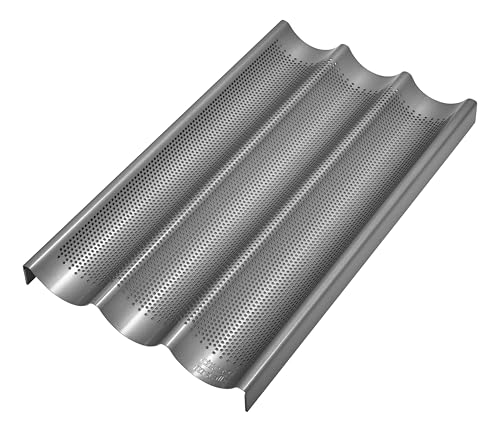
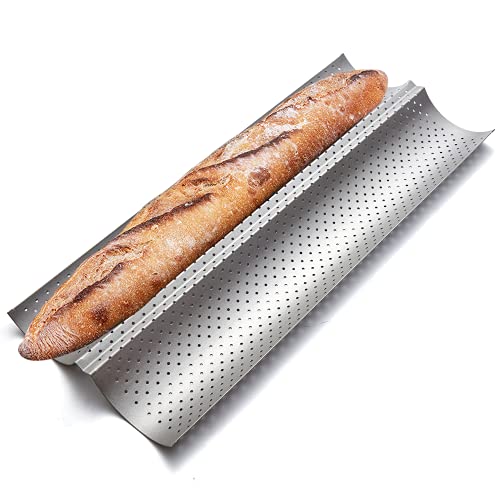
Channel count is the specification that decides this page. The Pavsrmy has four channels in a 15 by 13 inch pan. The Chicago Metallic and the Gicyiit both take three loaves, but in different footprints, 16 by 9 inches and 15 by 9.5 inches. The KITESSENSU takes two in a 15 by 6.3 inch strip. The Tiawudi is two four channel pans in one box, so eight loaves across two shelves.
Weight tracks footprint loosely. The KITESSENSU is the lightest of the five at 0.46 pounds, the Gicyiit is 0.8 pounds, the Chicago Metallic 0.86 pounds and the Pavsrmy 1.0 pounds. The Tiawudi’s 2.2 pounds covers both of its pans. Only one maker publishes the figure that actually decides a purchase, which is the smallest oven the pan fits: Pavsrmy states 1.2 cubic feet, or 35 liters.
The table cannot tell you the one thing every baker asks first, which is how wide and how deep each channel is. Only the Tiawudi puts a number on it, 2.8 inches across the gutter. A loaf shaped to the full 15 inch length sits differently in a 2.8 inch trough than in a narrow one, and nobody else publishes the figure. Hole diameter and hole spacing are also missing across all five, even though every listing sells the perforation as the point.
Channel Count, Footprint and Whether the Pan Fits the Oven
Four Channels Want a Full Size Oven
The Pavsrmy is the only pick that states which ovens it fits, and the answer is 1.2 cubic feet, or 35 liters, and upward. At 15 by 13 inches it is nearly square, and that is the shape that catches people out: a pan 13 inches across has to clear the rails on both sides, and a countertop oven rated below 1.2 cubic feet will not take it. The Tiawudi shares that 15 by 13 footprint.
Four channels also change how the bake behaves. Two loaves sit in the middle of the oven and two sit near the walls, so the pan is asking the oven for even heat across 13 inches of width. Both four channel picks answer that with carbon steel and dense perforation rather than with any published thickness figure. Neither states a gauge, so heat retention cannot be compared from the data.
Three and Two Channel Pans for Ordinary Ovens
The Chicago Metallic runs the other way, 16 inches long and 9 inches across for three loaves, which means a longer baguette in a narrower pan. The Gicyiit sits between the two at 15 by 9.5 inches, also for three, and its listing makes the fit argument explicitly, saying the three slot design fits most home ovens better than wider pans. Neither publishes a minimum oven size, so that remains a claim rather than a figure.
The KITESSENSU is the narrow option at 15 by 6.3 inches for two loaves, and at 0.46 pounds it is the lightest of the five. A strip that narrow fits a toaster oven shelf and a crowded full size oven alongside something else, and two loaves is the right number for a household that bakes a baguette to eat the same day. The trade is obvious: a party needs three passes.
Aluminum, Carbon Steel and What the Coatings Claim
The Only Aluminum Pan Here
The Chicago Metallic Commercial II is heavy weight aluminum, and it is the only one of the five that is not carbon steel. Its listing credits the aluminum with uniform distribution across all three loaf channels and no hot spots. Aluminum also explains why it is the only pick called dishwasher safe, though the same listing then recommends hand washing to preserve the coating, which is the usual compromise on a coated pan.
Its coating is the other outlier. Chicago Metallic states a two layer nonstick and still advises oiling the pan or lining it with parchment before baking. That is unusually frank for a nonstick listing, and it is worth knowing before you buy: the maker’s own best case for clean release involves parchment, which cancels part of the reason for buying a perforated pan in the first place.
Carbon Steel and the 446 F Ceiling
Pavsrmy and Gicyiit both state carbon steel rated to 446 F, described as thickened or heavy duty without a thickness figure. That rating matters for baguettes because a hot start is normal practice; 446 F sits inside the 425 to 450 range most home recipes reach at the top end, so read it as a ceiling you can work to rather than headroom. Neither maker says what happens above it.
Chicago Metallic and KITESSENSU publish no temperature rating at all, and KITESSENSU does not even name its material, which is the largest single gap on this page. Tiawudi does state 450 degrees F, calls its steel food grade and heavy duty, and offers a lifetime guarantee, while KITESSENSU offers ten years. A long guarantee is not a specification, but it is the only durability statement either of them makes.
Where the Listings Contradict Themselves
A Pan Listed at Both 1 and 1.5 Inches Deep
The Chicago Metallic’s own product name ends with 16 L x 9 W x 1.5 H, and its feature text repeats 16 by 9 by 1.5 inches. The structured height field says 1. Two of the maker’s own statements agree with each other and the third does not, so this page uses 1.5 inches and says so in the table. The difference is not trivial on a baguette pan, because channel depth is what stops a slack dough spreading flat.
The same pattern shows up on the KITESSENSU, whose title and size string both say 15 by 6.3 inches while the width field rounds to 6. The maker’s words are used here. These are small discrepancies, but they are a reminder that the tidy numbers in a specification box are often typed by someone other than the person who measured the pan, and the description is usually closer to the truth.
Where a Two Pack’s Fields Describe Nothing
The Tiawudi has the same problem from the other direction. Its own bullet states 15 by 13 by 1 inches and names a 2.8 inch gutter, while its dimension fields read 15 by 1 by 1, which is not a shape any baguette pan has. The maker’s sentence is used here and the fields are ignored, because a pan 13 inches across cannot have a 1 inch second side.
Its weight is the other figure to read carefully. The 2.2 pounds covers both pans, so a single Tiawudi tray is not comparable with the 1.0 pound Pavsrmy or the 0.86 pound Chicago Metallic unless you halve it, and the listing never does that for you. It also states 450 degrees F, which is the one temperature figure here above the 446 F the two carbon steel picks publish.
Which One Fits Your Kitchen
The baker with a full size oven and a crowd to feed. The Pavsrmy takes four loaves in a 15 by 13 inch pan and is the only pick that states the oven it needs, 1.2 cubic feet or 35 liters and up. Carbon steel rated to 446 F covers a hot start.
The baker who wants a longer loaf. The Chicago Metallic is 16 inches long where the other four are 15, and 9 inches across for three loaves. It is aluminum rather than carbon steel, the only pick called dishwasher safe, and the only one that advises parchment for best release.
The baker with an ordinary range oven. The Gicyiit takes three loaves in 15 by 9.5 inches, argues its own case on oven fit, and states 446 F and a 0.98 inch pan depth. It weighs 0.8 pounds, which makes it easy to load one handed with a proofed dough on it.
The baker with a countertop oven. The KITESSENSU is 15 by 6.3 inches for two loaves and the lightest of the five at 0.46 pounds, with a ten year warranty. You give up any published material or temperature figure, which is a real cost if you bake at the top of the dial.
The baker prepping a week of bread. The Tiawudi is two four channel pans, so eight loaves per session, and it is the only listing on this page that publishes a channel width, 2.8 inches. Its 2.2 pound figure is for both pans together, which is the only weight it states.
What We Could Not Verify
Every listing here sells perforation and channel shape, and almost none of it is specified:
- Hole diameter and hole spacing. All five sell airflow through the base and none publishes the size or pitch of the holes.
- Channel width on four of the five. Only the Tiawudi states a figure, 2.8 inches across the gutter.
- Steel or aluminum gauge. Words like thickened, heavy duty and heavy weight appear on every pick, with no thickness behind any of them.
- The coating chemistry. Pavsrmy and Gicyiit say BPA free and food grade, Chicago Metallic says two layer, and none names the coating.
- Minimum oven size for four of the five. Only Pavsrmy publishes one, so fit has to be measured at home for the rest.
- Whether the KITESSENSU is carbon steel, aluminum or aluminized steel. Its listing never says, and no temperature rating is given either.