How the Five Compare on the Numbers
The figure that decides this is the blade length each slot takes, and only three of the five publish one. Utoplike cuts two sets of slots, 8 for blades of 9.45 inches and 8 for blades of 15.7, plus a middle slot for a sharpening steel. SpaceAid holds knives up to 12 inches. Joseph Joseph stops at 9 inches. ROYAL CRAFT WOOD and Bambusi both quote a knife count and no blade length at all.
Footprint splits them the same way. Utoplike is 16.6 by 12.2 inches, which is a block that fills a wide drawer on its own. Bambusi is 17 by 5.3, Joseph Joseph 15.5 by 5.5, and SpaceAid 15 by 5.9, all narrow strips that sit beside other things. ROYAL CRAFT WOOD is 3.5 inches wide per block and ships two of them, joined by magnets or used apart.
What the table cannot tell you is how thick a blade any slot will clear, except on one listing. Bambusi is the only maker that publishes a slot thickness at all, giving 4 millimeters for its wide slots and 3 for its slim ones. A thick German chef’s knife spine can exceed 3 millimeters, which is exactly the measurement a buyer needs and the one every other listing here replaces with a knife count.
Fixed Slots Against Flexible Dividers
Grooves Cut Into Bamboo
Four of these five are a solid block with slots milled into it, and the slot count is the specification. Utoplike carves 16 of them in two lengths and adds carved grooves at the handle end so fingers can get under a knife, plus angled handle support the listing says stops a long knife shooting out of the back of the block when a drawer is slammed. That is a specific failure addressed specifically.
Bambusi cuts 16 slots in two thicknesses and points them down, so every blade sits in its own channel with the edge covered and the handle presented. Its argument is safety with children in the house, and it is the only maker here to put a millimeter figure on the slot. ROYAL CRAFT WOOD gives 7 slots per block and describes them only as individual.
Cork, Rubber and Two Tiers
SpaceAid is the only pick that does not use fixed slots. Its dividers are a cork and rubber composite that holds a blade by friction rather than by fitting a channel, which means a thick cleaver and a thin filleting knife both sit in the same tray. The limit it publishes is length, 12 inches, and it publishes no knife count because the count depends on the knives.
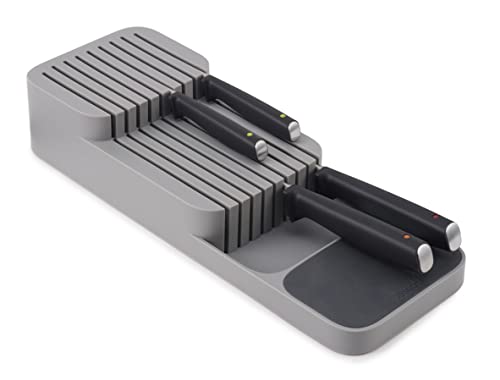
Joseph Joseph solves the same problem with height instead, stacking two tiers in one footprint: small knives above, large knives below. It is the only pick here that is not bamboo, the lightest of the four that publish a weight at 0.6 pounds, and the only one with non slip feet, which a 0.6 pound tray genuinely needs in a drawer that gets pushed shut hard.
The Blade Length Nobody Wants to Publish
Three Makers State a Limit
A knife block in a drawer either takes your longest knife or it does not, and the answer is a number. Utoplike publishes two: 8 slots cut for 9.45 inch steak knives and 8 cut for 15.7 inch knives, which covers a bread knife and a carving knife with room to spare. SpaceAid publishes 12 inches. Joseph Joseph publishes 9, which excludes most bread knives outright.
ROYAL CRAFT WOOD and Bambusi both say which knives fit by naming them instead: chef, bread, santoku, carving, utility and paring. That is a reasonable list and it is not a measurement, because a 10 inch chef’s knife and an 8 inch one are both chef’s knives. Both blocks are around 15.55 and 17 inches long overall, which sets an upper bound but not a slot length.
Why a Slot Thickness Matters
Bambusi publishing 4 millimeters and 3 millimeters is the single most useful specification on this page and it is worth explaining why. Blade thickness at the spine is what a slot has to clear, and a forged German knife is commonly thicker than a stamped Japanese one. A slot that fits a santoku will not take a heavy chef’s knife, and a buyer with a mixed set needs to know which slots are wide.
No other listing gives a figure, which pushes the risk onto you. Utoplike at least distinguishes slot lengths so the long slots are not also the narrow ones. SpaceAid sidesteps it entirely with compressible dividers that adapt to any spine. ROYAL CRAFT WOOD and Joseph Joseph publish neither a thickness nor a blade width, only a count of 14 and 9.
Fitting the Drawer
One Maker Does the Arithmetic for You
Utoplike publishes the drawer it needs rather than only its own size: an inner measurement larger than 17.1 by 12.7 inches and a height greater than 2.3 inches, for a block of 16.6 by 12.2 by 1.8. That gives half an inch of clearance on each plan dimension and half an inch above, which is the margin a drawer runner and a handle need, and no other listing here states one.
Bambusi goes a different way and is just as honest: a 17 inch drawer holds 11 knives while a 22 inch drawer fits all 16, and leave room above the 2 inch base for the handles. That is a maker admitting its own capacity claim is conditional. Joseph Joseph states a minimum drawer height of 3 inches, and SpaceAid simply prints measure your drawer height first in capitals.
Two Listings Left Out
The first was the same Utoplike block in a narrower 12 knife version, 16.6 by 9.6 by 1.8 inches, needing a drawer wider than 10.1 inches instead of 12.7. It is the right choice for a narrower drawer and it is the same product with four fewer slots, so including both would have used two of five places on one design. Its published weight is 3.65 pounds against 2.4 for the larger block, which is the kind of figure that does not inspire confidence.
The second was a single 7 slot block from the same maker as the 14 slot pair, at the same 3.5 by 15.55 by 1.8 inches. The 14 slot listing is literally two of them with magnets on the sides, and it can be separated back into two, so the pair covers the single and the single does not cover the pair. Neither listing publishes a weight.
Which One Fits Your Kitchen
The cook with a full set and a sharpening steel. Utoplike takes 16 knives in two slot lengths, 8 for 9.45 inch blades and 8 for 15.7, with a middle slot for a steel. It publishes the drawer it needs, an inner 17.1 by 12.7 inches and over 2.3 high, and carves grooves so fingers reach under a handle.
The kitchen with two narrow drawers. ROYAL CRAFT WOOD is two 7 slot blocks joined by side magnets, 3.5 inches wide each, so they work as one 14 slot block or split between drawers. It lifts out for cleaning. No weight, no blade length and no drawer requirement is published anywhere in the listing.
The household with children. Bambusi points every blade down into its own slot so edges stay covered and handles present, in finished bamboo at 17 by 5.3 by 2 inches and 2.5 pounds. It is the only pick publishing slot thicknesses, 4 millimeters and 3, and the only one asking for mineral oil.
The drawer that is deep rather than wide. Joseph Joseph stacks 9 knives on two tiers in a 15.5 by 5.5 inch footprint, needing 3 inches of drawer height. Blades up to 9 inches only, so no bread knife. Non slip feet, 0.6 pounds, hand wash, and the only pick here that is not bamboo.
The mismatched collection of knives. SpaceAid uses cork and rubber composite dividers that grip a blade by friction instead of fitting a milled slot, so a thick cleaver and a thin filleting knife share the same tray. Knives up to 12 inches, 15 by 5.9 by 2.5 inches, 2.95 pounds, fully assembled.
What We Could Not Verify
These blocks are sold by the number of knives they hold, which is the least useful figure available:
- Slot thickness on four of the five. Only one maker publishes any figure, at 4 millimeters and 3.
- Blade length for ROYAL CRAFT WOOD and Bambusi, both of which name knife types instead.
- A knife count for SpaceAid, whose flexible dividers make the count depend on the knives.
- A published weight for either ROYAL CRAFT WOOD block, and a drawer requirement for three of the five.
- What the Joseph Joseph tray is made of, beyond being the only pick that is not bamboo.
- Whether any of the bamboo blocks is finished underneath, which is what decides if it marks a drawer base.