How the Five Compare on the Numbers
Two listings in this pool were left out. One publishes no hopper capacity, no count of coarseness levels and no grinding core material across five bullets, which leaves nothing to compare. The other is more interesting: its final bullet asks the buyer to check the product height against their cabinets before ordering, and the listing then publishes no height anywhere at all. A warning about a figure the maker declines to give is not a specification.
Weight is published on all five and one figure has to be set aside. Zadelar’s 0.44 pounds cannot describe two 304 stainless grinders and a charging base, and its dimension fields of 8 by 8 by 13 inches are plainly the carton rather than a mill. Of the rest, Gaivis is the heaviest of the five at 1.5 pounds, with ioion at 1.39, ThermoMaven at 1.38 and BELRIGO at 1.37, all describing a pair.
What the table cannot tell you is how fine the fine setting is. All five talk about coarseness and not one publishes a particle size, a grind range or even the words that would let two settings be compared. Nor does any listing state how long a full hopper takes to empty at any setting, which is what a runtime claim in months would need in order to mean anything.
Two Identical Hoppers, Two Different Percentages
The 110 Milliliter Coincidence
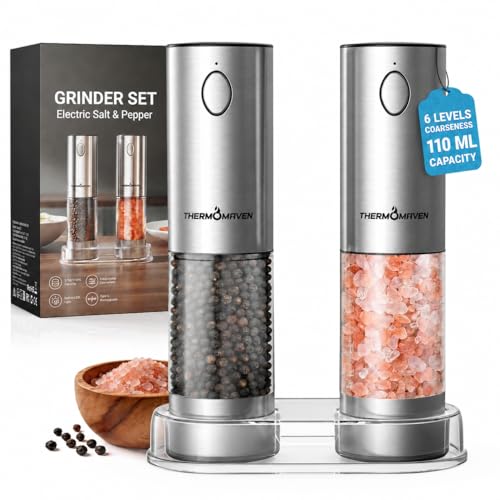
ThermoMaven and Zadelar both publish a 110 ml hopper, and both build a marketing claim on it. ThermoMaven says 250 percent more capacity than other grinders. Zadelar says it holds 40 percent more pepper. Two listings, the same stated volume, two very different percentages, and neither names the grinder it is comparing itself against.
Gaivis publishes 100 ml and converts it for you as 3.74 ounces, which is the only capacity on this page given in a unit a US kitchen uses. That figure sits a tenth below the other two, so all three of the listings that publish a hopper are within a few spoonfuls of each other. The percentages are the part with nothing behind them.
The Two That Publish No Capacity at All
BELRIGO and ioion both describe a large capacity and neither gives a number. ioion at least gives you a way to check: it publishes a transparent body so the spice level is visible at a glance, and its dimension fields describe one grinder at 2 by 2 by 7.36 inches. From the outside dimensions you can at least see the order of size you are buying.
BELRIGO publishes neither a capacity nor a dimension, since its fields describe a two pack carton and were set aside. What it does publish is a weight for one grinder, 180 grams, against a published field weight of 1.37 pounds for the pair and its packaging. Those two figures are consistent with each other, which is more than most listings here manage.
Charge It, or Feed It Batteries
Months on a Charge, and Not One Grind Counted
Three of the five are rechargeable and all three claim a runtime in time rather than in use. ThermoMaven says about a month of daily use per charge. Gaivis says up to two months, and adds the only charge time worth having: five minutes of charging is enough to season a whole meal. Zadelar claims six months from a three hour charge.
Six months is six times ThermoMaven’s claim for the same 110 ml hopper, and nothing in either listing explains the difference. A runtime in months depends entirely on how often you grind, which is exactly what the maker cannot know. None of the three publishes a number of grinds, a motor runtime or a battery capacity, so the three claims cannot be set against each other at all.
Six AAA Cells and Two Hundred Grinds
The two battery models publish the more useful figures. BELRIGO takes six AAA cells per grinder and claims over 200 grinds, which is the only runtime on this page expressed in the thing the device actually does. ioion takes four AAA cells and states they are not included, and publishes no runtime of any kind.
Twelve cells for a pair is a real running cost, and BELRIGO’s own bullet is the one that makes the case for a rechargeable. Against that, a AAA grinder works the moment you put cells in it and keeps working when a charging dock is lost. Zadelar’s dock charges both grinders at once with the ports aligned vertically, which is the tidiest arrangement here and also one more thing to keep.
How You Make It Grind, and How Fine
Tilt, Press, or Unstated
Only two of the five say how the grind is triggered. BELRIGO publishes gravity sensing: tilt the grinder and it runs, which its listing frames as suiting arthritic hands since no button has to be held. ioion publishes the opposite, a button you press to grind and release to stop, which is the design that lets you put exactly three turns of pepper on a plate.
ThermoMaven, Zadelar and Gaivis describe one handed operation without saying what the hand does. Gaivis comes closest with a phrase about effortless one handed use and an automatic LED, which implies a sensor, but the listing never states it. On a tool whose whole point is not having to twist anything, that is a strange thing for three of five listings to leave out.
Five Levels, Six Levels, or No Levels
ThermoMaven and Gaivis publish six coarseness levels. Zadelar and ioion publish five. BELRIGO publishes none, and means it as a feature: stepless adjustment, infinitely variable from fine to coarse, which is how a decent manual mill works and is genuinely different from a click stop ring.
Gaivis publishes the one detail on this page that changes the daily experience: its adjustment is external, so you set the coarseness without reaching near the grinding outlet. Every other listing here either places the adjuster inside the mechanism or does not say. If you switch between fine for a sauce and coarse for a steak in the same meal, that is the difference between clean fingers and not.
Which One Fits Your Kitchen
Refilling as rarely as possible. ThermoMaven publishes 110 ml, six coarseness levels, two Type C cables and washable seasoning contact parts, and it is the only pick to publish dimension fields for a single grinder, 2.05 by 2.05 by 7.72 inches. Its bullets name both a ceramic grinder and internal stainless grinding parts.
Keeping the pair charged on the counter. Zadelar publishes a USB C dock that charges both grinders at once, 110 ml hoppers, top refill mouths, five grind settings, a 304 stainless one piece body and a 360 day replacement policy. Its published weight and dimension fields both describe the box, not the mills.
Switching grind mid meal. Gaivis is the only pick with external coarseness adjustment, six levels set without touching the grinding outlet, on a 100 ml hopper it also gives as 3.74 ounces. It charges in five minutes for a meal and claims up to two months, and it is the heaviest of the five at 1.5 pounds.
Hands that cannot hold a button. BELRIGO publishes gravity sensing, so a tilt starts it, plus stepless coarseness, transparent washable ABS hoppers, a blue LED and one grinder at 180 grams. The cost is six AAA cells per grinder, and a claim of over 200 grinds is the only runtime here counted in grinds.
Exact control over how much goes on. ioion is the only pick with a press and release button rather than a sensor, with five levels, ceramic blades, a cleaning brush in the box and a clear body so the level shows. It takes four AAA cells and states they are not included.
What We Could Not Verify
These six things decide how an electric grinder performs, and the listings settle none of them.
- What the percentage claims are measured against. Two listings publish the same 110 ml hopper and claim 250 percent more and 40 percent more capacity, neither naming a baseline product.
- Grind size at any setting. Five listings discuss coarseness and none publishes a particle size or a range, so a fine setting on one cannot be compared with a fine setting on another.
- Runtime in any comparable unit. Three rechargeables claim a month, two months and six months, and none publishes a grind count, a motor runtime or a battery capacity.
- Hopper capacity on two of the five. BELRIGO and ioion both describe a large capacity and neither gives a figure in any unit.
- Dimensions on three of the five. Two publish package sizes only and one publishes nothing, so the height that decides cabinet fit is unknown on three.
- What the grinding core is on two of them, and which it is on a third. Zadelar and BELRIGO name no core material, and ThermoMaven names a ceramic grinder in one bullet and internal stainless grinding parts in the next.