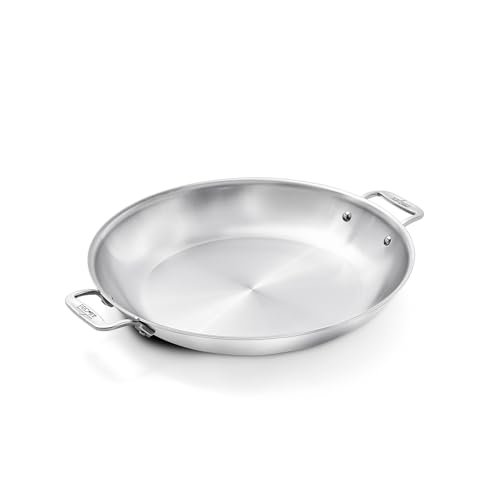
How the Five Compare on the Numbers
These five pans cover four diameters and four different metals, and the metal decides more than the diameter does. Garcima sells 40 cm of plain carbon steel with a hammered, slightly convex base and states plainly that it is not for induction. DELARLO and All-Clad are bonded stainless, five plies and three. Paelluxe puts enamel over 1.2 mm carbon steel. Imusa coats carbon steel with nonstick.
Weight follows construction almost exactly. The two carbon steel pans are the lightest that publish a figure, 2.55 lb for Paelluxe and 2.75 lb for Garcima, while the five-ply DELARLO is 6.63 lb before food goes in. All-Clad sits between at 3.28 lb for a 14 inch pan. Imusa publishes no weight at all, which for a 10 inch pan is the one figure a buyer could have guessed.
What the table cannot show is how a paella pan is meant to sit on heat. Garcima’s base is described as slightly convex and dimpled, which is a deliberate choice for an open ring and a poor one for a flat glass top. Nothing in the fields distinguishes that from DELARLO’s reinforced flat bottom. Nor does any listing publish the wall thickness of its stainless, so five plies against three is a count, not a measurement.
Carbon Steel or Clad Stainless
What Spain Actually Sells
Garcima’s listing is the least decorated of the five and the most specific about maintenance. It states that carbon steel must be dried immediately and rubbed with olive oil after use, and that darkening over time is normal rather than a fault. That is an accurate description of the metal, and it is also a commitment: the pan will rust if it sits wet in a drainer overnight, and no coating stands between the steel and the water.
The same listing rules out induction outright, which none of the clad pans do. It also throws in a use and care manual with a recipe, the only pan here whose listing mentions paper instructions. Serving four to six people is a modest claim for a 40 cm pan, and it is the only serving figure on this page that reads like a portion of rice rather than a marketing target.
What Five Plies Add, and Cost
DELARLO describes a five-layer fully clad body that carries heat up the side walls, not just across the base, and pairs it with a stainless lid for heat retention at the table. That construction is why it weighs 6.63 lb, the heaviest of the five by a wide margin, and roughly two and a half times the Paelluxe. Lifting it off a burner with a pound of rice and shellfish inside is a two-handed job.
All-Clad takes the same idea with three plies instead of five, an aluminum core between stainless layers, and reaches 3.28 lb at 14 inches. Its listing is the only one that names a factory and a year, Pennsylvania since 1971, and the only one that says handwash only, where DELARLO, Paelluxe and Imusa all describe easy cleanup. A tri-ply pan you cannot put in a dishwasher is a specific trade.
The Serving Counts Do Not Agree
Four to Six Against Twelve to Fourteen
Garcima and DELARLO are the same cooking diameter in round numbers, 40 cm against 16 inches, and their listings claim 4 to 6 servings and 12 to 14. That is not a small disagreement, it is a factor of two and a half on identical surface area. Only one of those numbers can describe a plate of paella, and the Spanish maker selling into a market that eats the dish is the one claiming the smaller figure.
Paelluxe is consistent with Garcima rather than with DELARLO: 6 servings from 13 inches, which scales sensibly against 4 to 6 from 16. Imusa’s 10 inch pan says individual portions or meals for two, which also lines up. Read across the five, DELARLO’s 12 to 14 is the outlier, and the Yeksum listing left off this page repeats the same 12 to 14 claim at the same diameter in near-identical wording.
Depth Is the Figure That Settles It
Paella is cooked in a thin layer so the rice can dry and the bottom can caramelize, which means a deep pan holds more food but makes worse paella. DELARLO is the only pan here that states a wall figure in its own text, 2.6 inches, and that bullet contradicts its published height field of 4 inches. The 4 almost certainly includes the lid, so the maker’s sentence is the one to use.
Nobody else publishes a usable wall figure at all. The height fields read 2.13 inches for All-Clad, 2 inches for Paelluxe and 1.57 inches for Imusa, and those are consistent with shallow pans, but a height field on a pan with riveted handles can just as easily be measured to the top of a handle. Paelluxe calls its own pan a deep dish design in one bullet, which the 2 inch field does not support.
Where the Published Dimensions Fall Apart
A Pan Listed Taller Than It Is Wide
Garcima’s published fields read 19.75 inches wide, 1.75 inches front to back and 19.75 inches tall, which describes no pan that has ever existed. The 1.75 is plainly the height of the walls and the 19.75 is plainly the span across the handles, with two fields swapped. The maker’s own bullet gives what matters: 16.125 inches rim to rim, and 20.25 inches with handles, so both published figures were discarded here.
That matters for a practical reason. A 40 cm pan needs 20.25 inches of clear space on a grill or a burner ring, not 16, and it will not fit inside a 24 inch oven turned sideways next to anything else. The field data would have told you 19.75, which is close enough by accident, but the pan it describes is 1.75 inches deep and square, which is nonsense.
Handles Inflate Every Width Here
The same problem is milder on the clad pans. All-Clad sells a 14 inch pan whose fields read 17.68 inches by 14.49, so the larger figure is the handle span and the smaller is roughly the rim. Paelluxe sells 13 inches and publishes 13 by 16, the same pattern. Neither maker says which figure is which, so neither can be compared against the other with any confidence.
DELARLO is the exception, publishing 16 by 16 for a 16 inch pan, which means the handle span is either missing from the figure or the pan is square. Imusa publishes 9.84 by 9.84 for a 10 inch pan, the same ambiguity in the other direction. None of these figures is wrong exactly, but none of them answers the question a buyer is asking, which is whether the pan clears their burner.
Which One Fits Your Kitchen
The cook who wants the real thing. Garcima, on a gas ring or a paella burner outdoors. Plain Spanish carbon steel, a dimpled convex base, 16.125 inches rim to rim, and an explicit instruction to oil it after drying. It will not work on induction and it will darken, both by design.
The host feeding a long table. DELARLO, for the lid and the five-ply walls rather than the serving claim. At 6.63 lb it is the heaviest here, which is the price of heat that climbs the sides. Treat 12 to 14 servings as optimistic and 2.6 inches of wall as the useful number.
The cook who uses one pan for everything. All-Clad’s D3 at 14 inches and 3.28 lb, bonded stainless that works on induction and goes from a rice dish to searing vegetables. The catch is handwash only, the single clearest restriction on this page, on a pan that otherwise asks nothing of you.
The cook who will not season steel. Paelluxe, 1.2 mm carbon steel under enamel at 2.55 lb, the lightest of the four that publish a weight. You get the thin, fast carbon steel body with a coating that resists rust and wipes clean, plus silicone handle holders, and you give up the option to scour it hard.
The one or two person kitchen. Imusa at 10 inches, nonstick coated carbon steel with riveted red handles. It is the only pan here sized for a single serving of rice rather than a gathering, and the only one whose listing carries a chemical content disclosure naming chromium, nickel and manganese compounds.
What We Could Not Verify
Everything above comes from the specification fields and the feature text these makers published. Several things a buyer would want are simply not in there.
- No maker except DELARLO publishes a wall depth, the figure that decides whether rice cooks in a thin layer or steams.
- No listing publishes a base thickness for the stainless pans, so five plies against three cannot be compared as metal.
- Imusa publishes no weight at all, so the 10 inch pan cannot be placed against the other four.
- All-Clad’s oven line reads oven and broiler safe up to 6 F, which is a truncated figure, so no oven limit was usable for it.
- Paelluxe and Imusa never state whether they work on induction, which for coated carbon steel is not predictable either way.
- No maker publishes the diameter of the flat cooking floor as distinct from the rim, and on a sloped pan those differ.