How the Five Compare on the Numbers
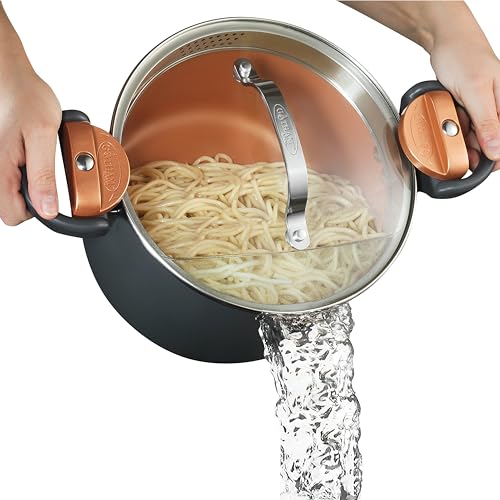
Every pot here drains its own water, but not in the same way, and that is the first fork in the decision. Cooler Concepts, Bialetti and Gotham Steel lock a perforated lid onto the rim so you tip the whole pot. Cuisinart uses a straining cover that fastens. Oster does not strain through the lid at all, and instead ships a separate strainer insert and a steamer insert inside a four piece set.
Weight barely separates them. Four of the five sit between 2.93 lb and 3.6 lb, and the heaviest of the five is the Oster, which is fair because that figure covers a pot, a lid and two inserts rather than a pot alone. Gotham Steel is the lightest at 2.93 lb. Where the five genuinely differ is shape: a tall narrow cylinder, an oval, and three conventional pots.
The table cannot tell you how hot the handles get while you are tipping a gallon of boiling water into a sink. Oster and Bialetti both claim stay cool handles. Cooler Concepts says the opposite in plain words, that the metal handles get hot and to use mitts. Gotham Steel and Cuisinart say nothing either way. That is a real difference in what you are agreeing to, and no field captures it.
Three Ways to Get the Water Out
Locking the Lid to the Pot
Three of these five put the holes in the lid and lock it down. Cooler Concepts and Gotham Steel both use twist and lock handle dials, and Bialetti’s lid twists into place with integrated straining holes. The appeal is obvious: no second vessel, no carrying a full pot across a kitchen to a colander already balanced in the sink, and no pasta lost down the drain when the colander shifts.
The cost is that the drain holes decide what you can cook. A locking lid with fixed perforations handles spaghetti and penne well, and handles orzo, pastina or anything smaller badly. None of the three publishes a hole size. Eatex, which is not on this page, is the only listing in this group that mentions dual strainers in two sizes, and it publishes no weight and an implausible height.
A Basket You Lift Out
Oster takes the other approach entirely. Its four piece set is a 5 qt pot with a lid, a steamer insert and a strainer insert, and you lift the food out of the water rather than pouring the water away. That is slower to set up and better in two specific cases: when you want the pasta water, which any sauce that needs loosening does, and when you are cooking something the holes in a lid would lose.
It is also the only pot here that steams. The same body takes a steamer insert, which makes it a two job pot in a cupboard that may only have room for one. Oster’s listing is the only one that publishes an assembled size in words, 11 inches by 8.5 by 10.5, and that matches its own published fields exactly, which is rarer in this category than it should be.
Shape Decides What Fits
Tall and Narrow Against Wide and Oval
Cooler Concepts states 9 inches tall and 6.5 inches across, and says directly why: a full 1 lb box of spaghetti stands upright in it without snapping. Its published fields agree on the narrow part, 6.3 inches front to back, and disagree on the height, giving 10.63 inches where the maker says 9. The extra inch and a half is the lid and locking handles, so the maker’s own figure is the one used here.
Bialetti solves the same problem in the opposite direction with an elongated oval, and its 16.25 inch front to back field is the length of that oval rather than any error. Long pasta lies flat rather than standing, which means you never wait for the ends to soften enough to push under. It is the only pot here that is not round, and the only one whose shape would waste space on a crowded stovetop.
What a Narrow Pot Costs
Narrow means the water column is deep, which means it takes longer to come to a boil for the same volume and boils over faster once it gets there. Cooler Concepts publishes 5.5 quarts in its title and size field and 5 quarts inside a bullet, so the working volume is somewhere in that range, in a footprint 6.5 inches across. That is genuinely useful in a small apartment kitchen and genuinely awkward for a large batch.
The three conventional pots spread the same water wider. Gotham Steel’s published fields read 9.45 inches across the body with a 13.15 inch measurement that is the handle span, and 7.15 inches of height for 5 quarts, which is a squat pot. Cuisinart is the opposite balance at 7.28 inches by 9.65 inches tall for a claimed 6 quarts, so it is closer to Cooler Concepts than to Gotham.
Coatings, Steel, and What Each One Asks of You
Ceramic and Nonstick Over Aluminum
Gotham Steel and Bialetti are both coated pots, and coatings on a pasta pot matter less than they do on a pan, because boiling water does not stick. Where they earn their place is the sauce you finish in the same pot afterwards, and the starch ring that forms at the water line. Gotham Steel states a triple coated ceramic surface reinforced with titanium, free of PFOA, PFOS, lead and cadmium.
Bialetti is nonstick coated aluminum and states PFOA free rather than listing four exclusions. Aluminum is the reason it is 3.5 lb for a large oval, and it is also the reason no induction claim appears anywhere in the listing. Neither maker publishes a temperature limit for its coating, and neither says how many years of dishwasher cycles the surface is expected to survive.
Bare Stainless and What It Does Not Do
Cooler Concepts and Cuisinart are uncoated steel, and Oster is polished stainless over an encapsulated aluminum base. Nothing can peel off any of the three. Cooler Concepts is the only pot on this page that names its alloy, food grade 304, and the only one that states induction compatibility outright, which matters because an aluminum body will not work on an induction hob at all.
What bare steel asks in return is that you accept sticking and scrubbing when you cook anything but pasta in it, and hot handles. Cuisinart’s contribution is different: it is the only pot here with measurement markings in cups and liters stamped inside, which turns a pasta pot into something you can use for a recipe that needs a measured volume of stock without a jug.
Which One Fits Your Kitchen
The small apartment cook. Cooler Concepts, at 9 inches tall and 6.5 inches across, holds a standing 1 lb box of spaghetti in a footprint narrower than a dinner plate. Food grade 304 steel, induction ready, and the only maker honest enough to warn that the handles get hot.
The person who cooks long pasta most nights. Bialetti’s oval, 16.25 inches front to back, lets spaghetti and lasagna sheets lie flat from the moment they go in. Nonstick coated aluminum at 3.5 lb, with a lid that twists and locks and handles stated to stay cool.
The cook who wants the pasta water. Oster, because you lift the strainer insert out and the starchy water stays in the pot for the sauce. It is a four piece set at 3.6 lb including a steamer insert, and the only listing here whose stated size matches its own fields.
The cook who measures. Cuisinart, for the volume markings in cups and liters inside the pot. Stainless with a straining cover that fastens, 7.28 inches across the body and 9.65 inches tall, with a capacity its own listing gives as both 6 and 6.3 quarts.
The cook who hates scrubbing. Gotham Steel, the lightest of the five at 2.93 lb, with a triple coated ceramic interior reinforced with titanium and stated free of PFOA, PFOS, lead and cadmium. The tempered glass lid lets you watch a pot that is prone to boiling over.
What We Could Not Verify
These figures are the ones the makers published. The gaps below are the ones that mattered and were not there.
- No maker publishes the size of the holes in a strainer lid, which decides whether small shapes survive draining.
- Three of these five give a different capacity in the title, the size field and a feature bullet, and none says which is correct.
- Only Cooler Concepts states induction compatibility, so the other four cannot be assumed to work on an induction hob.
- Neither coated pot publishes a temperature limit or an expected life for its coating.
- No maker publishes a base thickness, so how quickly each pot reaches a boil cannot be compared.
- Only Cuisinart mentions internal volume markings, and no maker states whether its markings are stamped or printed.