How the Five Compare on the Numbers
Cooking for a family in a wok is three jobs, not one. Food has to be turned and lifted out, sauce has to be ladled over it, and anything fried has to come out of the oil without the oil coming with it. Three of these five ship a spatula, a ladle and a skimmer together. Two ship a spatula alone, and both of those are shorter.
Length follows the same split. The three sets are all stated at 17 inches, with Berglander giving 43.5 cm as well and FJNATINH hedging to 16 to 17 inches. The two single spatulas are 14.7 and 14.8 inches. Two and a bit inches sounds trivial until you are reaching over a wok that has been on high heat for ten minutes with a family waiting.
The figure a family cook would most like is the one nobody publishes: the depth of the blade’s curve, or equivalently how much food it can carry in one lift. A spatula that holds a quarter of a wok’s contents empties it in four passes and one that holds a tenth takes ten. Width is published on four of five and depth of dish on none of them.
One Tool or Three
What the Ladle and Skimmer Are Actually For
YOSUKATA, Berglander and FJNATINH all ship the same trio and all three describe it in terms of jobs rather than pieces. YOSUKATA names stir frying, flipping and scooping. Berglander names soups, frying and straining. FJNATINH names turning and cooking. Those are three descriptions of the same workflow: the spatula moves food, the ladle moves liquid, the skimmer separates the two.
For a family meal that matters more than it does for one portion. A single serving of stir fry goes from wok to plate with a spatula and nothing else. Four portions with a sauce means you are either ladling with a spatula, which spills, or reaching for a tool from a different drawer that is six inches too short and not made of the same steel.
When One Good Spatula Is the Better Buy
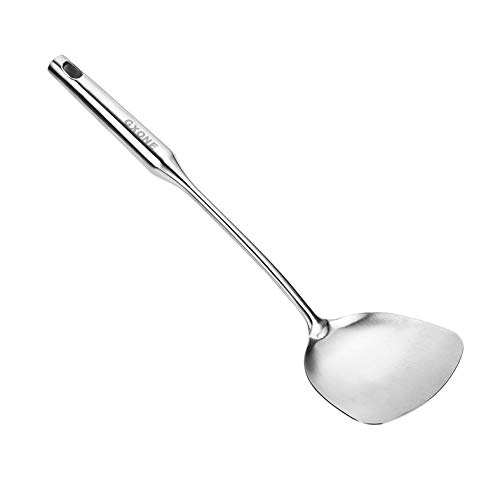
Zulay and GXONE are single spatulas and both spend their listings on the spatula itself rather than on a count. Zulay publishes a polished mirror finish, a precision angled head with a slightly curved edge, a 4 inch width, a built in hanging hole and a lifetime guarantee. GXONE publishes 14.7 inches by 3.8 inches, 212 grams, a hollow handle and thickened 304 stainless.
Both of those are more detail about one tool than any of the three sets publishes about its spatula. If you already own a ladle you like and a slotted spoon that works, a set of three is two thirds redundant, and the money and the drawer space both go further on one properly specified tool with a guarantee behind it.
Reach, Width, and Weight for Volume Cooking
Two Inches of Reach Is Not Nothing
All three sets state 17 inches and both single spatulas state under 15. Berglander adds 43.5 cm, which is the same figure in metric and a sign the number came off a drawing rather than a marketing page. FJNATINH states 16 to 17 inches, which is a range on a single tool and the least confident length claim in this pool.
What reach buys on a family meal is distance from the heat while your arm is over the pan for longer. YOSUKATA makes exactly that argument, saying the length keeps the chef’s hands safe, and FJNATINH says the same, that enough length keeps hands away from the hot wok. Neither publishes the handle length separately from the total, so how much of the 17 inches is grip is unknown.
Width and What It Means for a Full Wok
Berglander publishes a 5 inch blade, the largest width figure stated here. Zulay publishes 4 inches, FJNATINH 3.9 and GXONE 3.8. YOSUKATA publishes none, because its dimension fields were dropped as a package size when it shipped as a set of three. On a full wok a wider blade means fewer passes to empty it.
The weights line up with the counts rather than with quality. YOSUKATA is 1.54 pounds for three tools and Berglander 1.48 pounds for three, which is a similar amount of steel. FJNATINH is 0.82 pounds for three, roughly half of either, and part of that is a wooden handle rather than a steel one. Zulay is 0.31 pounds for one and GXONE 0.47.
Steel, Handles, and Cleaning After a Big Meal
Three Listings Name the Grade
YOSUKATA, FJNATINH and GXONE all state 304 stainless steel, and GXONE adds thickened, which is a claim about gauge without a figure. Zulay says food grade stainless with a polished mirror finish, and Berglander says high grade stainless steel. A grade number can be looked up; food grade and high grade cannot, and they are the two listings that also publish the least about their edges.
FJNATINH is the only one with a wooden handle, and it is the only listing here that mentions welding, saying the workmanship and the welding are superb and that the tool is not prone to dents, cracks, rust or falling off. A wood to steel joint is exactly where a utensil fails, so naming the weld is the right thing to name.
Cleaning Is Where One Set Goes Quiet
After a family meal there are three dirty tools instead of one. YOSUKATA, Zulay and GXONE all state dishwasher safety outright. FJNATINH states dishwasher safe and then recommends hand washing for a longer service life, which is the honest version and is what most people do with a wooden handle anyway.
Berglander publishes nothing about cleaning at all, across five bullets that cover material, size, handles, versatility and appearance. On a three piece set with a textured handle that is a real omission. Two listings also publish a built in hanging hole, YOSUKATA and Zulay, which on a 17 inch tool that will not fit a drawer is more useful than it sounds.
Which One Fits Your Kitchen
A family meal with a sauce. YOSUKATA is a spatula, ladle and skimmer at 17 inches in 304 stainless steel, with thin finely curved edges, handles the maker says stay cool, a built in hanging hole and stated dishwasher safety. Its blade width was not published because its fields describe the set’s carton.
Emptying a full wok in fewer passes. Berglander publishes a 5 inch blade, the largest width figure here, on a 17 inch three piece set given also as 43.5 cm, with textured handles designed to reduce fatigue. It publishes no steel grade, no edge description and nothing about cleaning.
A set that will not get too hot to hold. FJNATINH pairs 304 stainless with a wooden handle across three tools, is the only listing here that names its welding, and publishes 0.82 pounds for the set. It states 16 to 17 inches rather than a single figure and recommends hand washing.
One spatula you will keep. Zulay is a single 14.8 inch spatula with a 4 inch blade, a polished mirror finish, a precision angled head described as slightly curved, a built in hanging hole, stated dishwasher safety and a lifetime guarantee. It is the only pick here with a guarantee of any length.
A spatula with published numbers. GXONE states 14.7 inches by 3.8 inches and 212 grams, in thickened 304 stainless steel on a hollow handle, dishwasher safe. Its published weight of 0.47 pounds matches its own stated 212 grams, which is the only figure in this pool that checks against itself.
What We Could Not Verify
These are the figures that decide how a wok spatula handles a family sized load, and nobody publishes them.
- No listing publishes the depth of the blade’s curve, so how much food it lifts in one pass is unknown on all five.
- No listing publishes a blade thickness in millimeters, including the one that describes its steel as thickened.
- No listing separates handle length from total length, so how much of 17 inches is grip is unstated.
- YOSUKATA publishes no blade width, because its dimension fields describe the carton of a three piece set.
- Berglander publishes no steel grade, no edge description and no cleaning instruction at all.
- No listing publishes a weight for the spatula on its own within a three piece set.